On this page
This chapter asks one question again and again: how do historians know what people believed 2,000 years ago? The answer is texts, buildings and sculpture read together, and Sanchi is the chapter's test case.
What does Thinkers, Beliefs and Buildings cover in Class 12?
It is Theme 4 of NCERT's Themes in Indian History Part I (Reprint 2026-27), subtitled Cultural Developments (c. 600 BCE-600 CE). Buddhism is the focus, with Jainism, Mahayana and early Puranic Hinduism alongside.
In the CBSE History curriculum for 2026-27, Themes 1 to 4 of Part I share 25 of the 80 theory marks; there is no separate figure for this theme. Each Part gets 7 one-mark MCQs, 2 three-mark short answers, 1 eight-mark long answer and 1 four-mark source-based question. The learning outcomes ask you to compare religious developments and read the stories in sculpture, and the map list names seven major Buddhist sites, Sanchi among them.
The 2026-27 sample paper uses this chapter for two MCQs, a 3-mark question on the Buddha's early life and a map item.
What did the Buddha and Mahavira teach?
Both questioned the Vedas' authority and stressed individual effort, in NCERT's account. Buddhist texts mention as many as 64 rival schools of thought.
Jainism: in Jaina tradition, Mahavira was preceded by 23 tirthankaras. The whole world is alive, even stones and water, so ahimsa is central. Monks and nuns took five vows: not to kill, steal or lie, to stay celibate and to own no property.
Buddhism: the world is transient (anicca) and soulless (anatta), and sorrow (dukkha) is part of life. The way out is a middle path between severe penance and self-indulgence, leading to nibbana.
The sangha: monks lived on alms. Women were admitted later, through Ananda's mediation, and Mahapajapati Gotami became the first bhikkhuni.
The texts: the Tipitaka's three baskets are the Vinaya (monastic rules), Sutta (teachings) and Abhidhamma (philosophy) Pitakas.
Why were stupas built, and why did Sanchi survive?
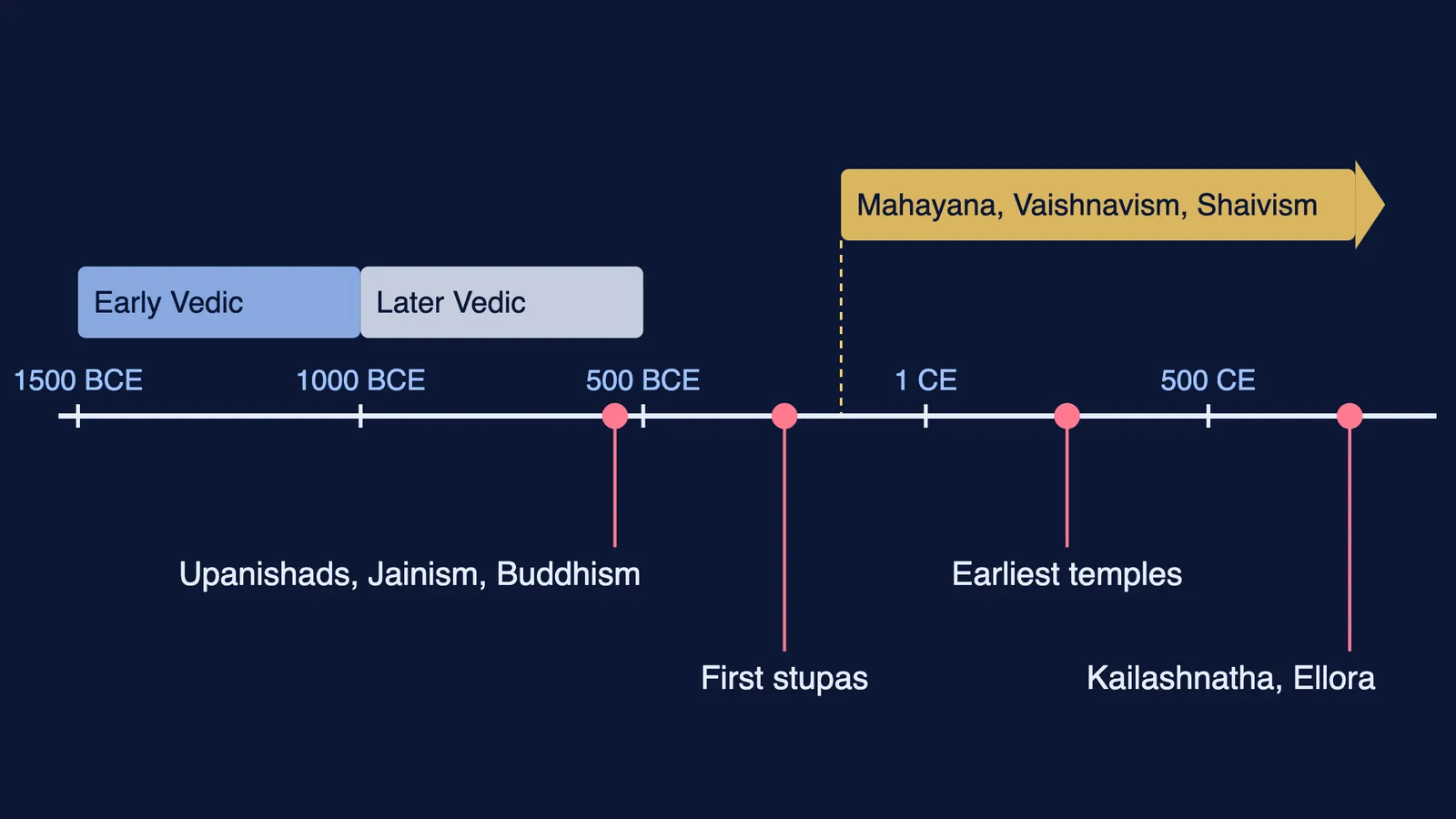
Stupas were mounds over relics of the Buddha, and by the second century BCE stupas stood at Bharhut, Sanchi and Sarnath, according to the NCERT chapter. Inscriptions record who paid: kings such as the Satavahanas, a guild of ivory workers who financed part of a Sanchi gateway and hundreds of named men and women.
Learn the parts: the anda (mound), the harmika above it, the yashti (mast) with its chhatri (umbrella), the railing and four carved gateways. Worshippers entered from the east and walked clockwise.
Amaravati, found in 1796, was stripped of its sculpture. Sanchi, "discovered" in 1818 with three of four gateways standing, survived in place. The Begums of Bhopal funded its preservation, and H.H. Cole's plea for in situ preservation was adopted there. Sanchi became a World Heritage Site in 1989.
How do you read the sculpture at Sanchi?
Early sculptors often showed the Buddha through symbols, not in human form. The NCERT text gives three you must know:
Empty seat: the Buddha's meditation.
Stupa: the mahaparinibbana.
Wheel: the first sermon at Sarnath.
A carved village scene is the Vessantara Jataka once compared with the text. Other motifs, such as the shalabhanjika and the serpent, come from popular traditions. James Fergusson, who had not read Buddhist literature, took Sanchi for a centre of tree and serpent worship.
What changed with Mahayana Buddhism and Puranic Hinduism?
By the first century CE, the NCERT chapter says, the Buddha gradually came to be seen as a saviour, and Bodhisattas as compassionate beings who used their merit to help others. Its followers called this Mahayana; the older tradition called itself Theravada.
Vaishnavism recognised ten avatars of Vishnu, and Shiva was often shown as the linga. The Puranas, compiled by about the middle of the first millennium CE in simple Sanskrit, were meant to be read aloud to everyone. Early temples had a small garbhagriha, later topped by a shikhara. Rock-cut work culminated in Ellora's Kailashnatha temple in the eighth century.
How do you answer source-based and long questions from this chapter?
For any extract, ask: who produced it, what it literally says, what a historian can infer, and what it leaves out. Our guide to answering source-based questions in history exams walks through it, and our Kings, Farmers and Towns guide applies it to inscriptions.
Practise with our own questions:
(1 mark) Which Sanchi symbol stands for the first sermon?
(3 marks) Entering the Great Stupa from the east, which three parts does a worshipper meet?
(3 marks) Compare one Jaina and one Buddhist idea about escaping the cycle of rebirth.
(4 marks) A donor inscription names a woman, her village and her family. What does it tell you about who supported stupas, and what can it not tell you?
(8 marks) How did the idea of a saviour reshape both Buddhist and Puranic traditions in the early first millennium CE?
Key: 1, the wheel; 2, gateway, railing, then the anda, circled clockwise.
Fermi's AI tutor works out what a student already knows and builds a plan for the session. The same habit helps here: start with your weakest section.