

On this page
Many students revise this chapter as a list of kings and dates. The CBSE syllabus also asks how historians know about early India, especially from inscriptions. Learn the story and the evidence together and the source-based questions get much easier.
What does Kings, Farmers and Towns cover in Class 12?
It is Theme 2 of NCERT's Themes in Indian History Part I, subtitled Early States and Economies (c. 600 BCE-600 CE). It runs from the early states and the Mauryan empire to the countryside, towns and trade, and ends with how inscriptions are read and what they cannot tell us.
In the CBSE History curriculum for 2026-27, Themes 1 to 4 of Part I together carry 25 of the 80 theory marks. The learning outcomes listed for this theme include decoding inscriptional evidence and analysing how inscriptions have shaped our understanding of political and economic change.
For a warm-up, see our guide to Ashoka and the Mauryan empire for Class 6.
What were the mahajanapadas, and why did Magadha become the most powerful?
According to the NCERT chapter, early Buddhist and Jaina texts mention sixteen states known as mahajanapadas; Vajji, Magadha, Koshala, Kuru, Panchala, Gandhara and Avanti occur often. Most were ruled by kings, but some, called ganas or sanghas, were oligarchies where power was shared by a number of men, often called rajas.
Between the sixth and fourth centuries BCE, Magadha became the most powerful mahajanapada. Modern historians give four reasons:
productive agriculture
iron mines in present-day Jharkhand
elephants from the region's forests for the army
the Ganga and its tributaries for cheap communication
Early Buddhist and Jaina writers credited ambitious kings such as Bimbisara, Ajatasattu and Mahapadma Nanda, and their ministers. A strong answer gives both views.
How was the Mauryan empire administered?
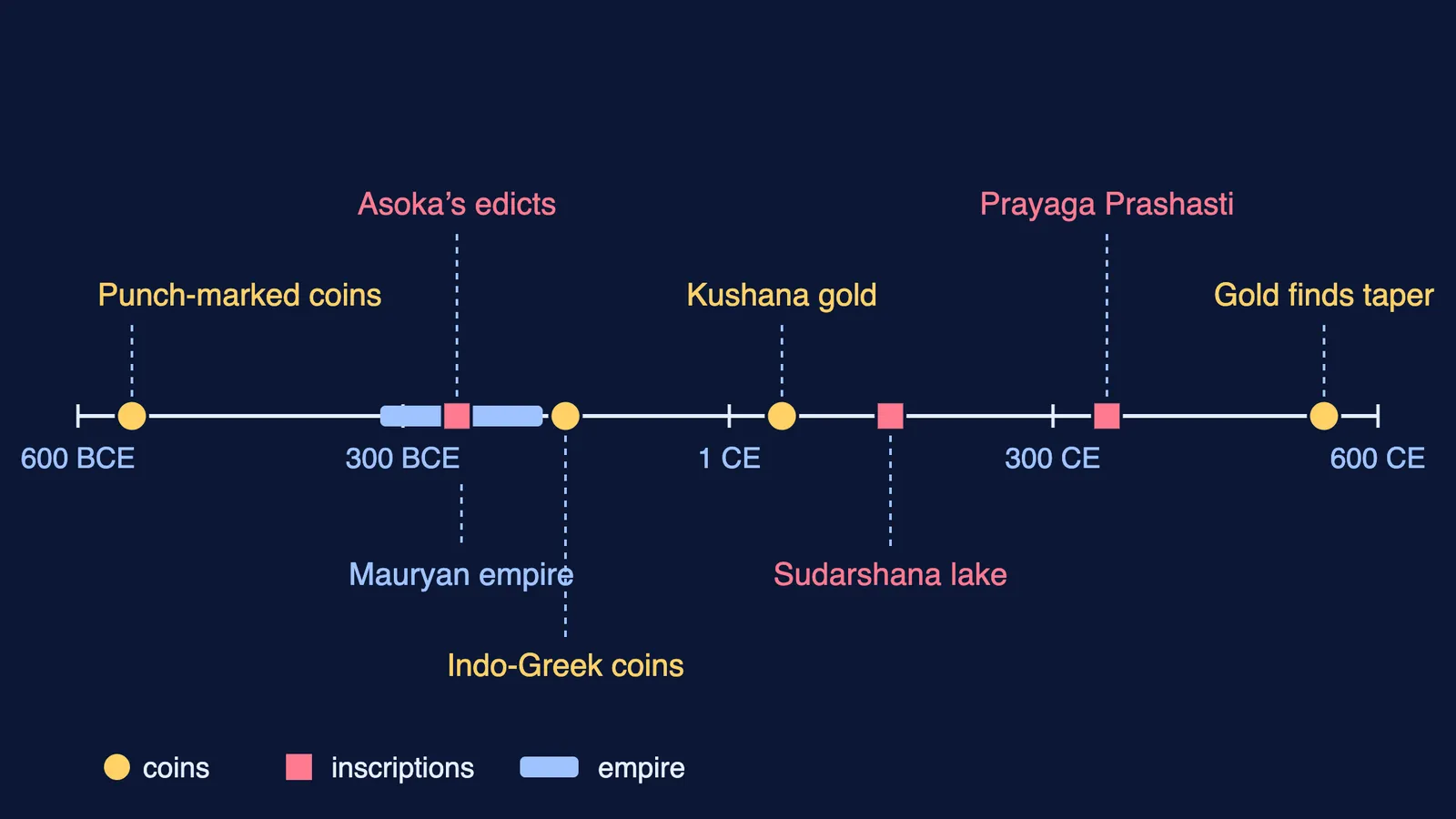
Chandragupta Maurya founded the empire around 321 BCE, and it lasted about 150 years, as the NCERT text notes. It had five major political centres: the capital Pataliputra and the provincial centres of Taxila, Ujjayini, Tosali and Suvarnagiri.
Historians now think control was not uniform. It was strongest around the capital and the provincial centres, which sat on trade routes or, for Suvarnagiri, possibly near Karnataka's gold mines. Megasthenes describes a military committee with six subcommittees: navy, transport and provisions, foot-soldiers, horses, chariots and elephants. Asoka also appointed officers called dhamma mahamatta to spread his message of dhamma.
What changed for farmers and towns?
From about the sixth century BCE, the NCERT chapter explains, plough agriculture with iron-tipped ploughshares spread in fertile valleys such as the Ganga and the Kaveri, while hilly tracts kept hoe agriculture. Irrigation and the transplantation of paddy raised output, but the gains were uneven: Pali texts use gahapati for small peasants and large landholders, and Tamil texts name vellalar, uzhavar and adimai. Later, land grants such as Prabhavati Gupta's were recorded in inscriptions, most of them on copper plates.
Towns grew along routes of communication. Votive inscriptions name washing folk, weavers, goldsmiths and merchants, and guilds called shrenis probably regulated craft production.
How do inscriptions and coins work as historical sources?
Epigraphy is the study of inscriptions, and numismatics is the study of coins, in the NCERT chapter's definitions. James Prinsep deciphered Asokan Brahmi in 1838. Source 10 does not name Asoka; it uses the titles devanampiya (beloved of the gods) and piyadassi (pleasant to behold).
Punch-marked coins of silver and copper date from about the sixth century BCE. The Indo-Greeks issued the first coins with rulers' names and images, the Kushanas issued gold coins from about the first century CE, and the Yaudheyas, a tribal republic, issued copper coins. The limits matter too: letters can be faint or damaged, many inscriptions have not survived, and each shows the view of whoever commissioned it.
How do you answer a source-based question from this chapter?
Use the same four steps on any extract:
Who wrote it, and for whom? A king's edict, a court poet's praise or a foreign visitor's account.
What does it say literally? Underline the officials, taxes and goods.
What can a historian infer? One point about the state or economy.
What can it not tell us? One limit, in one line.
Worked example, Source 10, where Asoka orders pativedakas to report to him at all times. Step 1: the king is speaking about himself. Step 2: reporters must reach him anywhere, even while he eats. Step 3: he wanted information from across the empire. Step 4: his claim that earlier rulers had no such arrangement may be an exaggeration, which NCERT asks you to judge.
For more practice, read how to answer case-based questions in CBSE board exams, and try a cause-and-effect chart for a history chapter on Magadha's rise.
Fermi's AI tutor is built for STEM subjects, but it starts the way this chapter needs: it works out what a student already knows and builds a plan for the session. Do the same here and begin with your weakest block, not page one.


