

On this page
Ashoka is the Mauryan king who won a war and then said, in writing, that he regretted it.
Who was Ashoka the emperor?
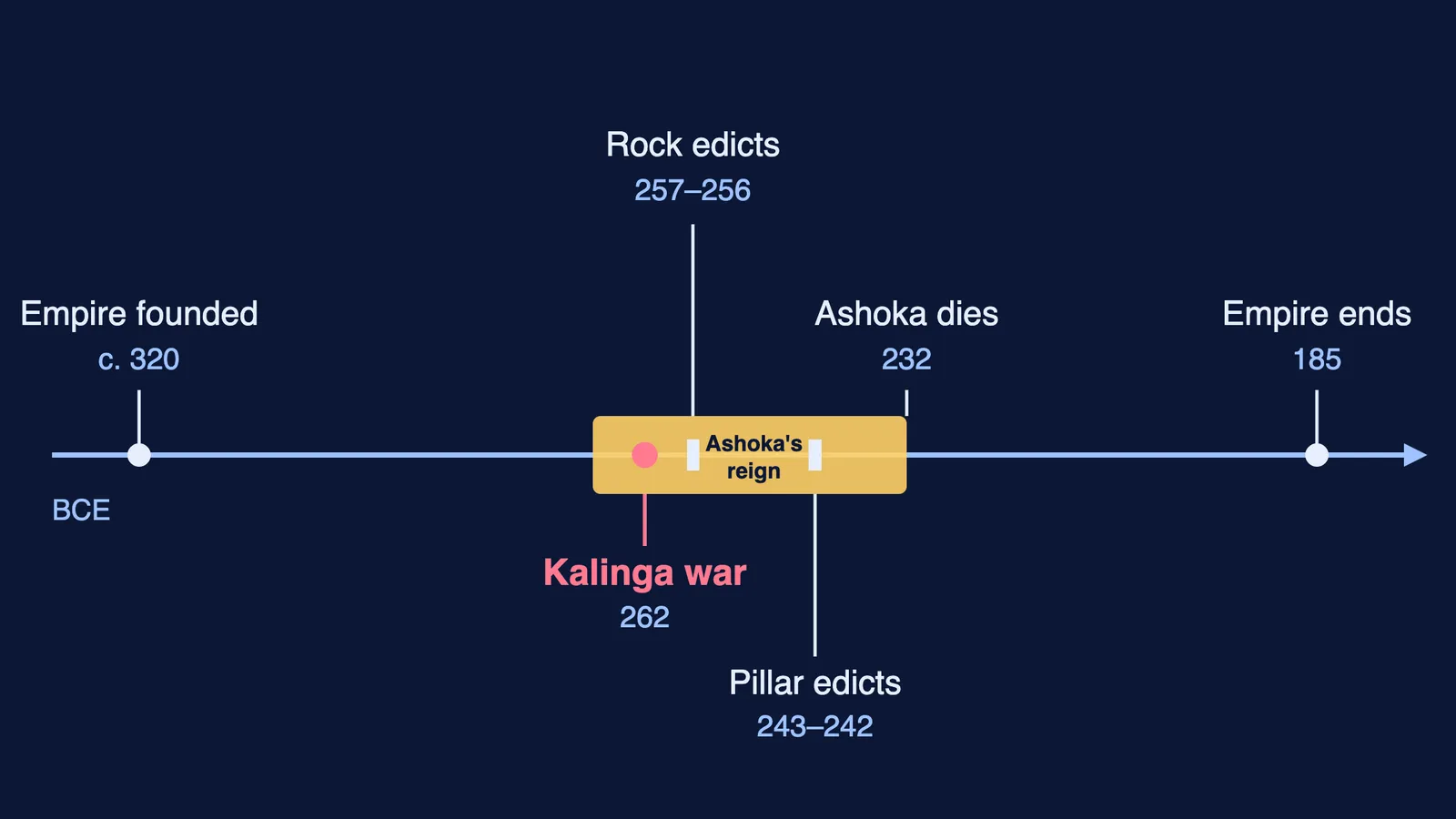
Ashoka was the grandson of Chandragupta Maurya, who founded the Mauryan empire around 320 BCE, and he ruled from about 268 to 232 BCE (Maurya Empire overview). He became the third Mauryan king after the death of his father, Bindusara (Ven. S. Dhammika, The Edicts of King Asoka).
How big was the Mauryan empire?
The capital was Pataliputra, today's Patna, in Magadha (Maurya Empire overview). Under Ashoka the empire briefly held the major cities and routes of the subcontinent except the deep south, with other core regions at Taxila in the north-west, Ujjain in Malwa and Kalinga on the Bay of Bengal coast (same source).
The Cholas and Pandyas of the far south lived outside Ashoka's empire (Dhammika's notes to the edicts). Ashoka's edicts are found in more than thirty places across India, Nepal, Pakistan and Afghanistan (same source). In an answer, name the capital and two regions rather than writing "very large".
What happened in the Kalinga war?
Kalinga roughly corresponds to modern Odisha (Dhammika). Ashoka conquered it eight years after his coronation, and Dhammika dates the war to 262 BCE.
We know the cost because Ashoka recorded it himself. Rock Edict 13 says: "One hundred and fifty thousand were deported, one hundred thousand were killed and many more died (from other causes)" (Rock Edict 13, Dhammika's translation). The same edict says he "feels deep remorse for having conquered the Kalingas" and now considers conquest by Dhamma "the best conquest".
These are the king's own numbers, not an independent count, so a careful answer says "according to Ashoka's own edict".
What was Ashoka's dhamma?
Dhamma was Ashoka's code of good conduct for everyone. Rock Edict 11 lists it as proper behaviour towards servants and employees, respect for mother and father, generosity to friends, relatives, Brahmans and ascetics, and not killing living beings (Rock Edict 11).
Ashoka was a Buddhist, but his edicts ask people to respect every religion. Rock Edict 12 warns that whoever praises their own religion and condemns others "only harms his own religion" (same source).
He also made dhamma the work of government (Dhammika's translation):
He appointed officers called Dhamma Mahamatras to work among all religions and to look after the fair treatment of prisoners (Rock Edict 5).
He had wells dug and trees planted along roads, and arranged medical treatment for people and animals (Rock Edict 2).
He claimed his conquest by dhamma had reached beyond his borders, as far as Tamraparni, an ancient name for Sri Lanka (Rock Edict 13 and the notes).
What are the edicts of Ashoka, and how were they read?
The edicts are Ashoka's messages carved on rocks and polished stone pillars; some pillars stand near important towns so that as many people as possible could read them. Most are in the Brahmi script, from which later Indian scripts developed, and one bilingual edict in Afghanistan is in Greek and Aramaic (Dhammika).
In 1837 James Prinsep deciphered an inscription on a pillar in Delhi, and in 1915 an edict that names Asoka confirmed that King Piyadasi and Ashoka were the same person (same source).
You see Ashoka every day: India's State Emblem, adopted on 26 January 1950, is adapted from the Lion Capital of Ashoka at Sarnath (State Emblem of India).
How do you write a full-marks answer on Ashoka?
Use the EKDE plan (Empire, Kalinga, Dhamma, Edicts), plus one line on the turning point. Worked example for "Why is Ashoka called a unique ruler?" (5 marks), with the figures from Rock Edict 13:
Empire: Ashoka ruled the Mauryan empire from Pataliputra; it covered most of the subcontinent except the far south.
Kalinga: after conquering Kalinga, he recorded in his own edict that 100,000 people were killed and 150,000 deported.
Turning point: instead of celebrating, he wrote of his deep remorse and called conquest by dhamma the best conquest.
Dhamma: he asked people to respect elders, be generous, avoid harming living beings and respect all religions.
Edicts: he had these ideas carved on rocks and pillars, so we can still read his own words.
Before you submit, check three things: did you name a place, quote or paraphrase his own words, and give one example of dhamma in action?
To revise, draw the timeline at the top of this post from memory and explain it aloud in two minutes. The same method works for the Harappan civilisation chapter in Class 6 and next year's Mughal empire chapter in Class 7. For "why" questions, try a cause-and-effect chart for a history chapter.
If maths or science revision is also on your list this week, Fermi's AI tutor can work out what you already know and build a plan for the session.


