On this page
State and Society up to 1000 CE is Chapter 5 of the new NCERT Class 9 Social Science book, *Understanding Society: India and Beyond* Part 1, which schools use from the 2026-27 session. The full chapter is free on the NCERT textbook site. It traces how the subcontinent moved from clans to kingdoms to empires, and how society, learning and trade changed. Below: key ideas, common mistakes and a five-day plan.
What does State and Society up to 1000 CE cover?
The CBSE Class IX Social Science curriculum for 2026-27 gives this theme 9 instructional hours. Its topics are the Vedic age, the administration of early empires, knowledge traditions, and trade, guilds and crafts. The same document says the course structure will be provided later, so chapter-wise marks are not yet published.
The chapter starts by separating two words. A society is held together mainly by customs and practices. A state is an organised political system built on rules and laws, with institutions to enforce them. From here on, texts such as the Ṛigveda add to archaeology. The book notes that the Ṛigveda's date is debated, with estimates from the fifth to the second millennium BCE.
How did early India move from clans to empires?
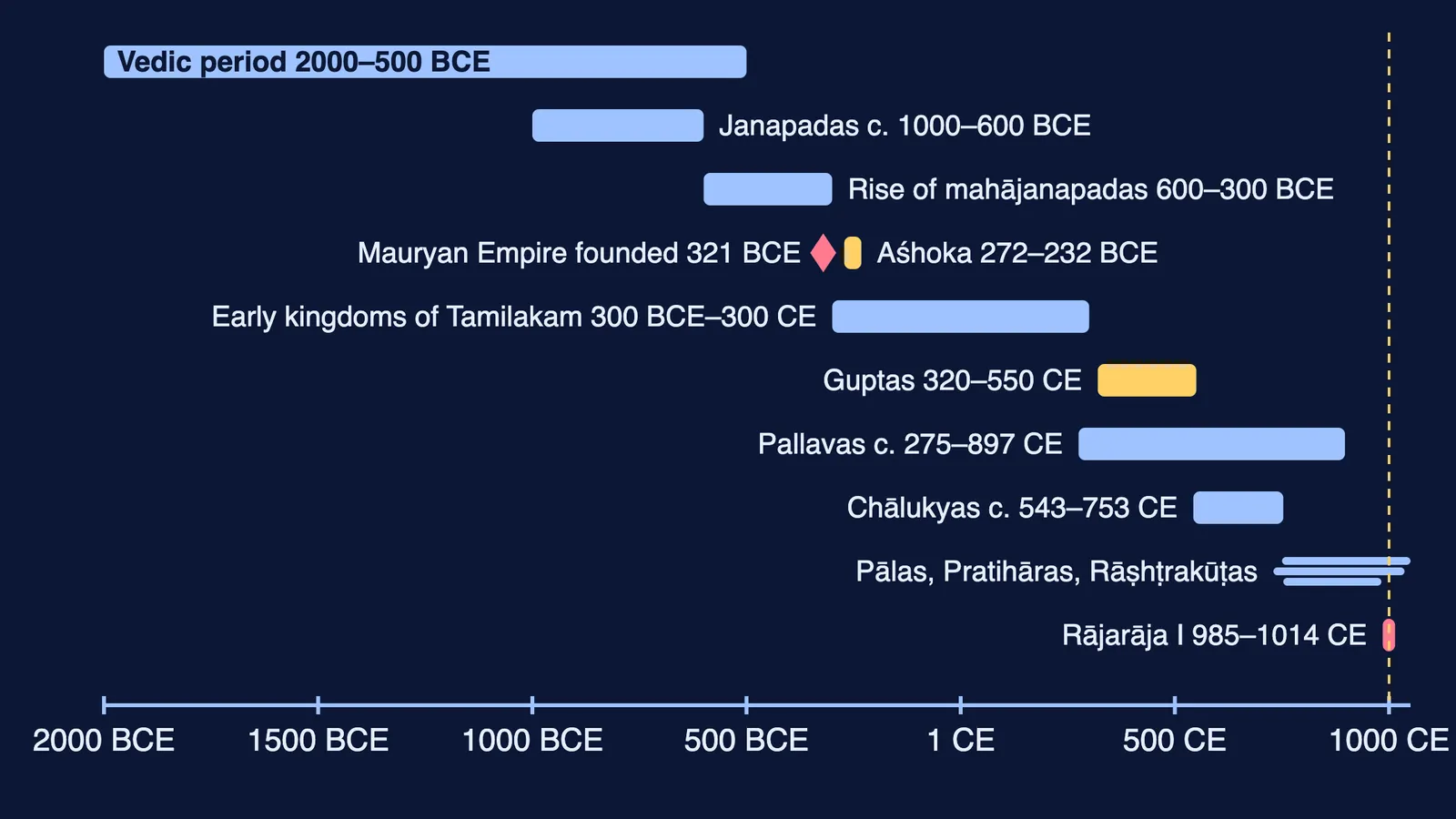
Learn the chapter as a four-step ladder, using the dates in the NCERT chapter:
Jana (clan). Kin groups; the Ṛigveda names about thirty. The rājā was a clan chief who led in war and protected his people, alongside three assemblies: the sabhā, the samiti and the vidhata.
Janapada (territory). Between roughly 1000 and 600 BCE, belonging shifted from kin to land.
Mahājanapada (larger state). Sources usually list sixteen. Magadha, in present-day Bihar, grew strongest. Northern India had both monarchies (rājyas) and republics (gaṇas or saṁghas).
Empire. Chandragupta Maurya founded the Mauryan Empire in 321 BCE. The Guptas ruled from 320 to 550 CE. In the Deccan and the south came the Satavāhanas, the Pallavas, the Chālukyas of Badami and the imperial Cholas of the 9th to 11th centuries, whose ruler Rājarāja I reigned from 985 to 1014 CE.
The chapter also stresses continuity: the ideal of authority over the whole subcontinent, which the Arthaśhāstra calls the chakravarti kśhetra, still shows in the 11th century, when the Chola ruler Rajendra I took the title Gangaikonda. For more on the Mauryas and their sources, see our Class 12 guide to kings, farmers and towns.
How were early Indian kingdoms run?
Kauṭilya described the state as seven linked parts (saptāṁga): king, ministers, territory, forts, treasury, army and allies. Kings ruled with a council of ministers, the mantri-pariṣhad. Empires were split into provinces, districts and villages. The Guptas added a minister of peace and war, the sāndhivigrahika. The Chola order, from big to small, was maṇḍalam, valanāḍu, nāḍu and ur.
Villages ran much of their own affairs. The 10th-century Uttaramerur inscription of Parantaka I describes the kudavolai system: candidates' names on palm leaves went into a pot, and a child drew them in public to pick the village assembly and its committees (variyams).
What does the chapter say about society, dharma and the economy?
Dharma here means duty, righteousness and moral conduct, not religion. Aśhoka's edicts used the Pāli form, dhamma.
Varṇa and jāti: the varṇas were fixed at four, but jātis had no limit and kept growing as new groups and occupations appeared.
Women: Ṛigvedic hymns are attributed to women sages such as Apālā, Ghoṣhā and Lopāmudrā; Prabhāvatī Gupta ruled the Vākāṭaka kingdom as regent.
Learning: the chapter's timeline dates Nālandā to 427 CE and Vikramśhilā to 783–820 CE.
Economy: the Mauryan land tax was generally one-sixth of the produce. Two land routes, Dakṣhiṇāpatha and Uttarāpatha, linked the subcontinent, and guilds (śhreṇīs) regulated quality and prices.
Which mistakes cost marks in this chapter?
Swapping the assemblies. The sabhā was smaller and mainly judicial; the samiti was larger and dealt with policy.
Treating janapada and mahājanapada as the same. The second came later and was bigger.
Mixing the early Sangam-age Cholas with the imperial Cholas centuries later.
Writing that dharma means religion.
Giving the Ṛigveda one fixed date. Say it is debated.
Trusting an AI chat's dates. Learn how to check an AI's history dates against NCERT.
How should you prepare for CBSE 2026-27?
Day 1: draw the timeline above from memory, with five anchor dates: 321 BCE, 272–232 BCE, 320–550 CE, 427 CE and 985–1014 CE.
Day 2: write the four-step ladder and a one-line job for each assembly.
Day 3: list the levels of administration, north and south, from province to village.
Day 4: make a cause-and-effect chart for a history chapter on why Magadha rose: location, fertile plains and strong rulers.
Day 5: make flashcards for dharma, varṇa, jāti, saptāṁga and kudavolai, and explain each aloud.
If maths and science chapters are due the same week, Fermi's AI tutor can work out what you already know and build a plan for the session, so you start each sitting with a clear next step.