On this page
The Konark Sun Temple in Odisha was built as a stone chariot for the Sun god, and its carved wheels are often described as working sundials. In Sahapedia's account of the temple, the chariot is carved as if mounted on 24 wheels, each about 10 feet high, set into the plinth 12 on each side. The temple is oriented towards the east and stands at 19.8875° N, 86.0947° E, according to Wikipedia's Konark Sun Temple article, so its two rows of wheels face north and south.
How is the Konark wheel divided into hours?
When four sandstone replicas of the wheels were installed at Rashtrapati Bhavan, announced by the President's Secretariat on 29 October 2024, a Drishti IAS summary set out the wheel's parts:
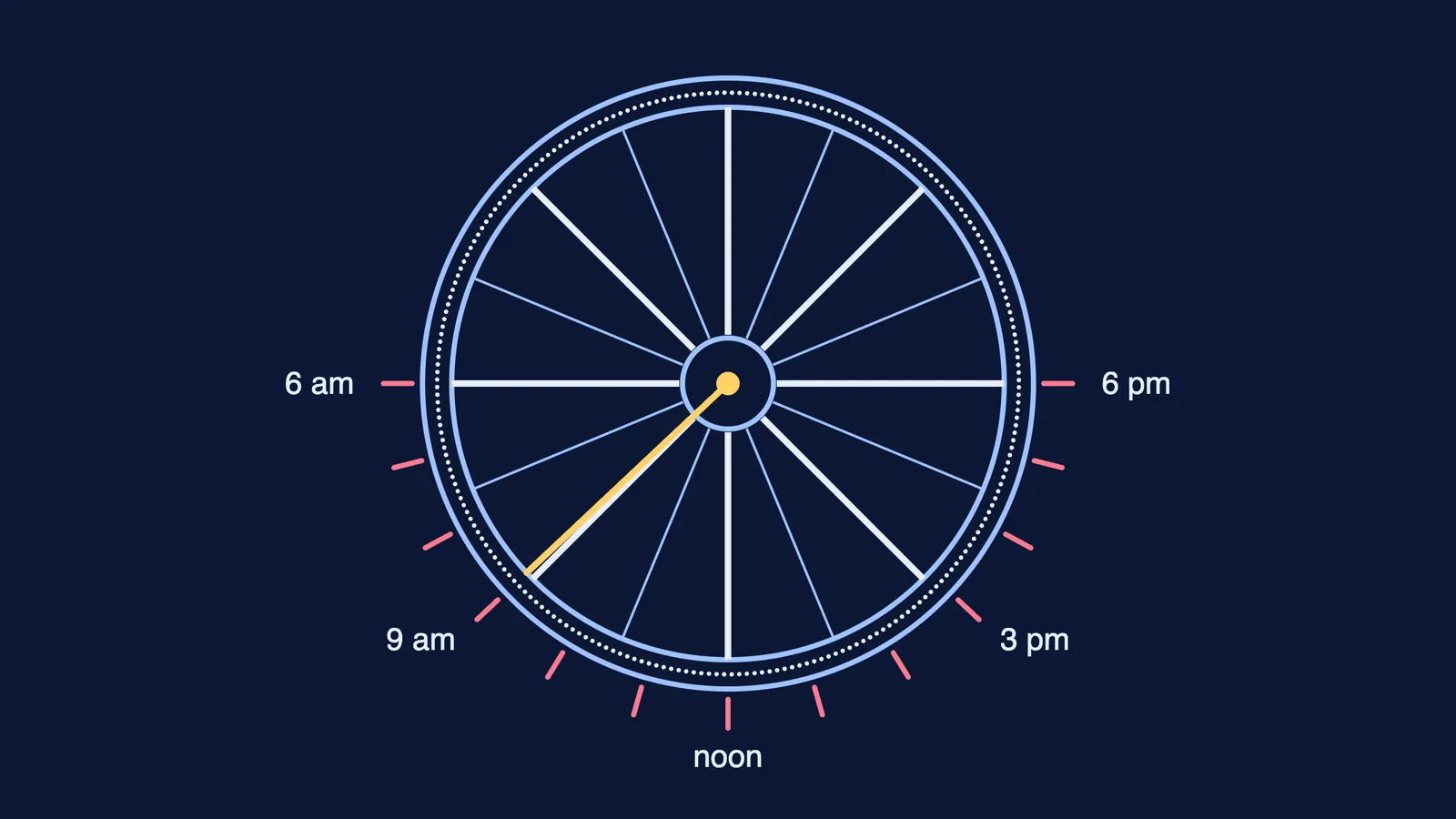
Each wheel has 8 thick spokes and 8 thin spokes.
Two neighbouring thick spokes are 3 hours apart, so the 8 thick spokes share out 24 hours.
A thin spoke sits halfway between them, marking 1.5 hours.
The top thick spoke is midnight, and time runs anticlockwise.
Beads between the spokes mark 3-minute steps.
NewsBharati's write-up adds that there are 30 beads between a thin spoke and the next thick spoke. The arithmetic agrees: 90 minutes divided by 30 beads is 3 minutes a bead.
Go anticlockwise from midnight at the top: the left-hand thick spoke is 6 am, the bottom spoke is noon and the right-hand spoke is 6 pm. Every daytime reading falls on the lower half of the wheel.
Where does the shadow come from?
None of the accounts we read says what casts the shadow, so this is our reconstruction, not a documented fact. The simplest pointer that fits is a pin standing straight out from the axle of a south-facing wheel. Face such a wheel and east is on your right. Morning sun throws the pin's shadow down and to your left; at noon it points straight down; by evening it points right. That is exactly the anticlockwise sweep the spokes describe.
How do you read the time from a Konark wheel?
A worked example for a morning reading:
Find the last spoke the shadow has passed, moving anticlockwise. Say it is the thick spoke halfway between the left side and the bottom: that is 9 am.
Count the beads from that spoke to the shadow. Say 10 beads: at 3 minutes a bead, 10 × 3 = 30 minutes.
Add them: the wheel reads 9:30. Had the shadow already passed the next thin spoke, you would start from 10:30 instead.
That 9:30 is local sun time, not the time on your phone. Two corrections close the gap.
Is the Konark sundial accurate?
Wikipedia repeats the popular claim that the wheels can tell time "accurately to a minute". Our check suggests that needs care.
First, geometry. Evenly spaced spokes assume the shadow turns a steady 15° every hour. Using the solar position equations published by NOAA, we worked out where the pin's shadow falls at Konark on an equinox. Its angle from straight down obeys tan θ = tan H ÷ cos(latitude), where H is the sun's hour angle. At 9 am the shadow sits at 46.8° instead of 45°, about 7 minutes off; at 6 am, noon and 6 pm the error is zero. So a 9:30 bead reading is closer to 9:37 sun time, and the error changes with the seasons.
Second, clock time. According to Wikipedia's Indian Standard Time article, IST is calculated from the reference longitude 82°30′ E, and CSIR-NPL maintains Indian Standard Time. Konark is about 3.6° further east, and NOAA's formula adds 4 minutes per degree, so the sun runs about 14 minutes ahead of IST there. The equation of time, the seasonal drift of sun time against clock time, adds more: NOAA's formula gives about −7.9 minutes on 21 March and +7.6 minutes on 23 September. Solar noon at Konark therefore comes at about 11:54 IST on 21 March but about 11:38 IST on 23 September.
Put together for 23 September: a bead reading of 9:30 becomes about 9:37 sun time, and about 9:15 IST.
How can you try this at home?
Draw a circle on card with 8 thick lines 45° apart, top as midnight, and a thin line between each pair. Push a pencil straight through the centre and tape the card to a sunny south-facing wall. Compare its readings at 9 am, noon and 3 pm with your phone, applying the two corrections above. It works best from October to February, when the noon sun stands well to the south.
The shadow geometry is cousin to our lamp-post shadow problem, and the 4-minutes-per-degree rule is how sailors found longitude with Harrison's clock. For more medieval Indian engineering, read why the Delhi iron pillar doesn't rust.
If the sun's path across the sky is hard to picture, the Fermi Simulation Lab has interactive simulations for ideas that are easier to see than to read.