On this page
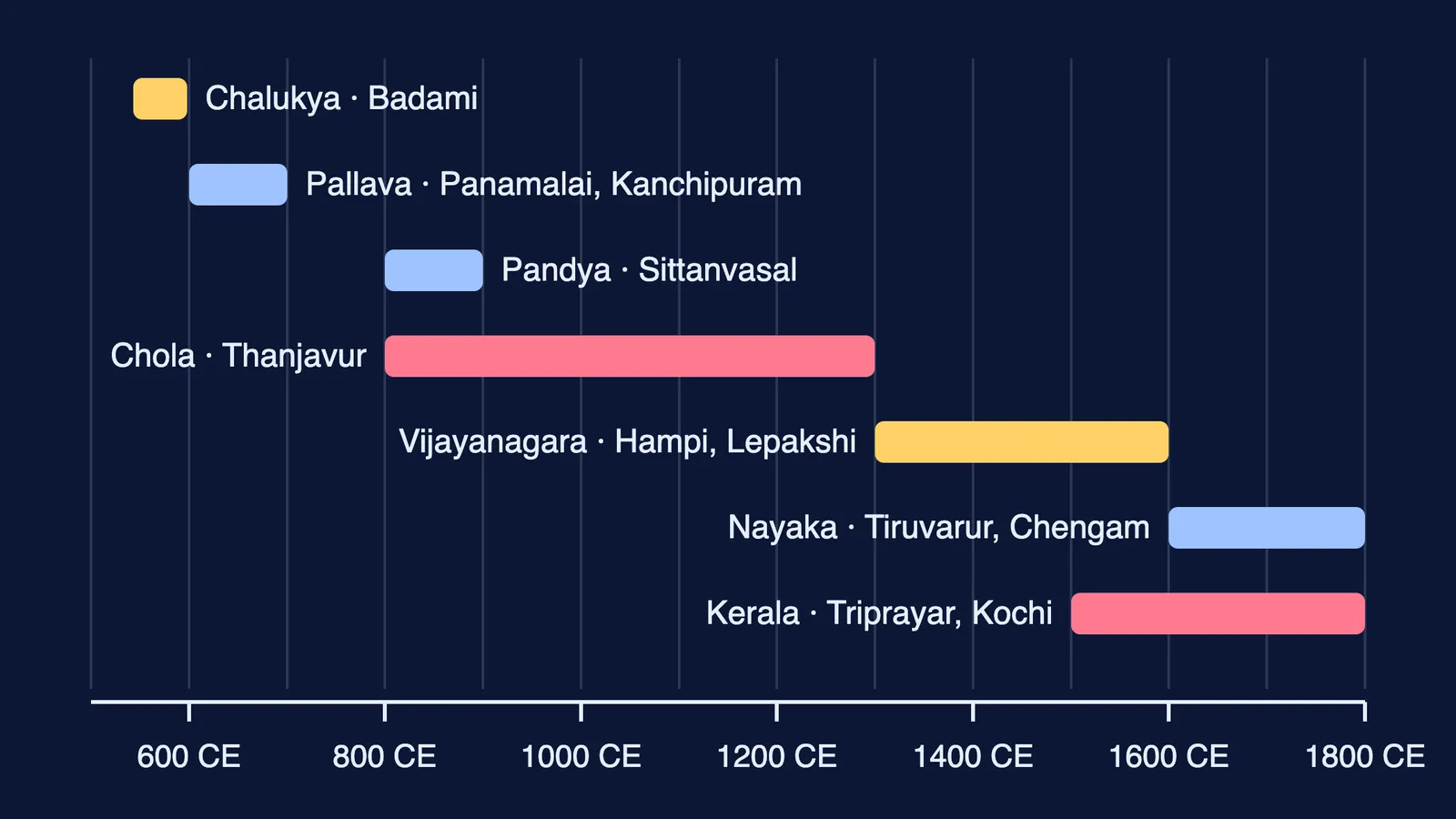
Chapter 5 of NCERT's An Introduction to Indian Art, Part I (Reprint 2026-27) picks up where Ajanta leaves off. It follows wall painting south and through time: Badami in the sixth century, then Pallava, Pandya and Chola temples, then Vijayanagara, Nayaka and Kerala murals up to the eighteenth century.
Is Later Mural Traditions in the CBSE Class 11 Fine Arts syllabus?
No. The CBSE Fine Arts curriculum for 2026-27 does not name this chapter in its Class 11 theory units, and names no textbook. This guide follows the NCERT book; treat the chapter as background reading. The History of Indian Art theory paper is 30 marks in 2 hours, split into Unit 1 (15 marks) and Unit 2 (15 marks); the same units apply to Painting, Graphics, Sculpture and Applied Art. Unit 1 includes Ajanta, and Unit 2 includes the Chola Nataraja bronze and the Pallava Descent of Ganga at Mahabalipuram. The curriculum sets no marks for this chapter.
It shows how the Ajanta style travelled. For how Ajanta's own colours were made, see how the Ajanta paintings were made.
What do the Badami cave paintings show?
Badami, in Karnataka, was the capital of the early Chalukyas, who ruled from 543 to 598 CE. The book says King Mangalesha, younger son of Pulakesi I, sponsored the caves. An inscription in Cave No. 4 gives the date 578–579 CE and records a Vishnu image, which is why it is called the Vishnu Cave (NCERT Ch 5).
Only a fragment survives, on the front mandapa's vaulted roof. One scene shows Kirtivarman, Mangalesha's elder brother, seated with his queen and feudatories watching a dance, with Indra and his retinue near the corner. The book reads it as Ajanta's mural style carried south. Look for large eye-sockets, half-closed eyes and full lips, and for outlines that suggest volume using line alone.
How did murals change under the Pallavas, Pandyas and Cholas?
Pallava. Mahendravarman I (seventh century) built temples at Panamalai, Mandagapattu and Kanchipuram. An inscription gives him titles such as Vichitrachitta (curious-minded) and Chitrakarapuli (tiger among artists). Panamalai keeps a graceful female divinity. At Kanchipuram, painted under Rajasimha, traces of Somaskanda show round, large faces, more ornament and longer torsos.
Pandya. Surviving examples are at Tirumalaipuram and the Jaina caves of Sittanvasal (ninth century CE, per the book's caption). Sittanvasal's veranda pillars show dancing celestial nymphs: vermilion-red outlines on a pale ground, yellow bodies, and slightly elongated eyes that sometimes jut beyond the face.
Chola (ninth to thirteenth century). The book places the masterpieces in the eleventh century. The key paintings are in the Brihadeswara temple at Thanjavur, built under Rajaraja Chola; they line the narrow passage around the shrine. A sixteenth-century Nayak layer covered them, and cleaning revealed the Chola layer beneath: Shiva in Kailash, as Tripurantaka and as Nataraja, and a portrait of Rajaraja with his mentor Kuruvar.
What marks Vijayanagara and Nayaka paintings?
The Vijayanagara dynasty (fourteenth to sixteenth century) ruled from Hampi to Trichy, with Hampi as capital. Tiruparakunram near Trichy shows the early phase. In Hampi, the Virupaksha temple's mandapa ceiling narrates episodes from the Ramayana, the Mahabharata and the dynasty's own history, including the teacher Vidyaranya carried in a palanquin. Lepakshi, near Hindupur in Andhra Pradesh, has paintings on the Shiva temple walls. For the city itself, read our Class 12 guide to Vijayanagara and Hampi.
The style: faces in profile with large frontal eyes, narrow waists, flat figures, and scenes boxed into rectangular compartments.
Nayaka painting (seventeenth and eighteenth centuries) extends that style with regional changes. Sites include Tiruvarur (the Muchukunda panel), Chidambaram (Shiva as Bhikshatana Murti, Vishnu as Mohini) and the Sri Krishna temple at Chengam, whose 60 Ramayana panels mark the late phase. Male figures stay slim-waisted, with a lighter abdomen than in Vijayanagara work.
What makes Kerala murals different?
Kerala painters (sixteenth to eighteenth century) borrowed selectively from Nayaka and Vijayanagara work and took cues from Kathakali and kalam ezhuthu, the ritual floor painting of Kerala. Their colours are bright, and their figures look three-dimensional. Stories often follow local and oral versions of the epics. The book counts more than sixty sites, including three palaces: Padmanabhapuram palace, the Krishnapuram palace at Kayamkulam and the Dutch palace at Kochi. Mature-phase sites include the Triprayar Sri Rama temple and the Vadakkunathan temple in Thrissur.
The chapter ends with living wall art, usually made by women for ceremonies, festivals or upkeep: pithoro (Rajasthan and Gujarat), Mithila painting (northern Bihar) and warli (Maharashtra). See our Class 9 guide to the history of arts for a longer timeline.
Practice questions
Make a seven-row card (dynasty, century, site, style clue), then try these original questions (mark labels are our suggestion):
(1 mark) Why is Badami Cave No. 4 called the Vishnu Cave?
(1 mark) Name the palace in Kochi that has Kerala murals.
(2 marks) Give two features of the dancing figures at Sittanvasal.
(3 marks) How was the Chola layer at Brihadeswara found under later paint?
(4 marks) Compare Vijayanagara and Kerala murals on faces, colour and story sources.
Not sure which dynasty to start with? Fermi's AI tutor works out what you already know and builds a plan for the session.