On this page
Chapter 2 of the NCERT book KTPI textbook for Class 11, 2026-27 reprint surveys nine schools of Indian thought. Here is how it maps to the 2026-27 syllabus, the schools side by side, and practice questions.
Is Indian Philosophical Systems in the Class 11 KTPI written exam?
Yes. The book and the syllabus number their chapters differently: this is Chapter 2 in the NCERT book but Chapter 4, "Indian philosophical systems", in the CBSE KTPI syllabus 2026-27.
The syllabus's Class XI course structure table gives that chapter 27 periods, a 20% weightage and 14 of the 70 marks. It is one of the chapters with marks in that table, unlike Chemistry, Mathematics, Environmental Conservation and Theatre and Drama, which the same table marks "for internal assessment only". Internal assessment carries 30 marks (project, portfolio and viva).
The syllabus asks you to list the nine systems with the key features of each, compare them, and relate them to everyday life. One of its learning outcomes, reflecting on ethical goals in Western and Indian thought, goes beyond this NCERT chapter, which does not discuss Western philosophy.
What are the nine Indian philosophical systems?
The chapter presents darśana (philosophy) through two major components: prameya, the objects of knowledge, and pramāṇa, the means of knowledge. It then sorts the schools by one test, whether they accept the Vedas as a valid source of knowledge.
Āstika (six schools, in three complementary pairs): Sāṅkhya and Yoga (theory and practice); Pūrva Mīmāṁsā and Uttara Mīmāṁsā or Vedānta (the ritual portion of the Vedas, and the Upaniṣads, Gītā and Brahmasūtra); Nyāya and Vaiśeṣika (epistemology and metaphysics).
Nāstika (three schools): Cārvāka, Jaina and Bauddha.
The book also names three wider intellectual traditions: Nigama (Vedic), Āgama (Vaiṣṇava, Śaiva and Śākta scriptures) and Śramaṇa (groups of monks that appeared around the sixth century B.C.).
What does each school teach, in one line?
These summaries follow the NCERT chapter; learn the Sanskrit term alongside each.
Cārvāka (Lokāyata): perception is the only valid means of knowledge; the world is made of four elements; there is no soul and no God.
Jaina: every being has numerous properties (anekāntavāda) and our knowledge is partial and relative (syādvāda); the three gems are right faith, right knowledge and right conduct.
Bauddha: the four noble truths, the twelve-link chain with ignorance at its root, and the eight-fold path; impermanence and no permanent self (anātmavāda).
Sāṅkhya: two eternal realities, Prakṛti and Puruṣa; three guṇas (sattva, rajas, tamas); 25 principles.
Yoga: Patañjali's Yogasūtra; yoga as restraint of mental modifications; eight limbs from yama to samādhi.
Nyāya: sixteen categories centred on logic and debate; Gaṅgeśa's Navya-Nyāya built a precise technical language.
Vaiśeṣika: seven categories (padārthas), including viśeṣa, which gives the school its name; credited with an atomic theory of creation.
Pūrva Mīmāṁsā: Jaimini's school of Vedic ritual and duty, known for its methods of interpreting sentences.
Vedānta: three schools: Śaṅkara's Advaita, Rāmānuja's Viśiṣṭādvaita (qualified monism) and Mādhva's Dvaita, in which souls may reach liberation by bhakti and God's grace.
How do the schools differ on the means of knowledge?
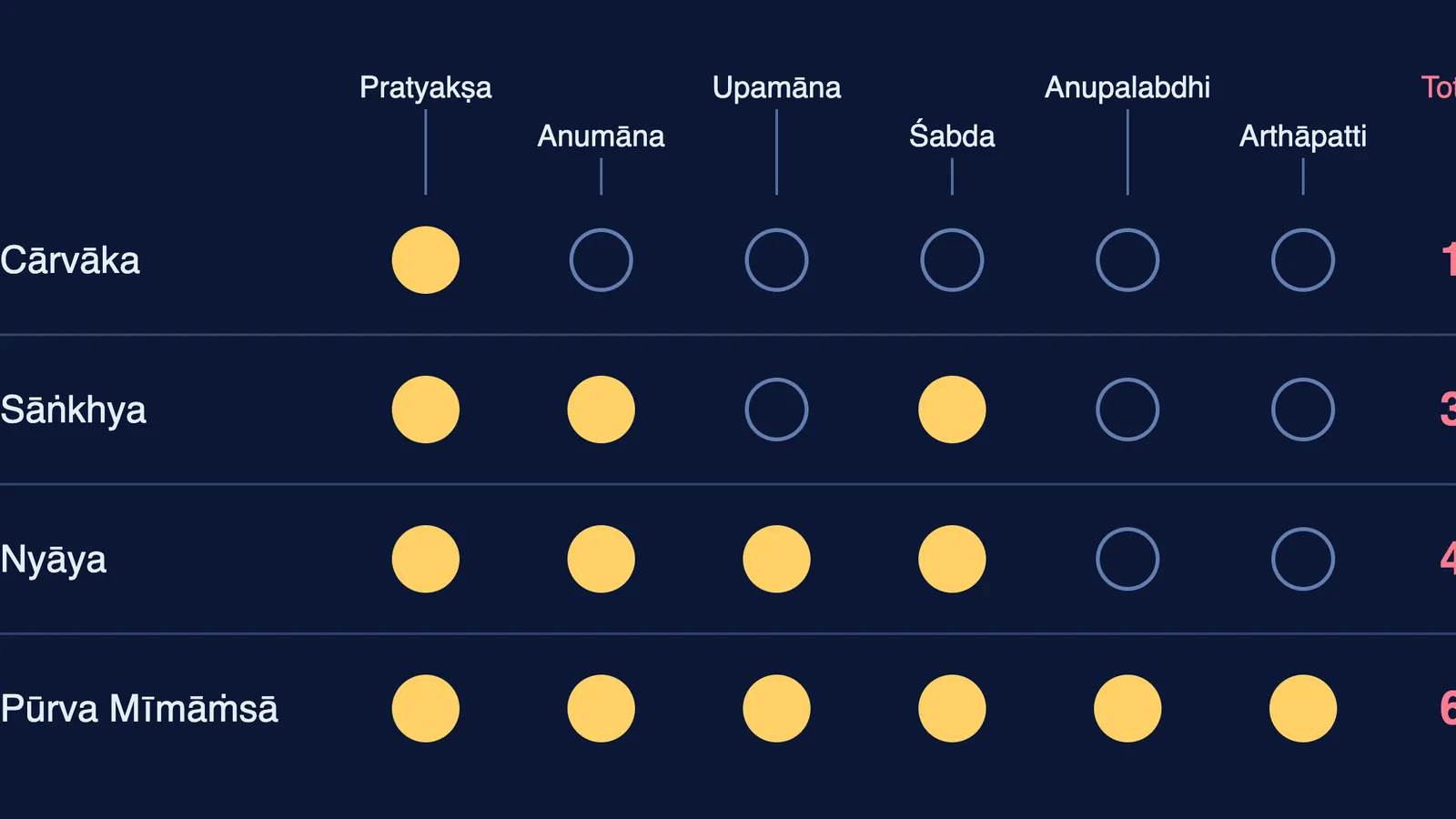
The chapter names six pramāṇas. In the book's English: direct perception (pratyakṣa), inference (anumāna), analogy (upamāna), verbal testimony (śabda), non-perception (anupalabdhi) and implication (arthāpatti). It states exactly how many four of the schools accept, which gives you a ready-made comparison (the diagram above):
Cārvāka: perception only (1).
Sāṅkhya: perception, inference and verbal testimony; the book says it does not accept analogy (3).
Nyāya: perception, inference, comparison and verbal testimony (4).
Pūrva Mīmāṁsā: perception plus five indirect (parokṣa) means, so all six (6).
The book gives no count for the other five schools, so don't invent one. This compares methods; it does not rank the schools.
Practice questions on Indian philosophical systems
The marks below are our suggestion. We wrote these questions ourselves.
(1 mark) Which pramāṇa does Sāṅkhya not accept, though Nyāya does? *Answer: upamāna.*
(2 marks) Why does the chapter treat Nyāya and Vaiśeṣika as a pair? *Hint: one is rich in epistemology, the other in metaphysics; they merged into one stream after the tenth century.*
(2 marks) The chapter uses the term triratna (three gems) in two schools. Name the three gems in each. *Hint: one is Jaina, one is Bauddha.*
(5 marks, case) Meera sees the road wet in the morning and concludes it rained at night. Her cousin says only what she saw herself counts. Name Meera's pramāṇa, the school closest to her cousin's view, and two schools in the chapter that would accept Meera's reasoning.
(5 marks) Using the chapter's terms, give one key idea of each of the three Vedānta schools and one point all three share.
Stuck on which school accepts which pramāṇa? Fermi's AI tutor works out what you already know and builds a plan for the session.
For a different angle on Patañjali's eight limbs, see our Yoga Class 11 physical education guide. For Buddhist and Jaina ideas in History, read Thinkers, beliefs and buildings Class 12, and if the subject grows on you, see whether a philosophy degree is useful in India.