On this page
Yoga is Unit 3 of ten in CBSE Class 11 Physical Education (048). The CBSE 2026-27 curriculum lists five topics: meaning and importance of yoga, an introduction to Ashtanga yoga, yogic kriyas (shat karma), the types of pranayama, and active lifestyle and stress management through yoga. The prescribed book is CBSE's own Physical Education Class XI textbook (second edition, January 2023), not an NCERT title.
How many marks is the Yoga unit in Class 11 PE?
The 2026-27 curriculum prints the weightage for Unit 3 Yoga as 06+01b*: 6 marks plus 1 b* mark, 7 in all (the ten units total 70 theory marks). The note under the table defines b*: "b*are the Concept based questions like Tactile diagram/data interpretation/ case base study for visually Impaired Child."
Yoga also appears in the practical. The same curriculum gives Yogic Practices 7 marks out of the 30 practical marks, and the viva voce can include yoga.
What does yoga mean, and what are the eight limbs of Ashtanga yoga?
The textbook traces the word yoga to the Sanskrit root "yuj", meaning union. It presents yoga as a way of living rather than a religion.
Ashtanga yoga, as Patanjali set it out, has eight limbs:
Yama: five codes of conduct towards others (ahimsa, satya, asteya, brahmacharya, aparigraha).
Niyama: five rules for oneself (saucha, santosha, tapa, swadhyaya, ishwar pranidhan).
Asana: a steady, comfortable posture.
Pranayama: regulating the breath and life force (prana).
Pratyahara: withdrawing the senses from outside objects.
Dharana: fixing attention on one point.
Dhyana: an unbroken state of meditation.
Samadhi: total absorption, the final stage.
What are the shat kriyas and the types of pranayama?
The book names six cleansing processes, the shat kriyas: kapalbhati, trataka, neti, dhauti, nauli and basti. It details kapalbhati, trataka, jal neti and vamana dhauti.
For pranayama, the book explains three phases of a breath: puraka (inhalation), kumbhaka (holding) and rechaka (exhalation). It then gives the technique and benefits of anulom-vilom (nadi shodhana), surya bhedana, ujjayi, bhramari, sheetkari and sheetali, with precautions printed for only some of them.
The textbook's own precautions, often asked in exams:
Kapalbhati: avoided in pregnancy, slipped disc and asthma, and during menstruation.
Trataka: not on a candle flame for people with epilepsy; children should avoid it.
Bhramari: not on an empty stomach.
Sheetkari: not with a cold, cough or tonsillitis.
The CBSE textbook also advises checking with a physician or yoga therapist before practice if you live with a long-term illness, ongoing pain or a heart condition, and asking a yoga expert during pregnancy or menstruation. This post is a study guide, not health advice; learn the techniques under your PE teacher. Asana-by-asana cautions for lifestyle diseases come in Class 12, covered in our guide to yoga as a preventive measure for lifestyle diseases.
How does yoga help with stress management and concentration?
The textbook links an active lifestyle to five yogic approaches: ahara (food), vihara (relaxation, recreation and relationships), achara (right conduct), vichara (right thinking) and vyavahara (right behaviour). Its guidelines include practising on an empty or light stomach and never jerking the body.
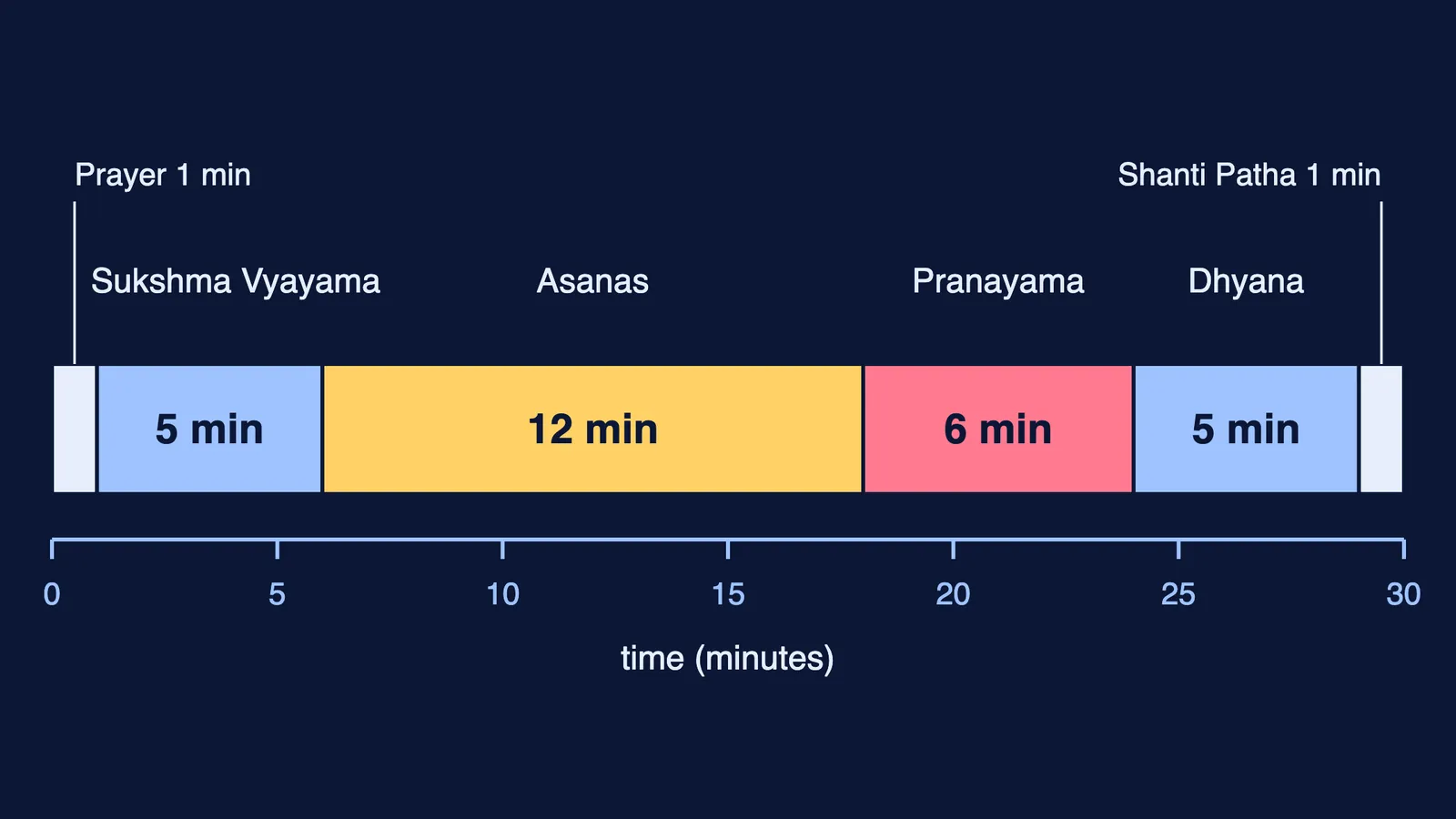
Its 30-minute stress-management protocol, shown in the timeline above, runs:
Prayer, 1 minute.
Sukshma vyayama (joint movements), 5 minutes.
Sthula vyayama (sarvangapusti), listed without a separate time.
Asanas, 12 minutes: tadasana, urdhva hastottanasana, ushtrasana, sasankasana, uttana mandukasana, vakrasana, bhujangasana, pawanmuktasana and setubandhasana.
Pranayama, 6 minutes: anulom-vilom and bhramari.
Dhyana, 5 minutes.
Shanti patha, 1 minute.
The timed parts add to 1 + 5 + 12 + 6 + 5 + 1 = 30 minutes. The unit ends with yoga nidra, a relaxation done lying in shavasana while attention moves through the body.
If exam stress feels heavy for more than a few days, talk to a parent, teacher or counsellor. India's free, 24/7 Tele MANAS helpline is 14416 or 1800-89-14416, according to the Press Information Bureau.
Practice questions for Class 11 Yoga
These are our own questions. The mark labels follow the question types in the CBSE 2026-27 PE sample paper (Class 12; CBSE has not published a Class 11 paper) and are our suggestion only.
(1 mark) A student fixes her gaze on a black dot to improve focus. Which kriya is this?
(1 mark) Which limb of Ashtanga yoga comes between pranayama and dharana?
(2 marks) Name the three phases of a pranayama breath and say what happens in each.
(3 marks) Give one precaution each for kapalbhati, bhramari and sheetkari.
(3 marks) Distinguish between dharana and dhyana with an exam-day example.
(5 marks) Your class has 30 minutes before a test. Arrange the stress-management protocol in order, with times, and explain why pranayama comes before dhyana.
Answer key for 1-2: trataka; pratyahara.
What to read next
The other Class 11 PE guides cover changing trends and careers in physical education and doping in sports.
Studying a science subject alongside PE? Fermi's AI tutor works out what you already know, builds a plan for the session, and teaches through it.