

On this page
In the CBSE Class 11 Physical Education syllabus for 2025-26, Unit 10, 'Training & Doping in Sports', carries 7 of the 70 theory marks, and one of its five topics is the concept of doping and its disadvantages (CBSE Physical Education curriculum 2025-26). Here is that topic in full, with a plan for a long answer.
What is doping in sports?
For your exam, doping is the use of a prohibited substance or method to gain an unfair advantage in sport. The World Anti-Doping Agency (WADA) decides what counts.
A substance or method may be added to the list if it meets two of three criteria: it can enhance performance, it poses an actual or potential health risk, or its use violates the spirit of sport (Athletics Integrity Unit). The 2026 list came into effect on 1 January 2026 (WADA Prohibited List 2026).
Which substances and methods are banned?
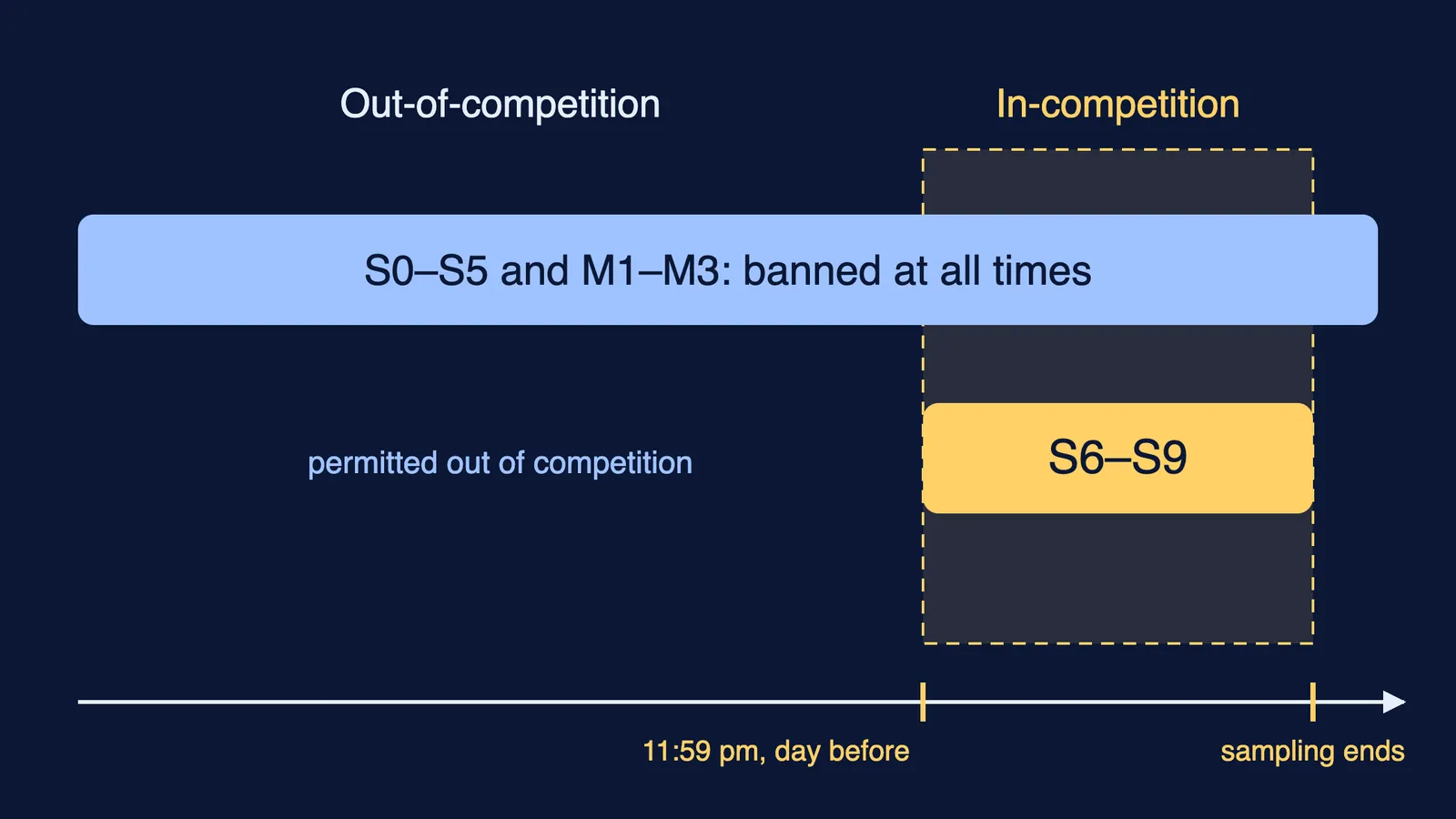
The WADA Prohibited List 2026 sorts everything into three groups:
Prohibited at all times (in and out of competition): S0 non-approved substances, S1 anabolic agents, S2 peptide hormones, growth factors, related substances and mimetics, S3 beta-2 agonists, S4 hormone and metabolic modulators, S5 diuretics and masking agents, and the methods M1 manipulation of blood and blood components, M2 chemical and physical manipulation, and M3 gene and cell doping.
Prohibited in competition: S6 stimulants, S7 narcotics, S8 cannabinoids and S9 glucocorticoids.
Prohibited in particular sports: P1 beta-blockers.
Testosterone, growth hormone and EPO sit in the always-banned group (Athletics Integrity Unit). Unless WADA has approved a different period for a sport, the in-competition period starts at 11:59 pm on the day before a competition and ends when the competition and sample collection are over.
What are the side effects of doping?
This is the 'disadvantages' topic. Learn one or two per class:
Anabolic steroids (S1): damage that is sometimes long-lasting or irreversible, including high blood pressure, blood clots, heart attack, stroke, liver tumours, severe acne and aggression; breast growth in men; a deeper voice in women; and, in teenagers, bones that stop growing too early (NIDA).
EPO and blood doping (S2, M1): extra red blood cells thicken the blood, making it hard for the heart to pump and raising the risk of stroke, heart disease and blockages (embolisms) in the brain or lungs; transfusions add the risk of HIV and hepatitis (USADA).
Stimulants (S6): insomnia, anxiety, dependence, a faster heart rate, higher blood pressure and a raised risk of stroke, heart attack and irregular heartbeat (USADA).
Diuretics (S5): dehydration, cramps, dizziness, low blood pressure, low sodium and potassium levels, and abnormal heart rhythms (USADA).
If the biology underneath is shaky, the Fermi Concept Library has a lesson on every concept in biology and chemistry, so you can link each effect to the organ involved.
How does NADA test athletes in India?
WADA sets the list. In India, the National Anti Doping Agency (NADA), an autonomous body under the Ministry of Youth Affairs and Sports (NADA India), runs testing, education, results management and investigations in line with the World Anti-Doping Code 2021 (NADA India: about us). NADA was set up in November 2009, and Parliament passed the National Anti-Doping Bill in 2022 to make it a statutory body (PRS Legislative Research).
A urine test, as NADA describes it, runs like this:
Testing happens with no advance notice.
A Doping Control Officer or volunteer notifies you, shows identification and explains your rights and responsibilities.
An officer of the same gender watches you provide the sample.
You give at least 90 ml of urine and split it into A and B bottles.
The A sample is analysed; the B sample can be stored for up to ten years.
For a blood test, a Blood Collection Officer draws blood into vials that become the A and B samples. Athletes in NADA's Registered Testing Pool file their whereabouts every quarter, including a 60-minute slot, and three whereabouts failures in 12 months can count as a rule violation (NADA athlete testing). If you need a listed medicine, you apply for a Therapeutic Use Exemption, and NADA's committee usually decides within 21 days of a complete application (NADA TUE process).
How do you write a long answer on doping?
Unit 10 carries 7 marks in all and doping is one of its five topics (CBSE syllabus), so trim this five-part plan to the marks the question carries:
Define: doping, plus WADA's two-of-three rule.
Classify: the three groups, with an example of each (S1 anabolic agents; S6 stimulants; P1 beta-blockers).
Side effects: one class per line, one effect each.
Testing: the five urine-test steps, whereabouts and the TUE.
Conclude: doping breaks fair play and respect for others, Olympic values from Unit 2 of the same syllabus.
If you compete, ask any doctor or chemist: 'I compete in [sport] and can be tested by NADA. Is this medicine on the WADA Prohibited List? If it is, is there an alternative, or do I need a Therapeutic Use Exemption?'
Not sure where to start revising Unit 10? Fermi's AI tutor can work out what you already know and build a plan for the session, so you start with what you have not learned yet.


