On this page
If you take Physical Education in Class 12, one unit asks you to match asanas to diseases and to say when each pose is unsafe. In the CBSE Physical Education syllabus for 2026-27, Unit 3 is "Yoga as Preventive measure for Lifestyle Disease" and carries 06+01 marks in theory. The same document asks for a practical record file that gives the procedure, benefits and contraindication for any two asanas for each lifestyle disease.
Why does Class 12 PE treat yoga as prevention for lifestyle diseases?
These diseases are common in India, and daily habits such as activity play a part. The ICMR-INDIAB study00119-5), published in The Lancet Diabetes & Endocrinology in 2023, surveyed 113,043 people aged 20 and older across 31 states, union territories and the National Capital Territory between 2008 and 2020.
11.4% of Indian adults had diabetes, and another 15.3% had prediabetes.
35.5% had hypertension.
28.6% had generalised obesity, and 39.5% had abdominal obesity.
Activity levels are low among teenagers too. According to the WHO physical activity fact sheet, one in four adolescents aged 11 to 17 worldwide reported no active days in the past week. A day counts as active when it has at least 60 minutes of moderate-to-vigorous activity.
If the biology behind these numbers is hazy, our posts on what a 120/80 blood pressure reading means and how asthma differs from emphysema explain them. The Fermi Concept Library has a lesson for every concept in biology.
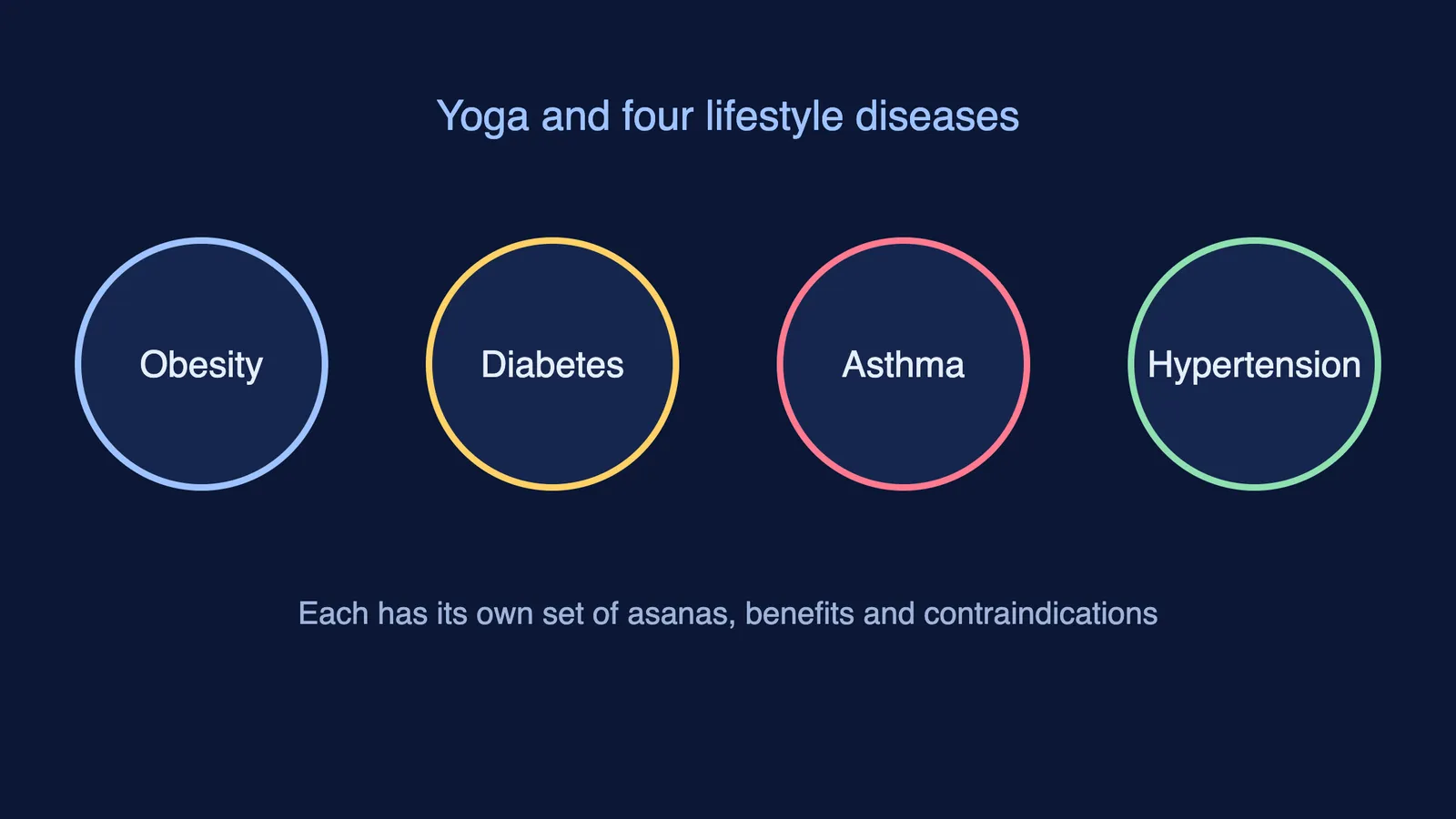
Which asanas are in the Class 12 PE syllabus for each disease?
These lists come from the 2026-27 CBSE syllabus. Check that your school follows this syllabus year.
Obesity: Tadasana, Katichakrasana, Pavanmuktasana, Matsyasana, Halasana, Paschimottanasana, Ardha Matsyendrasana, Dhanurasana, Ushtrasana, Suryabhedan pranayama.
Diabetes: Katichakrasana, Pavanmuktasana, Bhujangasana, Shalabhasana, Dhanurasana, Supta Vajrasana, Paschimottanasana, Ardha Matsyendrasana, Mandukasana, Gomukhasana, Yogmudra, Ushtrasana, Kapalbhati.
Asthma: Tadasana, Urdhwahastottanasana, Uttan Mandukasana, Bhujangasana, Dhanurasana, Ushtrasana, Vakrasana, Kapalbhati, Gomukhasana, Matsyasana, Anulom-Vilom.
Hypertension: Tadasana, Katichakrasana, Uttanpadasana, Ardha Halasana, Sarala Matsyasana, Gomukhasana, Uttan Mandukasana, Vakrasana, Bhujangasana, Makarasana, Shavasana, Nadi Shodhan pranayama, Sitali pranayama.
Back pain and arthritis: Tadasana, Urdhwahastottanasana, Ardha Chakrasana, Ushtrasana, Vakrasana, Sarala Matsyendrasana, Bhujangasana, Gomukhasana, Bhadrasana, Makarasana, Nadi Shodhan pranayama.
What are the contraindications of these asanas?
The Ministry of AYUSH's Common Yoga Protocol gives a caution for each practice; base your answers on it:
Kapalbhati: avoid with heart conditions, giddiness, high blood pressure, vertigo, chronic nosebleeds, epilepsy, migraine, stroke, hernia, gastric ulcer, pregnancy and during the menstrual cycle.
Bhujangasana: avoid for 2-3 months after abdominal surgery, and with hernia or ulcers.
Shalabhasana: avoid with high blood pressure, peptic ulcer or hernia. Go carefully with severe lower back pain.
Pavanmuktasana: avoid with abdominal injuries, hernia, sciatica, severe back pain and during pregnancy.
Ushtrasana: avoid with heart disease or hernia.
Vakrasana: avoid with acute back pain, spinal disorders, after abdominal surgery and during menstruation.
Uttanpadasana: people with hypertension or back pain should raise one leg at a time without holding the breath.
Ardha Halasana: the protocol calls it beneficial for people with hypertension but says to practise it under supervision. With lower back pain, do not lift both legs together.
Notice a pattern you can use in a case-based question. Kapalbhati appears under diabetes and asthma but not hypertension, which fits the protocol's warning against it for high blood pressure. Shalabhasana, which carries the same warning, is also missing from the hypertension list.
How do you write a full-mark answer on an asana?
Use four parts: name and disease, procedure in steps, two benefits, two contraindications. Here is Bhujangasana for hypertension, from the Common Yoga Protocol:
Lie on your stomach with your forehead on the ground and legs stretched out.
Place your palms beside your chest, elbows raised and parallel.
Inhale slowly and lift your head and chest up to the navel.
Hold for 10-30 seconds with normal breathing.
Exhale, lower your forehead and relax in Makarasana.
Benefits: relieves stress, reduces abdominal fat, and helps with backache and bronchial problems.
Contraindications: hernia or ulcers, or abdominal surgery in the last 2-3 months.
For the record file, choose two asanas per disease, draw a simple stick figure of each, and write all four parts. If you are short of time, Fermi's AI tutor can work out what you already know and build a plan for the session.
Is yoga safe if you already have asthma, diabetes or high blood pressure?
These poses are for exams and everyday prevention, not treatment. The Common Yoga Protocol itself says that anyone with a chronic disease, pain or a heart problem should consult a physician or yoga therapist first. If you have asthma, diabetes or high blood pressure, ask your doctor which poses suit you, and remember that yoga does not replace the treatment you have been prescribed.
To study yoga further, read our guide to the BNYS naturopathy and yoga course.