
On this page
Section 14.6 of the NCERT Class 11 Biology chapter, Breathing and Exchange of Gases, covers three disorders in a few lines each: asthma, emphysema and occupational respiratory disorders. It is easy to skim, and exam questions then ask you to tell them apart.
What does NCERT say about asthma, emphysema and occupational disorders?
Here is section 14.6 of the NCERT chapter, reduced to what an examiner checks:
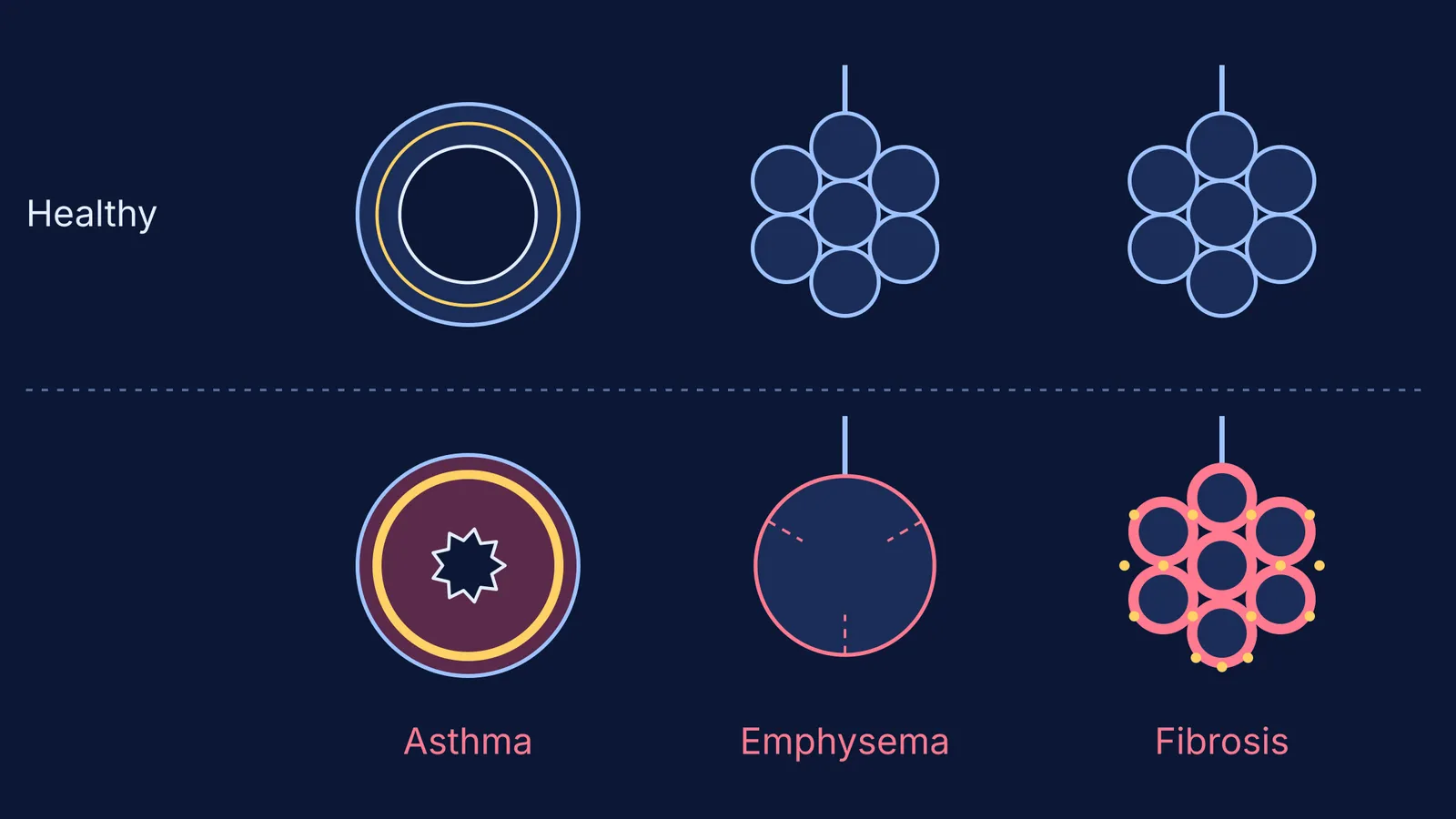
Asthma is a difficulty in breathing causing wheezing, due to inflammation of the bronchi and bronchioles.
Emphysema is a chronic disorder in which alveolar walls are damaged, so the respiratory surface is decreased; NCERT names cigarette smoking as one of its major causes.
Occupational respiratory disorders arise in industries such as grinding and stone-breaking, where so much dust is produced that the body's defence mechanism cannot fully cope; long exposure causes inflammation leading to fibrosis (proliferation of fibrous tissues) and serious lung damage. NCERT's prevention line is that workers should wear protective masks.
Notice what NCERT does not give: a cause for asthma, only the mechanism. The WHO asthma fact sheet lists triggers such as dust, smoke, fumes, pollen, animal fur and colds, and notes that a family history raises risk. Useful background, but in an NCERT-based exam, lead with the textbook line.
What actually goes wrong in each?
Asthma is a problem of the tubes. The WHO describes inflammation and narrowing of the small airways, with the muscle around them tightening, which makes it harder to breathe. That narrowing is what causes the cough, wheeze and chest tightness WHO lists as symptoms. WHO estimates that asthma affected 363 million people in 2023 and caused 442,000 deaths.
Emphysema is a problem of the air sacs. WHO describes emphysema as destruction of the lung's air sacs. Gas exchange happens across the alveolar walls, so losing them shrinks the surface available for diffusion; our post on why the alveoli need such a large surface area explains why that matters. WHO counts emphysema as part of chronic obstructive pulmonary disease (COPD), which its COPD fact sheet calls the third leading cause of death worldwide, with 3.4 million deaths in 2023. The same sheet says tobacco smoking causes over 70% of COPD cases in high-income countries, but 30-40% in low- and middle-income countries, where household air pollution is a major risk factor.
Occupational disorders are a problem of the lung tissue itself. Dust the lungs cannot clear keeps the tissue inflamed, and fibrous tissue builds up. In India this is not an abstraction: a 2015 paper by V. Murlidhar in BMJ Case Reports cites a 1999 ICMR report estimating that about 3 million workers in India are at high risk of exposure to silica.
What is the difference between asthma, emphysema and occupational lung disease?
Compare all three on the same five points, so each line sets like against like.
Site affected: asthma, the bronchi and bronchioles; emphysema, the alveolar walls; occupational disorders, the lung tissue.
What goes wrong: asthma, inflammation of the airways; emphysema, damaged alveolar walls and a smaller respiratory surface; occupational disorders, inflammation leading to fibrosis.
Cause given in NCERT: asthma, none named; emphysema, cigarette smoking as a major cause; occupational disorders, long exposure to dust in industries such as grinding and stone-breaking.
Key phrase to write: asthma, "wheezing"; emphysema, "respiratory surface is decreased"; occupational disorders, "fibrosis".
Prevention in NCERT: only occupational disorders get one, protective masks for workers.
How do you write the compare-and-contrast answer?
Take a typical short-answer question: "Differentiate between asthma and emphysema." Here is an answer built from the NCERT lines:
"Asthma is a difficulty in breathing causing wheezing, due to inflammation of the bronchi and bronchioles. Emphysema is a chronic disorder in which the alveolar walls are damaged, so the respiratory surface decreases. Asthma affects the air passages, while emphysema affects the alveoli. One of the major causes of emphysema is cigarette smoking."
It defines both, makes one clear contrast on site, and adds the one cause NCERT gives. If occupational disorders are included, add a third definition with "dust", "fibrosis" and "protective masks".
Slips that cost marks:
Writing that asthma damages the alveoli. NCERT places it in the bronchi and bronchioles.
Defining fibrosis vaguely. NCERT calls it proliferation of fibrous tissues.
Listing asthma triggers but leaving out the mechanism, inflammation.
Forgetting that emphysema's effect is a smaller respiratory surface, which is the link back to diffusion.
For more on laying out these answers, see our guide to CBSE biology difference questions.
If the link between alveolar surface and diffusion still feels shaky, the Fermi Concept Library gives every concept in biology its own lesson and its place in the map, so you can see how breathing, diffusion and gas transport connect. For practice, the Fermi Problem Library has worked problems with a step-by-step solver that explains the reasoning rather than printing an answer.