

On this page
"Differentiate between" is one of the most predictable instructions in a CBSE biology paper, and one of the easiest places to lose half marks. The fix is mostly layout: compare both terms on the same feature, one feature per row, and write enough rows for the marks on offer.
What does a difference question in CBSE biology test?
The Class 12 biology theory paper carries 70 marks across 33 questions in five sections, according to the CBSE sample question paper for 2026-27. Section B has 2-mark questions, Section C has 3-mark questions and Section E has 5-mark questions, and a comparison can appear in any of them.
Reproduction (16 marks) and Genetics and Evolution (20 marks) together carry 36 of the 70 theory marks in the CBSE biology curriculum for 2026-27. These two units are full of paired terms: spermatogenesis and oogenesis, autogamy and geitonogamy, incomplete dominance and codominance.
The 2026-27 marking scheme shows how examiners split the marks. Its answer on addiction and dependence gives 1 mark to each term and splits the addiction mark into two halves. Its answer on the zygote and the primary endosperm nucleus gives 1 mark for stating both on one feature: the zygote is diploid, the primary endosperm nucleus is triploid. Both options of the last 5-mark question set out part of the answer as a table, with 1 mark per row. More on this in our guide to using CBSE marking schemes to write answers that earn the marks.
How many points should you write in a difference answer?
The sample marking scheme does not set a fixed number of points for comparisons, so treat this as a working guide drawn from how it splits marks:
2 marks: 2 to 3 rows, one feature each.
3 marks: 3 to 4 rows.
5 marks, or a comparison inside a long answer: 5 rows, with an example row where the topic has one.
One spare row is cheap insurance against a vague point; more eats time you need for Section E.
How do you write differences on the same basis?
Each row names one feature, then states it for both terms:
Draw three columns: Basis, first term, second term.
Pick features that genuinely differ: site, timing, number of products, ploidy, what the heterozygote looks like.
Write both cells in parallel wording, so the contrast shows at a glance.
End with an example row where the topic has standard examples.
The most common slip is the mismatched row: "Spermatogenesis occurs in the testis" opposite "Oogenesis produces one ovum". Both statements are true, but they answer different questions, so the row compares nothing.
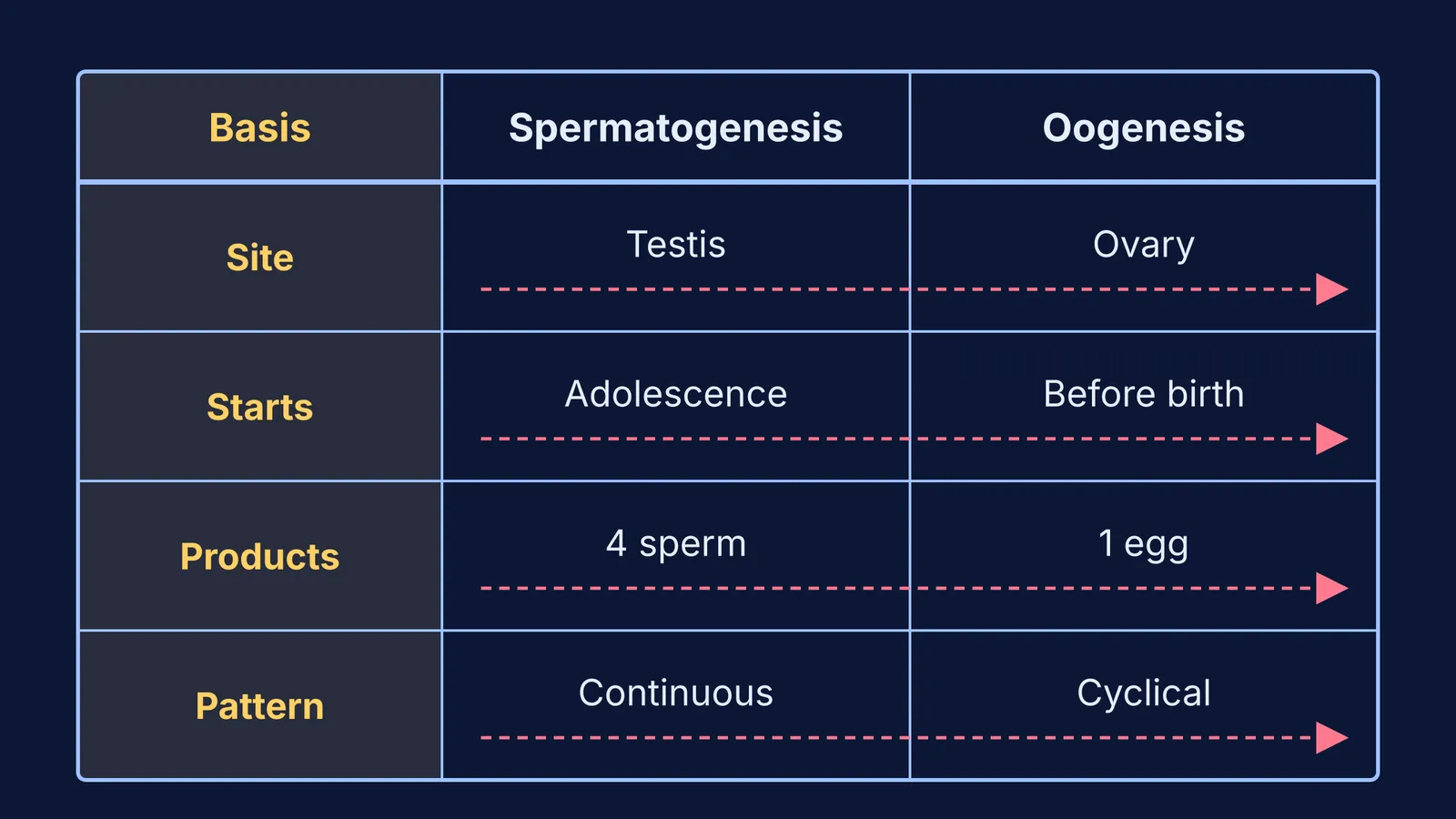
Worked example: spermatogenesis vs oogenesis
The facts below are from OpenStax Biology 2e, section 43.3. They make four rows:
Site: spermatogenesis happens in the wall of the seminiferous tubules of the testis; oogenesis happens in the outermost layers of the ovary.
When it starts: spermatogenesis is switched on during adolescence by gonadotropic hormones from the anterior pituitary; egg production begins before birth, and all future eggs are in prophase at birth.
Products of meiosis: each primary spermatocyte gives four sperm; each meiosis in oogenesis gives one egg, with the extra chromosomes going into polar bodies that degenerate.
Pattern: sperm production continues into old age; egg production is arrested until puberty, then individual cells continue at each menstrual cycle.
Worked example: incomplete dominance vs codominance
Incomplete dominance is the expression of two contrasting alleles such that the individual displays an intermediate phenotype, as defined in OpenStax Biology 2e, section 12.2. Codominance, in the same source, is when both alleles for the same characteristic are simultaneously expressed in the heterozygote.
Heterozygote: an intermediate phenotype; both parental traits show together.
Dominance: neither allele is completely dominant over the other; both alleles are expressed equally.
Example: snapdragon flower colour, where red and white parents give pink offspring; MN blood groups, where a heterozygote carries both the M and the N antigen on red blood cells.
Do not use the F2 ratio as a basis here. The same OpenStax section gives a 1:2:1 red:pink:white ratio for snapdragons, and says the 1:2:1 genotypic ratio still applies to codominant traits. A row with identical cells shows no difference.
What should you check before moving on?
Every row starts with a basis label.
Both cells in a row answer the same feature.
Rows are at least equal to the marks.
Terms are spelt as in NCERT: primary spermatocyte, polar body, primary endosperm nucleus.
If you cannot fill a row because the idea itself is shaky, the Fermi Concept Library covers every concept in biology, each with its own lesson and its place in the map. Genetics comparisons often sit next to crosses, like the two-gene mouse cross in the same sample paper, whose answer in the marking scheme is a 6:6:2:2 or 3:3:1:1 ratio. For those, the Fermi Problem Library has worked problems with a step-by-step solver that explains the reasoning rather than printing an answer.
For diagrams and case questions, read our plan for the CBSE Class 12 biology paper.


