On this page
If you took PCB and like the idea of a health career built around diet, yoga and drugless therapies, you will hear about BNYS. It is a full professional course with anatomy, physiology and a compulsory internship, not a short yoga certificate.
What do you study in BNYS?
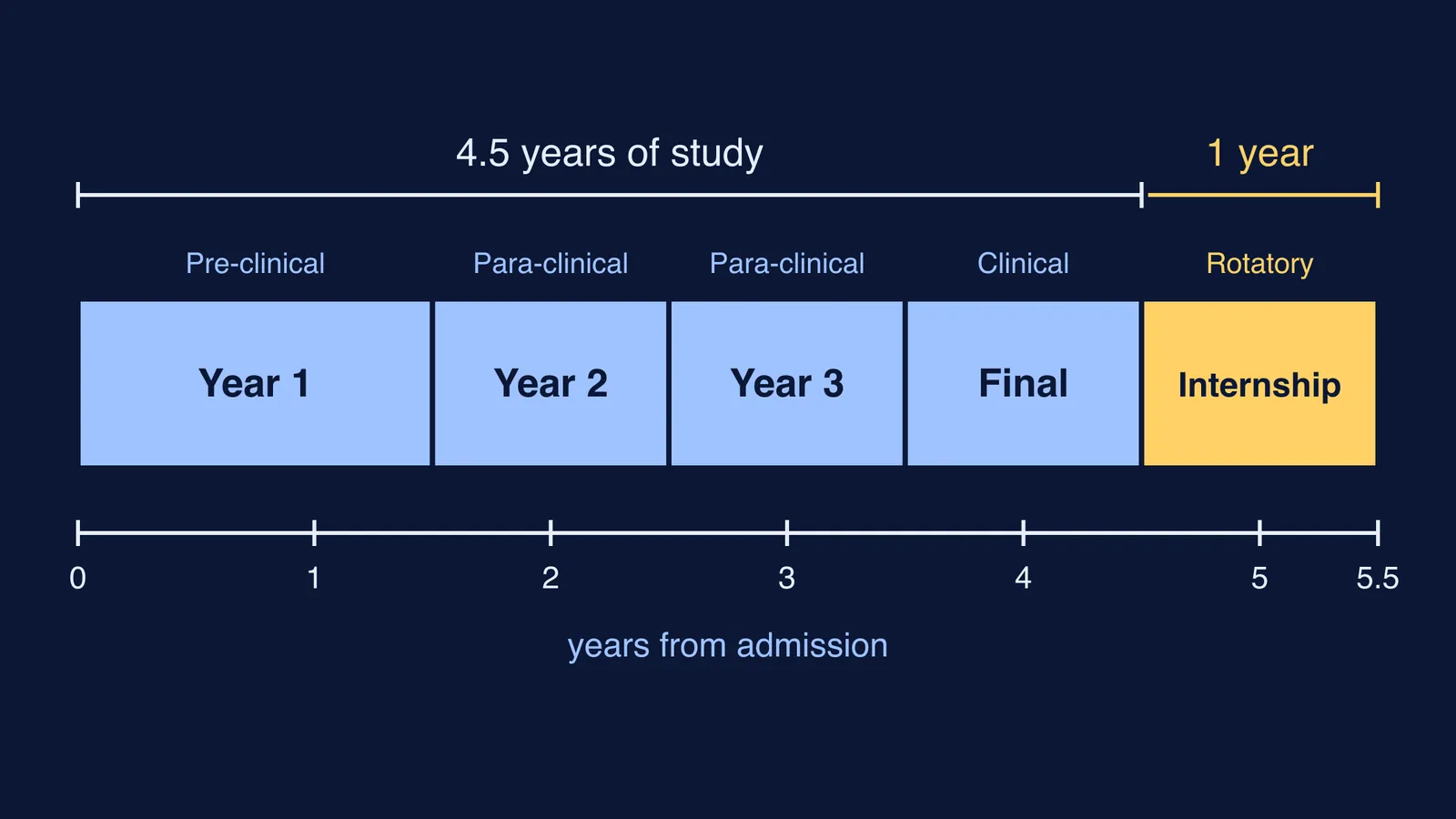
BNYS (Bachelor of Naturopathy and Yogic Sciences) lasts five and a half years: four and a half years of study followed by a one-year compulsory rotatory internship, according to the Rajiv Gandhi University of Health Sciences BNYS curriculum, notified in 2023. Its teaching-hours tables split the study years into four phases:
First year (18 months): anatomy, physiology, biochemistry, philosophy of naturopathy, principles of yoga and Sanskrit.
Second year: pathology, microbiology, community medicine, yoga philosophy, and basic pharmacology with forensic medicine.
Third year: manipulative therapies, acupuncture, yoga and its applications, nutrition and medicinal herbs, colour therapy, diagnostic methods with first aid and emergency medicine, and psychology.
Final year: fasting therapy and dietetics, obstetrics and gynaecology, yoga therapy, hydrotherapy and mud therapy, physical medicine and rehabilitation, clinical naturopathy and research methodology.
The first year alone has 1,450 teaching hours, and you need at least 80 per cent attendance in each subject.
How do you get admission to BNYS?
The central AYUSH counselling run by AACCC covers BAMS, BSMS, BUMS, BHMS and B.Pharm (Ayurveda), and its 2026-27 information bulletin does not list BNYS. BNYS admission is handled at state level instead, and the rules differ by state.
Tamil Nadu's 2026-27 BNYS prospectus ranks applicants on Class 12 science marks, not on an entrance exam score. You must have passed Physics, Chemistry and Biology (or Botany and Zoology) along with English, be at least 17 by 31 December 2026, and reach a minimum aggregate in science subjects: 50 per cent for the open category, 45 per cent for BC, 40 per cent for MBC/DNC and 35 per cent for SC/SCA/ST. The seats it covers are mainly for Tamil Nadu natives; students from other states can compete in the open category only if they studied Class 6 to 12 in Tamil Nadu.
Other states set their own rules, and some may ask for a NEET-UG score, so read the current bulletin of the state where you want to study. If you are also applying for BAMS or BHMS, see how AACCC and state counselling allot BAMS and BHMS seats.
Worked example: the Tamil Nadu rank score
The Tamil Nadu prospectus builds a score out of 200: your percentage in Physics and Chemistry taken together, plus your percentage in Biology (or Botany and Zoology taken together).
Say you scored 82 in Physics and 74 in Chemistry, each out of 100. Together that is 156 out of 200, or 78 per cent.
You scored 88 per cent in Biology.
Your rank score is 78 + 88 = 166 out of 200.
Marks from other boards are normalised: in the prospectus's illustration, 60 in Physics on a board whose top Physics mark was 90 counts as 66.66. Ties go first to the higher Biology percentage.
On this route your board marks carry the whole rank. If a biology or chemistry chapter is shaky, the Fermi Concept Library has a lesson for every concept in both subjects, so you can close gaps topic by topic before your board exams.
Where do BNYS graduates work after the course?
The RGUHS curriculum says graduates should be able to work in a variety of health care settings, and its final-year subjects show the clinical work involved: yoga therapy, diet, hydrotherapy and rehabilitation.
For specialist work, the Tamil Nadu Dr. M.G.R. Medical University postgraduate regulations list three-year MD courses in Naturopathy, Yoga, and Acupuncture and Energy Medicine, open to BNYS graduates.
In a January 2024 recruitment advertisement, the Central Council for Research in Yoga & Naturopathy (CCRYN), an autonomous body under the Ministry of Ayush, advertised 10 Research Officer (Yoga & Naturopathy) posts at Pay Level 10. Each needed BNYS plus an MD or PhD in yoga or naturopathy (or an MSc in Yoga with a PhD).
The National Commission for Indian System of Medicine Act, 2020 covers Ayurveda, Unani, Siddha and Sowa-Rigpa, according to PRS Legislative Research. Naturopathy is not among them, so ask how graduates register to practise in the state where you plan to work.
What should you ask a BNYS college before you join?
Which university is the college affiliated to?
Is there an attached hospital, and where exactly is the one-year internship done?
How do graduates register to practise in this state, and in my home state?
What is the full fee for all five and a half years, including hostel?
Where did the last two batches go: hospitals, MD seats, research or their own practice?
If you mainly want to teach yoga, a shorter yoga instructor certification may fit better. BNYS also belongs on the list of PCB degrees to discuss beyond NEET.
Start with your state's current admission bulletin, then shortlist colleges with these five questions.