On this page
Which yoga instructor certifications can students pursue?
If you are a college student looking to teach yoga, you do not need to pause your degree to spend years in an ashram. Standardized vocational certifications build teaching competency in focused, modular hours.
In India, the primary national authority is the Yoga Certification Board (YCB), established under the Ministry of Ayush. The YCB offers competency-based credentials recognized across public institutions:
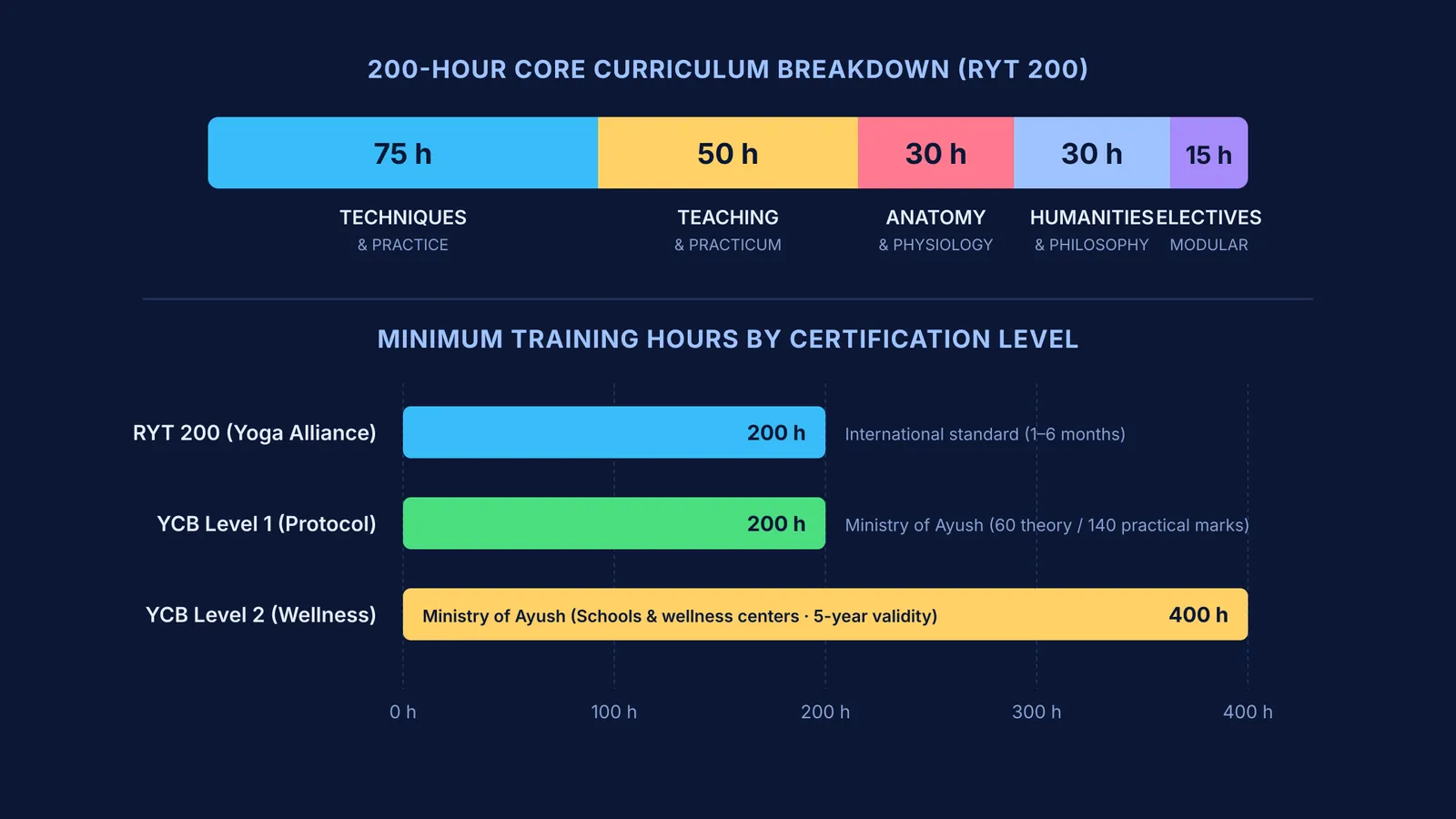
Level 1: Yoga Protocol Instructor (YPI): Requires not less than 200 hours of training. Open to candidates who have completed 10th standard, with no age restrictions specified by the board. The assessment includes a 60-mark theory paper and a 140-mark practical demonstration covering asanas, pranayama, and teaching skills, requiring 70% to pass each section.
Level 2: Yoga Wellness Instructor (YWI): Requires not less than 400 hours of training (12th standard suggested). It qualifies instructors to conduct wellness classes in schools, studios, and community centers, with a 5-year renewable validity.
Internationally, the recognized benchmark is the Registered Yoga Teacher 200 (RYT 200), governed by the Yoga Alliance 200-Hour Standards. Accredited schools deliver 200 classroom hours: 75 hours of techniques, training, and practice; 50 hours of professional essentials including teaching methodology and practicum; 30 hours of anatomy and physiology; 30 hours of yoga humanities; and 15 elective hours.
Undergraduate students frequently choose these 200-hour credentials because they qualify you to lead practical wellness classes without demanding a full-time academic commitment.
How do yoga certifications differ from university degrees?
A 200-hour certificate differs fundamentally from a university degree or clinical medical curriculum governed by bodies such as the Ministry of Ayush. Each pathway serves a distinct professional scope:
Vocational Certificates (YCB Level 1 and 2, RYT 200): Competency credentials taking one to six months. They train you to guide healthy individuals through postures and breathwork. They do not qualify you to diagnose conditions or prescribe clinical treatments.
Academic Degrees (B.Sc. in Yoga): Three-year undergraduate programmes regulated by the University Grants Commission. These degrees cover Sanskrit texts, research methods, and physiology, qualifying graduates for university master's study and UGC-NET lecturer exams.
Clinical Medical Degrees (BNYS): The Bachelor of Naturopathy and Yogic Sciences is a 5.5-year medical programme comprising 4.5 years of study and a 1-year clinical internship. Admission requires 10+2 with Physics, Chemistry, and Biology, conducted through state AYUSH counseling or NEET-UG. Graduates register with state medical boards as physicians.
For students exploring healthcare degrees, our guide to allied health science courses outlines admission routes across clinical disciplines.
How can you balance yoga teacher training with college coursework?
Completing 200 hours alongside regular degree studies under guidelines from the Yoga Certification Board requires choosing an appropriate cohort schedule:
Weekend cohorts: Run 4 to 5 hours on Saturday and Sunday across 20 to 25 weeks, protecting your weekday lectures.
Vacation intensives: Run 7 to 8 hours daily for four weeks during semester breaks; see our plan for the weeks after Class 12 for structuring break periods.
Hybrid formats: Cover philosophy and anatomy theory asynchronously online on weekday evenings, paired with weekend in-person practicums.
Regular practice also supports academic stamina. In a 2019 meta-analysis in *Frontiers in Psychiatry* (DOI: 10.3389/fpsyt.2019.00193), researcher Josefien J. F. Breedvelt and colleagues examined 24 randomized controlled trials with 1,373 tertiary education students. They found that yoga, meditation, and mindfulness produced significant reductions in student stress (effect size g = 0.42), anxiety (g = 0.46), and depressive symptoms (g = 0.42).
Physical training supports daily focus, but it is not clinical healthcare. Students experiencing severe mental strain can reach the national tele-mental health helpline Tele MANAS at 14416 (Tele MANAS).
Certification exams also test human anatomy and respiratory mechanics. The Fermi Concept Library covers every concept in biology and physics, each with its own lesson and its place in the map, helping student instructors review musculoskeletal movement and respiratory physiology.
What does a practical weekly balance plan look like?
To prevent certification training from eating into study hours while meeting the practical criteria set by the Yoga Certification Board, structure your week into dedicated blocks:
Morning Practice (6:30 AM – 7:30 AM, Tuesday to Friday): Complete 60 minutes of personal asana practice and pranayama before classes.
Degree Lectures (9:00 AM – 4:00 PM, Monday to Friday): Focus entirely on your college classes, labs, and coursework.
Targeted Study (6:00 PM – 8:00 PM, Weekdays): Complete assignments and revision. When energy drops after active mornings, Fermi's AI tutor can work out what you already know and build a plan for the session, working through problem sets alongside you so you sit down to a clear next step.
Weekend Modules (8:30 AM – 1:30 PM, Saturday and Sunday): Complete your mandatory teaching methodology, anatomy, and peer practicums.
Protecting these study hours keeps your academic grades secure; our guide on planning your day around a timetable details how to anchor fixed study blocks.