
On this page
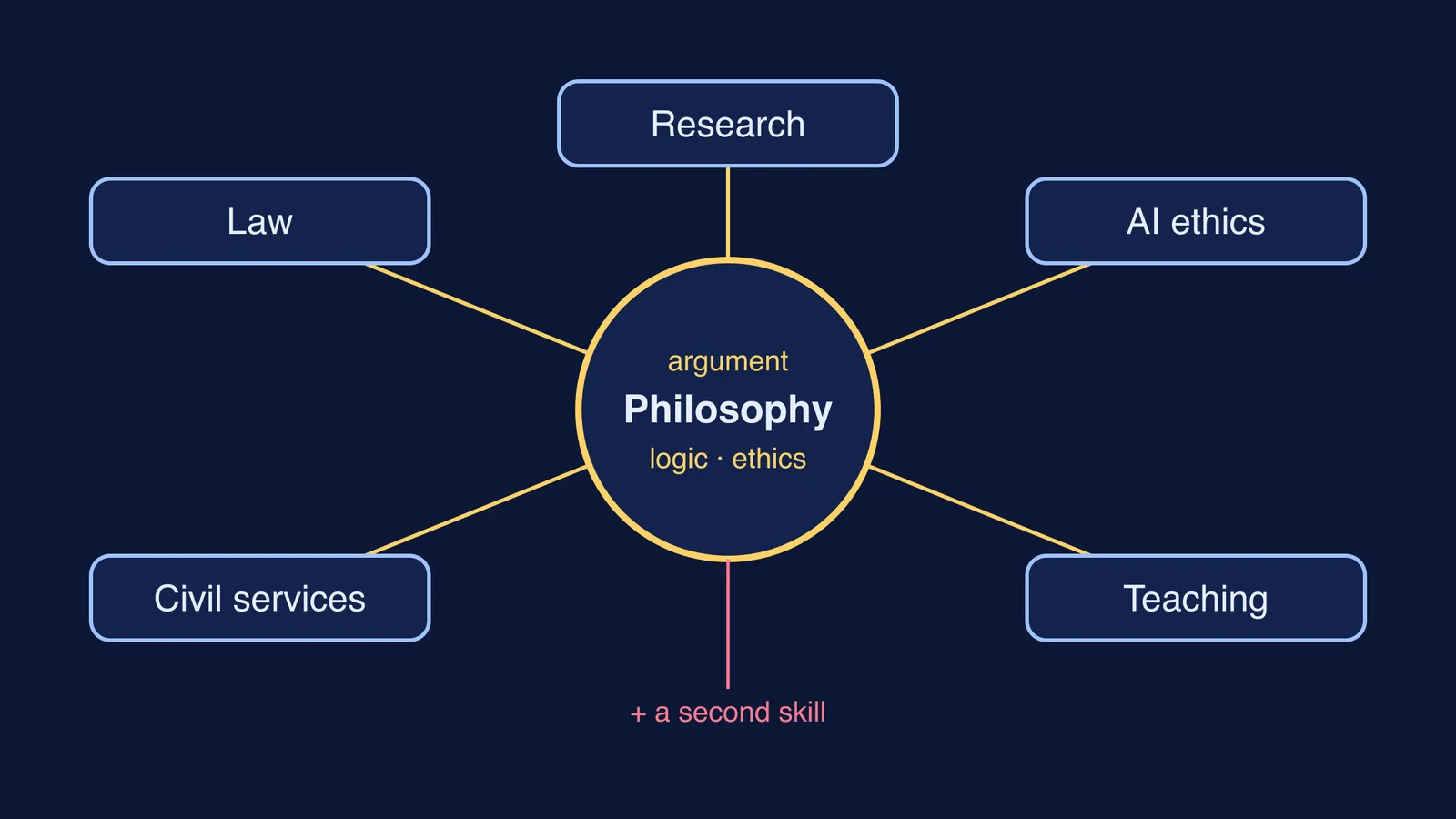
In many Indian homes, philosophy is seen as the degree you take when nothing else worked out. That is unfair. It trains a skill many careers pay for: taking an argument apart and building a better one. On its own, though, it rarely gets anyone a job.
What does a philosophy degree actually train?
Most BA philosophy courses build three things:
Argument: spotting the conclusion, the reasons given for it, and the hidden assumption that holds the two together.
Logic: checking whether a conclusion really follows, and naming the flaw when it does not.
Ethics: reasoning through a hard choice where two good principles conflict, and defending your answer.
There is some evidence for this. In a study published in the Journal of the American Philosophical Association, Michael Prinzing and Michael Vazquez analysed records from over half a million undergraduates at hundreds of US institutions. They found that students who were already strong verbally, curious and open-minded were more likely to pick philosophy. Even after accounting for those starting differences, philosophy majors outperformed all other majors on tests of verbal and logical reasoning and on a measure of intellectual habits.
Two cautions: the data are American, and they measure test scores, not salaries. The study suggests the training sharpens thinking; it does not show that the degree pays well by itself.
Where do philosophy graduates go in India?
Civil services. In UPSC's Civil Services Examination 2026 notice, Philosophy appears on the list of Mains optional subjects, and the optional is two papers of 250 marks each. Every candidate also writes General Studies IV, "Ethics, Integrity and Aptitude", worth 250 marks; its syllabus includes "contributions of moral thinkers and philosophers from India and world" and case studies. Our guide on which degree to choose for UPSC after 12th looks at how the subject you study links to the optional you take.
Law. You can take a three-year LLB after a bachelor's degree in any subject. For example, NLSIU Bengaluru's three-year LLB accepts "a Bachelor's degree in any discipline" with at least 45% marks (40% for SC, ST, OBC-NCL and PwD applicants). Law entrance tests reward the same training: the CLAT UG syllabus asks you to "recognise an argument, its premises and conclusions". If you are still in school and weighing law, compare BA LLB and BBA LLB first.
Teaching and research. Philosophy (subject code 003) is on NTA's list of subjects for UGC-NET June 2026. NET decides who is eligible for a Junior Research Fellowship, for appointment as Assistant Professor, and for PhD admission, according to the UGC-NET June 2025 information bulletin. That route usually means an MA first.
AI ethics and tech policy. In November 2021, UNESCO's 193 Member States adopted the Recommendation on the Ethics of Artificial Intelligence, the first global standard on the subject. In India, though, treat it as a route to build towards: these roles usually also ask for an understanding of data or law.
How do you combine philosophy with a second skill?
Choose the career first, then the skill that makes your philosophy training useful there, then one piece of work that proves it.
Law: pair it with legal reading. Proof: summarise recent Supreme Court judgments, setting out the argument on each side.
UPSC: pair it with answer writing and current affairs. Proof: a notebook of GS IV case studies you have answered and revised.
AI ethics or tech policy: pair it with basic programming and statistics. Proof: a short essay testing one AI system against the UNESCO principles.
Teaching or research: pair it with a classical or foreign language (Sanskrit, Pali, German) or with research methods. Proof: a seminar paper you could submit to a student journal.
Writing, policy or journalism: pair it with economics or data skills. Proof: explainers published on a blog or in a college magazine.
If your second skill is mathematics or computing, the Fermi Concept Library covers every concept in physics, chemistry, biology, mathematics and computing, each with its own lesson. And if you don't know where to start, Fermi's AI tutor can work out what you already know and build a plan for the session.
How do you explain this choice to your parents?
Parents usually worry about income. A plan answers that better than enthusiasm:
"I want to study philosophy because it trains the reasoning used in law, UPSC and policy. My target is law, and my second skill is legal reading. By the end of second year I will have a file of judgment summaries to show you. If I don't, we will sit down and decide together whether I should switch track."
Before you commit, check that the college's syllabus has proper papers in logic and ethics, and that it lets you take a minor or electives from another department. Our look at BA political science careers shows where a common pairing can lead.
Your next step: write down one career, one second skill and one proof of work, then read your target college's syllabus with those in mind.