
On this page
If you spend every free period on the ground, a physical education (PE) degree can turn that into a career. The National Council for Teacher Education (NCTE) sets the rules for these courses, and universities add their own entrance and fitness tests.
Which physical education teacher course can you do after 12th?
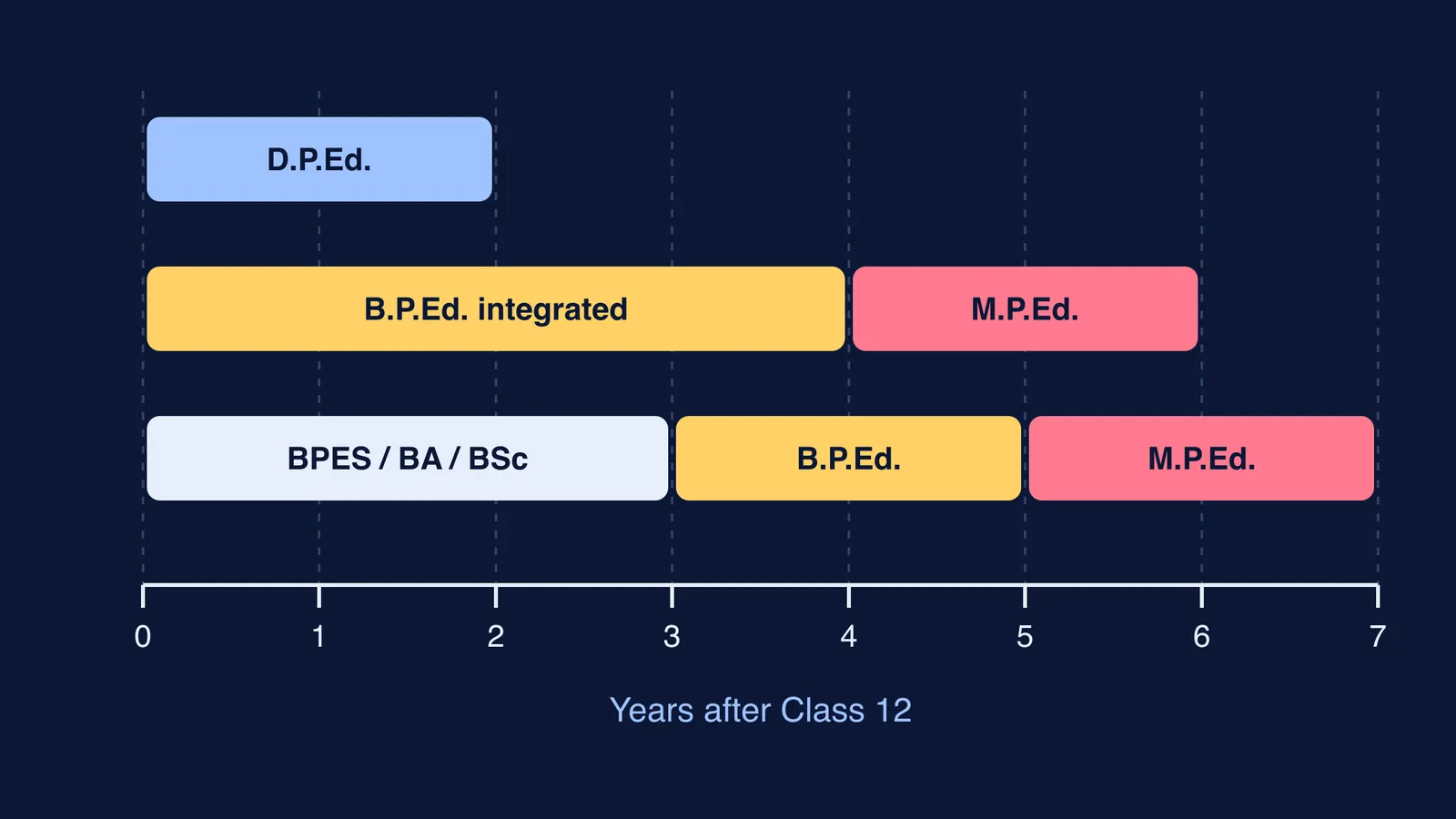
There are three main routes, drawn to scale in the diagram above.
Four-year integrated B.P.Ed., straight after 12th. At the Lakshmibai National Institute of Physical Education (LNIPE), Gwalior, the B.P.Ed. is an eight-semester programme open to students who passed 10+2 with at least 50% marks (45% for SC/ST and some other groups), with a maximum age of 21 on 1 July 2026, relaxed for OBC-NCL and SC/ST candidates (LNIPE prospectus 2026-27).
A three-year degree, then the two-year B.P.Ed. Study a Bachelor of Physical Education and Sports (BPES), which LPU lists as 3 years, or any bachelor's degree. NCTE sets the B.P.Ed. at two academic years; one way in is a bachelor's with 50% marks plus school, district or inter-college sports participation recognised by bodies such as AIU, IOA or SGFI, and another is a bachelor's in physical education with 45% (NCTE compendium, Appendix 7).
Two-year D.P.Ed. after 12th. The same NCTE document describes the Diploma in Physical Education as preparing PE teachers for Classes I to VIII, open to students who passed 10+2 with at least 50% marks.
A fourth route may be coming: draft NCTE rules published in February 2025 propose an Integrated Teacher Education Programme (ITEP) in physical education that awards a BPES and a B.P.Ed. together (Careers360). Our guide to ITEP and NCET, the four-year route to teaching explains how ITEP works.
What qualification do you need to teach PE in a school?
NCTE's 2014 minimum qualifications for physical education teachers rise with the class you teach (NCTE compendium):
Classes I to VIII: Class 12 plus a PE certificate or diploma of at least two years.
Classes IX and X: a bachelor's degree plus a B.P.Ed.
Classes XI and XII: a B.P.Ed. or equivalent with the required marks, plus a two-year M.P.Ed.
State governments and school boards add their own recruitment rules on top of these, so always read the actual job advertisement.
What is the physical fitness test for B.P.Ed. admission?
Tests differ by university, but LNIPE publishes its scoring tables, so it makes a useful model (LNIPE prospectus 2026-27). Its merit list combines a CUET written test (40%), the physical fitness test (30%) and a sports skill test (30%). The fitness test has four events worth 400 marks: 50 m sprint, standing broad jump, overhead medicine-ball back throw, and 1000 m run or walk. You need 55% to qualify and move on to the skill test.
Worked example: will you clear 55%?
Using LNIPE's conversion tables, here is how one male candidate might score:
50 m sprint in 7.0 seconds: 66 points.
Standing broad jump of 2.20 m: 57 points.
Overhead back throw of 10 m with a 3 kg ball: 56 points.
1000 m in 3 minutes 40 seconds: 60 points.
That is 239 out of 400, about 60%, clearing the 220 marks needed. For women, the same points come from 8.0 seconds, 1.70 m, 7.5 m with a 2 kg ball and 4 minutes 40 seconds. Time yourself on all four events and look up your points: your weakest event is the one to train first.
What does a B.P.Ed. student actually study?
NCTE's B.P.Ed. norms list theory courses such as anatomy and physiology, sports training, kinesiology and biomechanics, sports psychology, sports medicine, and measurement and evaluation. There is also a school internship of at least 30 lessons: 20 in schools and 10 coaching lessons (NCTE compendium, Appendix 7).
Biomechanics builds on Class 11 physics: levers, torque and projectile motion. If those are shaky, the Fermi Concept Library has its own lesson for each concept in physics and biology, and the Fermi Simulation Lab has interactive simulations for ideas that are easier to see than to read.
What can you do with a PE degree besides school teaching?
LNIPE's course list shows where graduates go next: postgraduate diplomas in sports coaching, fitness management, and strength and sports conditioning, and master's degrees in sports sciences, sports management, sports journalism and yoga (LNIPE prospectus 2026-27). To teach B.P.Ed. students as an assistant professor, NCTE's norms ask for an M.P.Ed. with 55% marks (NCTE compendium, Appendix 7); see how to become a college lecturer in India. If running leagues and events appeals more than coaching, read sports management after 12th.
A checklist for Class 11 and 12
Keep every sports certificate, from school meets to district and state level. Several B.P.Ed. eligibility options depend on them.
Aim for at least 50% in Class 12, the cut-off on most routes.
Get one main sport to a level you can show in a skill test.
Time the four fitness events monthly and track your points.
Recheck each prospectus and the CUET schedule every year.
Start with step 4 this week: one stopwatch session shows how far you have to go.