On this page
If you want to teach in an Indian college, the entry-level post is assistant professor, and the minimum rules for it come from the University Grants Commission (UGC).
What qualifications do you need to become a college lecturer in India?
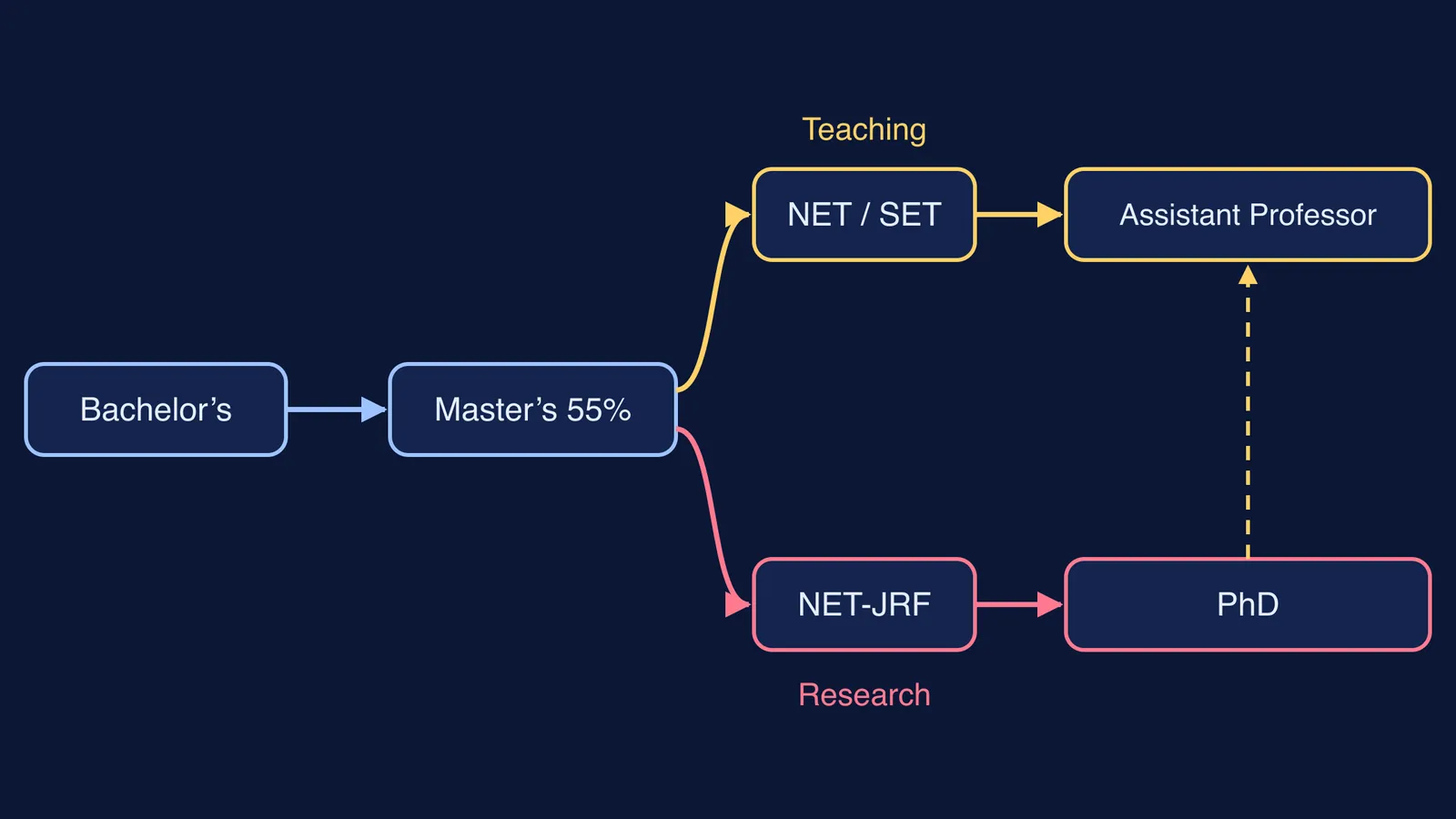
Under UGC's regulations, an assistant professor needs a master's degree with 55% marks in the relevant subject, plus a pass in the National Eligibility Test (NET) conducted by UGC or CSIR, or an accredited state test such as SET or SLET (UGC regulations compendium).
A 2023 amendment, in force from 1 July 2023, says "NET/SET/SLET shall be the minimum criteria for the direct recruitment to the post of Assistant Professor for all Higher Education Institutions" (UGC 2nd Amendment Regulations, 2023).
A PhD can stand in for the test. Candidates awarded a PhD under UGC's 2009 or 2016 PhD regulations are exempted from the NET/SLET/SET requirement (UGC regulations compendium). After the 2023 amendment, UGC said PhD holders remain eligible (Careers360 report).
Two practical limits, both from the NTA's UGC-NET December 2026 information bulletin:
A state SET you pass today makes you eligible only for universities and colleges in that state.
Once you qualify, recruitment follows the rules of the university, college or state government that is hiring.
The rules may change. In January 2025, UGC released draft regulations that list three routes to assistant professor: a PG degree with 55% and a PhD (or a UG degree with 75% and a PhD), a PG degree with 55% and NET or SET, or an ME or MTech with 55% (Business Today report on the draft).
How does UGC-NET work?
NET is conducted by the National Testing Agency (NTA). According to the December 2026 bulletin, it is a three-hour computer-based test with no break between its two papers. Paper I has 50 questions worth 100 marks on teaching and research aptitude. Paper II has 100 questions worth 200 marks on your subject. There is no negative marking.
Your result puts you in one of three categories:
JRF and assistant professor: you are eligible for the Junior Research Fellowship and can teach or join a PhD.
Assistant professor and PhD admission: you can teach or join a PhD, without the fellowship.
PhD admission only: you cannot be appointed as an assistant professor on this result.
To sit NET, general and EWS candidates need at least 55% in their master's, and OBC-NCL, SC, ST, PwD and third gender candidates need at least 50%. There is no upper age limit for the assistant professor category, while JRF applicants must be no older than 30, with up to 5 years of relaxation for some groups (same bulletin).
One trap for students in the new four-year degrees: the bulletin lets you sit NET with 75% in a four-year bachelor's, but qualifying on that basis makes you eligible for JRF and PhD admission, not for an assistant professor post. To teach, you still need the master's.
Science students often take CSIR-NET, which UGC rules also accept. See our explainer on what CSIR NET JRF is and who should take it.
How is the teaching path different from research?
Both paths start with a master's and often split at the same exam. Category 2 makes you eligible to teach; category 1 can add a funded start in research. The NTA bulletin says a JRF offer is valid for three years from the award letter, subject to finding a place at an institution.
Teaching: you need NET, SET or a qualifying PhD, then a college or university selects you. Your weeks are lectures, labs, exams and mentoring students.
Research: a fellowship funds your PhD, and your weeks are experiments, reading and writing papers. Our guide to how PhD students are funded in India explains fellowships and stipends.
The paths overlap: JRF holders are also eligible to teach, and a PhD can exempt you from NET. If you love explaining more than discovering, consider teaching at a JEE or NEET coaching institute.
What should you do at each stage?
This plan follows the eligibility rules in the NTA's UGC-NET bulletin:
Class 12 and UG: pick a subject you would happily explain for decades.
Master's: aim comfortably above 55%, and sit NET provisionally in your final year.
Choosing a category: tick JRF if you might want to research; it keeps teaching open too.
Paper I: prepare it separately. It tests teaching and research aptitude, reasoning and reading comprehension, not your subject.
Paper II: this is your master's syllabus.
Applications: check state SET limits and each university's rules.
For a physics, chemistry, maths or biology Paper II, the Fermi Concept Library gives every concept its own lesson and its place in the map, so you can spot the topics you have forgotten since your first year.
Before you commit, ask two teachers you admire: "What does a normal week look like?", "How much of your time goes to research?" and "What would you do differently at my stage?"
Your next step: open the latest NET information bulletin on the UGC-NET website and check your eligibility, line by line.