On this page
If you are thinking about a PhD in science or engineering, the first family question is usually money. Many full-time PhD students in India are paid a monthly fellowship, and how much depends on how you enter.
How are PhD students in India funded?
There are three common routes.
A national fellowship you win yourself. You qualify through an exam or a selection, and the money follows you to an approved lab. Examples are the CSIR or UGC NET Junior Research Fellowship (JRF), the INSPIRE Fellowship and the Prime Minister's Research Fellowship (PMRF).
A post on a professor's project. A faculty member wins a research grant and hires a "project JRF" from it.
An institute fellowship. Some universities and institutes pay admitted PhD students from their own or ministry funds. The admission page says whether yours does.
The money usually comes in three parts: the monthly stipend, a house rent allowance (HRA) if you have no hostel room, and a yearly contingency grant for research costs.
How much does a JRF or SRF get per month?
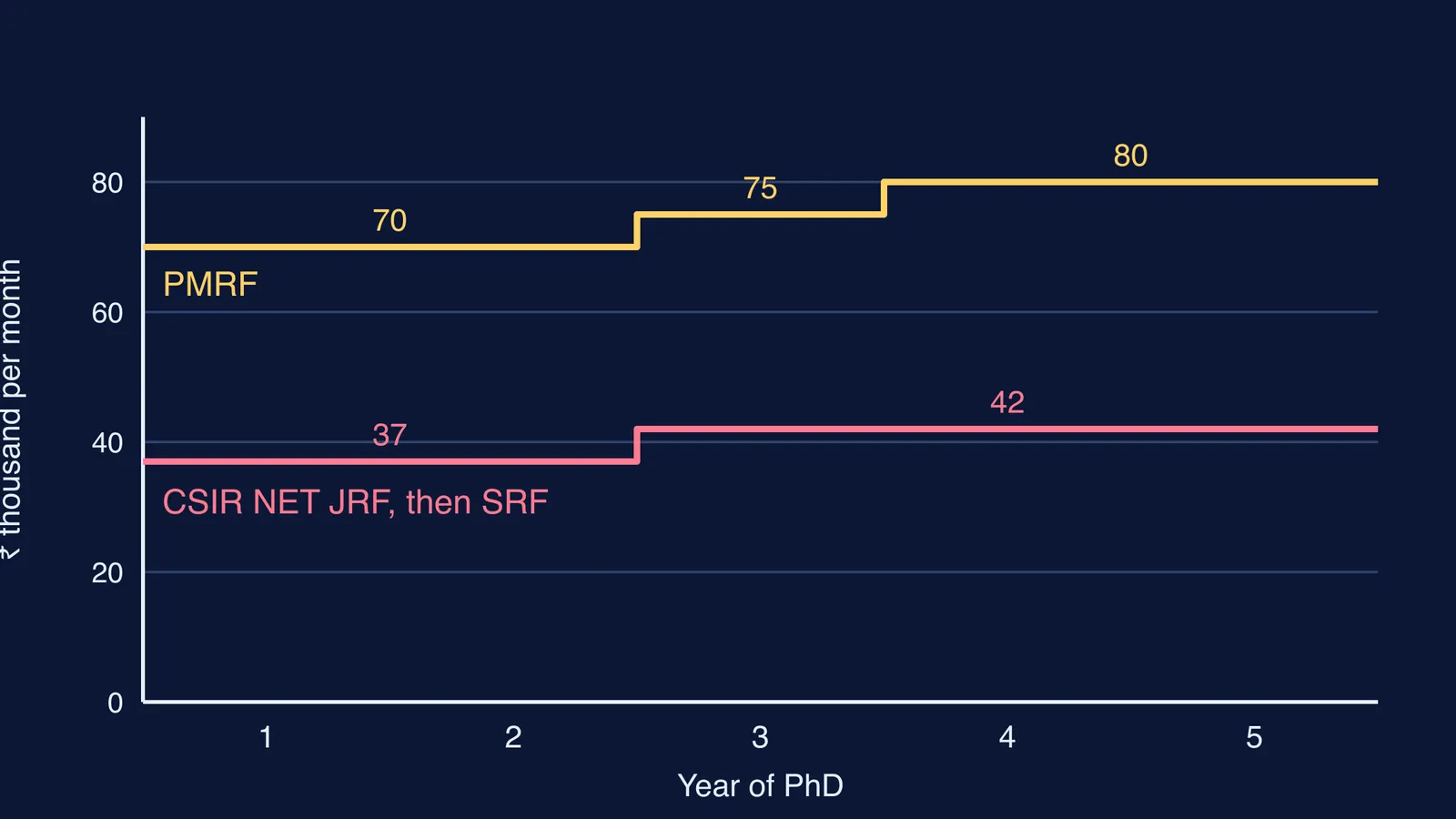
Under central government rates effective from 1 January 2023, a Junior Research Fellow gets ₹37,000 a month plus HRA, and a Senior Research Fellow gets ₹42,000 a month plus HRA, as listed on ISRO's research fellowships page. HRA is paid only if the institution does not give you hostel accommodation.
The CSIR rules show how the ladder works. A JRF selected through CSIR-UGC NET gets ₹37,000 a month for the first two years and a contingency grant of ₹20,000 a year, according to the CSIR-HRDG JRF guidelines. After two years, an expert committee reviews your research progress, and if it is satisfactory you move up to SRF at ₹42,000. You must register for a PhD within two years of joining, and JRF plus SRF together cannot exceed five years.
If you are still deciding whether to sit the exam, our guide to what CSIR NET JRF is and who should take it explains the basics.
What do PMRF and INSPIRE add?
The PMRF pays more than the standard rate. Fellows get ₹70,000 a month for the first two years, ₹75,000 in the third year and ₹80,000 in the fourth and fifth, plus a research grant of ₹2 lakh a year for five years, according to the MyGov PMRF scheme page.
The INSPIRE Fellowship, run by the Department of Science and Technology, rewards top marks rather than an exam score. Under its current guidelines, which apply from April 2026, you can qualify as a first-rank holder in your university's postgraduate exam with at least 70% in a batch of seven or more. A bachelor's first rank with at least 75%, in a batch of seven or more, also counts, as do INSPIRE Scholars with 70% in an MSc or 75% in a four-year BSc. Meeting these does not guarantee an offer: an expert committee selects. The same guidelines say you cannot hold two fellowships at once, the fellowship lasts at most five years, and changing your host institute is allowed only in exceptional cases.
Students who enter an integrated PhD after a BSc should check which of these they become eligible for.
What is a project JRF, and what should you ask?
The ANRF Core Research Grant pays for equipment, research personnel, consumables, travel and contingency, normally for three years. A project JRF is paid from that personnel budget. The catch is timing: a PhD often takes longer than one grant, so ask what happens to your stipend when the project ends. That question belongs on your list when you choose a PhD supervisor.
Worked example: five years on the CSIR NET route
Take the CSIR JRF and SRF rates and assume you upgrade to SRF on time.
Years 1 and 2 as JRF: ₹37,000 × 12 = ₹4,44,000 a year, so ₹8,88,000.
Years 3 to 5 as SRF: ₹42,000 × 12 = ₹5,04,000 a year, so ₹15,12,000.
Stipend total over five years: ₹24,00,000.
Contingency at ₹20,000 a year adds ₹1,00,000, which is for research costs, not living costs.
HRA is extra and depends on your city and whether you get a hostel. A late SRF upgrade keeps you on the lower rate for longer.
How do you check the current amount?
Rates change, and some pages lag behind. One government science portal still lists the JRF/SRF fellowship as ₹25,000/₹28,000, below the CSIR figures above. Before you accept an offer:
Open the funder's own page (CSIR-HRDG, the INSPIRE portal, the PMRF site or the institute's notice) and note the date of the rule it cites.
Ask the department office for the stipend in writing, with HRA shown separately.
Ask how often stipends are paid and who to contact if a payment is late.
If NET or GATE preparation shows up a weak topic, the Fermi Concept Library covers every concept in physics, chemistry, biology, mathematics and computing, each with its own lesson. Start with your offer letter, then the three questions above.