On this page
If you finish Class 12 already knowing you want to teach in a school, you no longer need to take a three-year degree and then a separate B.Ed. India now has a direct four-year route. It also matters for the future: a Government of Puducherry summary of NEP 2020 states that "by 2030, the minimum degree qualification for teaching will be a four year integrated B.Ed. degree".
What is ITEP, the integrated teacher education programme?
The Integrated Teacher Education Programme (ITEP) is a four-year degree that trains you in a subject and in teaching at the same time. In the words of the NTA public notice of 12 February 2026, ITEP is "a Dual Major Programme - the first major is in Education with School Specific Stage specialization and the second major is in an opted discipline."
The NEP 2020 points on teacher education describe it as "a dual-major holistic Bachelor's degree, in Education as well as a specialized subject". The same section keeps a 2-year B.Ed. for students who already have a bachelor's degree, so the older route has not disappeared.
The "stage" in your degree means the age group you train to teach. NEP 2020 splits school into foundational, preparatory, middle and secondary stages (Puducherry NEP summary).
According to the NTA notice, ITEP runs at selected central and state universities and institutions, including IITs, NITs, RIEs and government colleges. Two real examples:
NIT Tiruchirappalli runs a B.Sc. B.Ed. for the secondary stage, with 50 seats, eight semesters and a Class 12 requirement of PCM with a 50% aggregate.
RIE Mysuru, an NCERT institute, offers B.A. B.Ed. and B.Sc. B.Ed. in PCM and CBZ.
How does the NCET exam work?
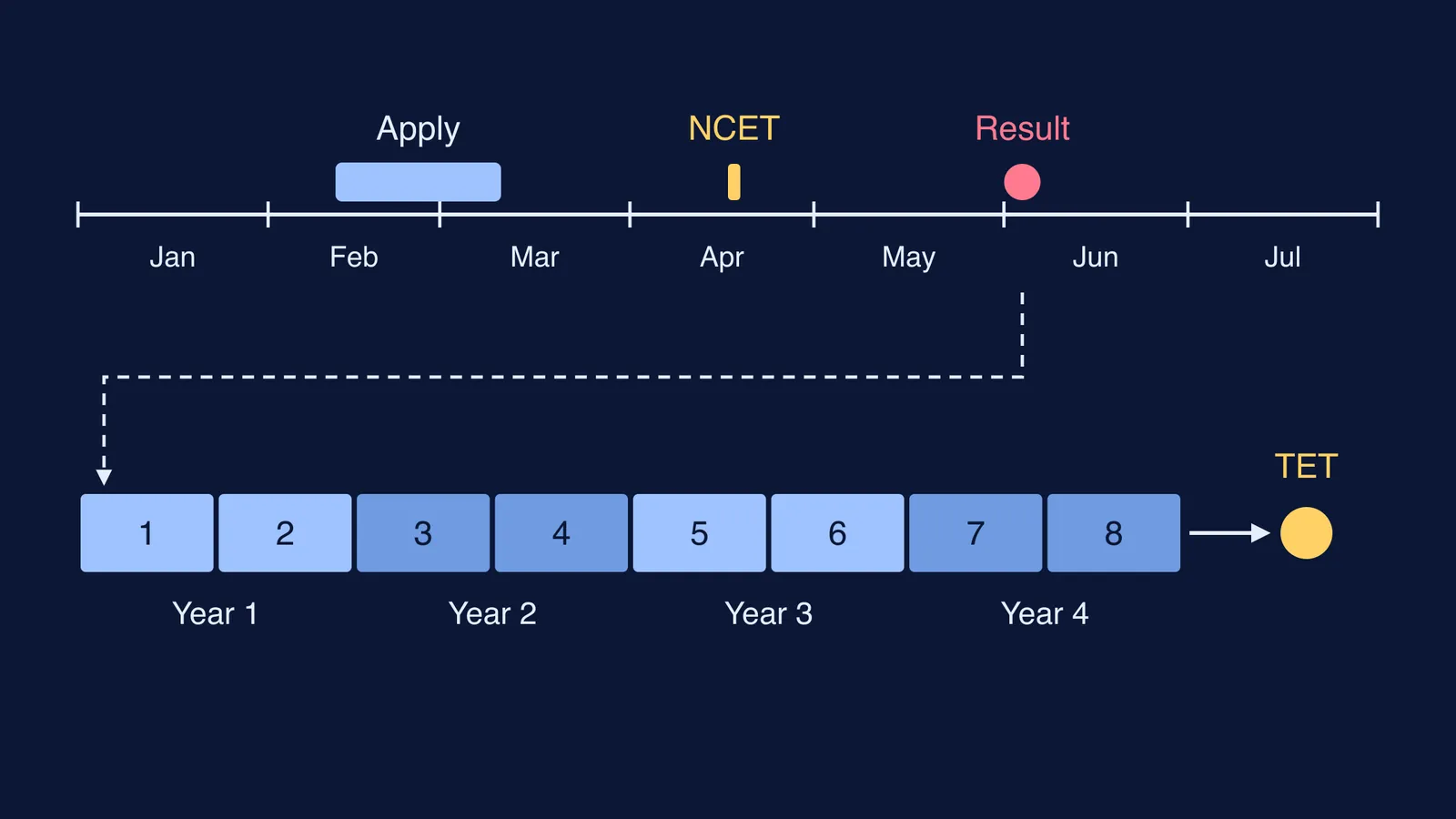
NCET is a computer-based test that NTA conducts for NCTE in 13 mediums (NTA notice). For 2026, applications were open from 12 February to 10 March, and each candidate could submit only one application. The exam was first set for 17 April; Careers360 reported that it was held on 17 and 18 April, with results on 4 June.
According to Careers360's summary of the 2026 bulletin, the paper has four sections:
Languages: two papers, with 20 of 23 questions to attempt in each.
Domain subjects: three papers, with 25 of 28 questions to attempt in each.
General test: 25 of 28 questions.
Teaching aptitude: 20 of 23 questions.
That comes to 160 questions to attempt out of 181, in 180 minutes, with +4 for a correct answer and -1 for a wrong one (Careers360). Careers360 reported a fee of Rs 1,200 for the general category, and said domain subjects follow the Class 12 syllabus.
NCET only makes you eligible. You still go through each institution's own counselling or admission process (NTA notice). NIT Tiruchirappalli, for example, takes applications through its Samarth portal. On 17 June 2026, NCTE told ITEP institutions to admit only through NCET 2026 and warned that other admissions "will be treated as unauthorised" (Careers360).
Which NCET subjects should a science student choose?
Here is a worked example. Ananya is in Class 12 with PCM and wants to teach maths at secondary level. She chooses Mathematics, Physics and Chemistry as her three domain subjects, so they match the B.Sc. B.Ed. eligibility on her shortlist. For languages, she picks English and the language she would like to teach in.
Now look at where the 640 marks come from, using the Careers360 exam pattern at +4 per question:
Domain subjects: 75 questions, 300 marks
Languages: 40 questions, 160 marks
General test: 25 questions, 100 marks
Teaching aptitude: 20 questions, 80 marks
Nearly half the marks come from Class 12 subjects she is already revising for her boards, so much of her NCET preparation overlaps with board work. The language papers, general test and teaching aptitude need their own practice.
If a Class 12 topic still feels shaky, the Fermi Concept Library has a lesson for every concept in physics, chemistry, biology and mathematics. The Fermi Problem Library has worked problems with a step-by-step solver that explains the reasoning.
What should a Class 12 student do month by month?
October to December: shortlist five to eight ITEP institutes and note each one's stage, subject combinations and minimum marks.
January: read last year's bulletin and try a timed set of general test and teaching aptitude questions.
February to March: apply as soon as the window opens. Use your own or a parent's phone number and email, because NTA sends all updates there (NTA notice).
March: board exams come first. Your domain revision counts for both.
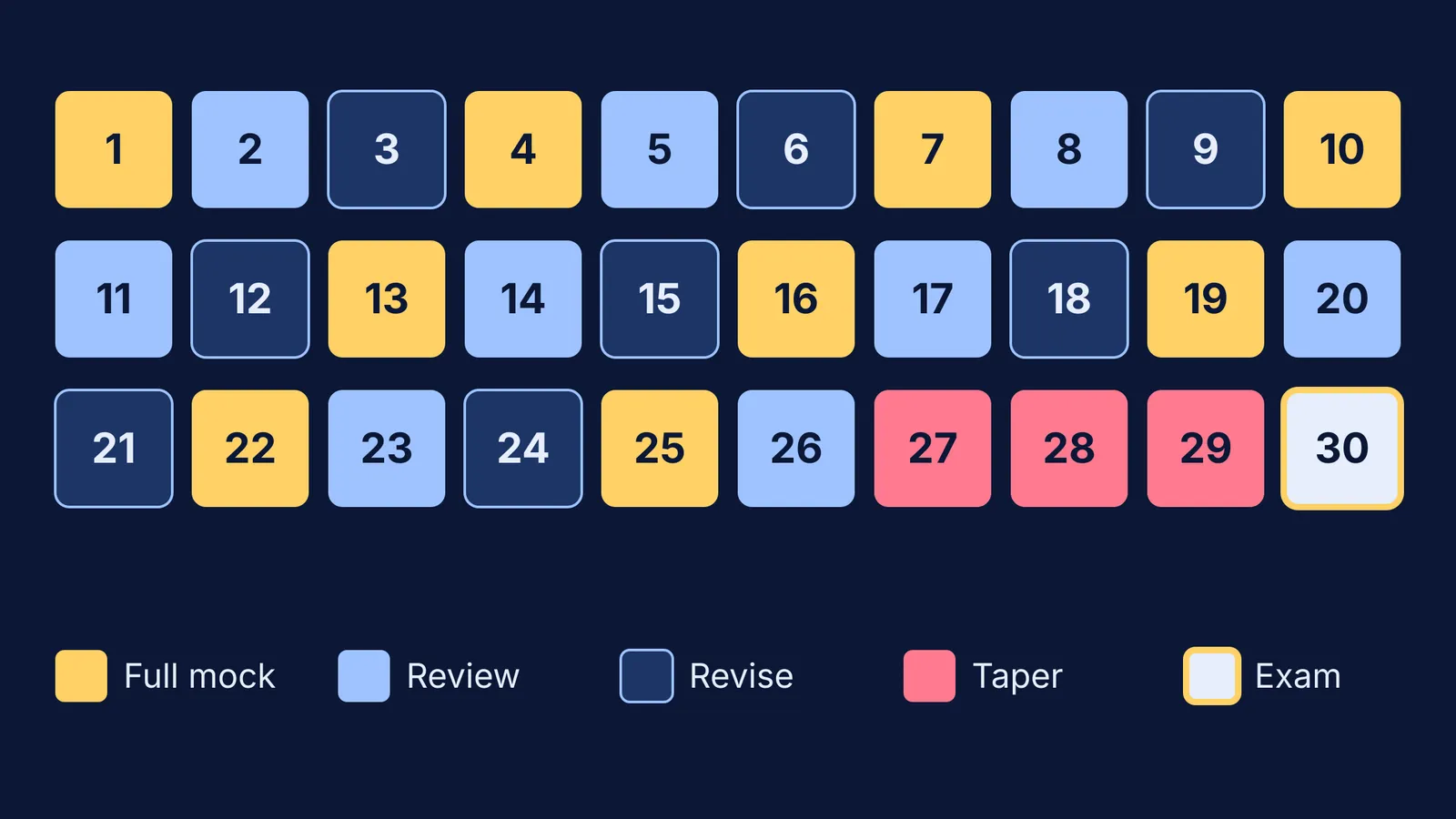
April: in the last three weeks, take full mocks in 180-minute blocks, the length of the paper (Careers360).
June: once the results are out, apply on each institute's own portal before its deadline.
During the degree: plan for a Teacher Eligibility Test. Under the RTE Act, teachers of Classes I to VIII must pass a TET (CTET, CBSE).
For a low-risk way to start, read our guide to becoming a teaching assistant for juniors. If you would rather teach after school, see how to become a college lecturer in India.