On this page
If you are in Class 12 and thinking about the IAS, the honest answer to "which degree?" is this: the one you can finish well and would be glad to use if UPSC does not work out. UPSC's rules and results data show the degree matters less than you might think.
Which degree do you need for UPSC?
The UPSC Civil Services Examination 2026 notice asks for a graduate degree from a university set up by a central or state law, a deemed university, or an equivalent qualification. It names no stream and no minimum percentage.
The same notice lets final-year students sit the written exam, as long as they show proof of passing before the interview; MBBS and BDS candidates must also show they have completed their internship. For 2026, general-category candidates had to be at least 21 and under 32 on 1 August, with six attempts, and more years and attempts for SC, ST, OBC and PwBD candidates.
So a three-year BA counts exactly as much as a four-year BTech, as long as the university is recognised; our guide on whether a private university degree is valid for government jobs shows how to check.
Does your degree decide your optional subject?
No. In the Main exam, the optional subject is two papers of 250 marks each, which is 500 of the 1,750 written marks, per the 2026 notice. The notice says candidates "may choose any one of the optional subjects" from a list of 25 subjects plus the literature of any one of 23 languages, including English and Hindi.
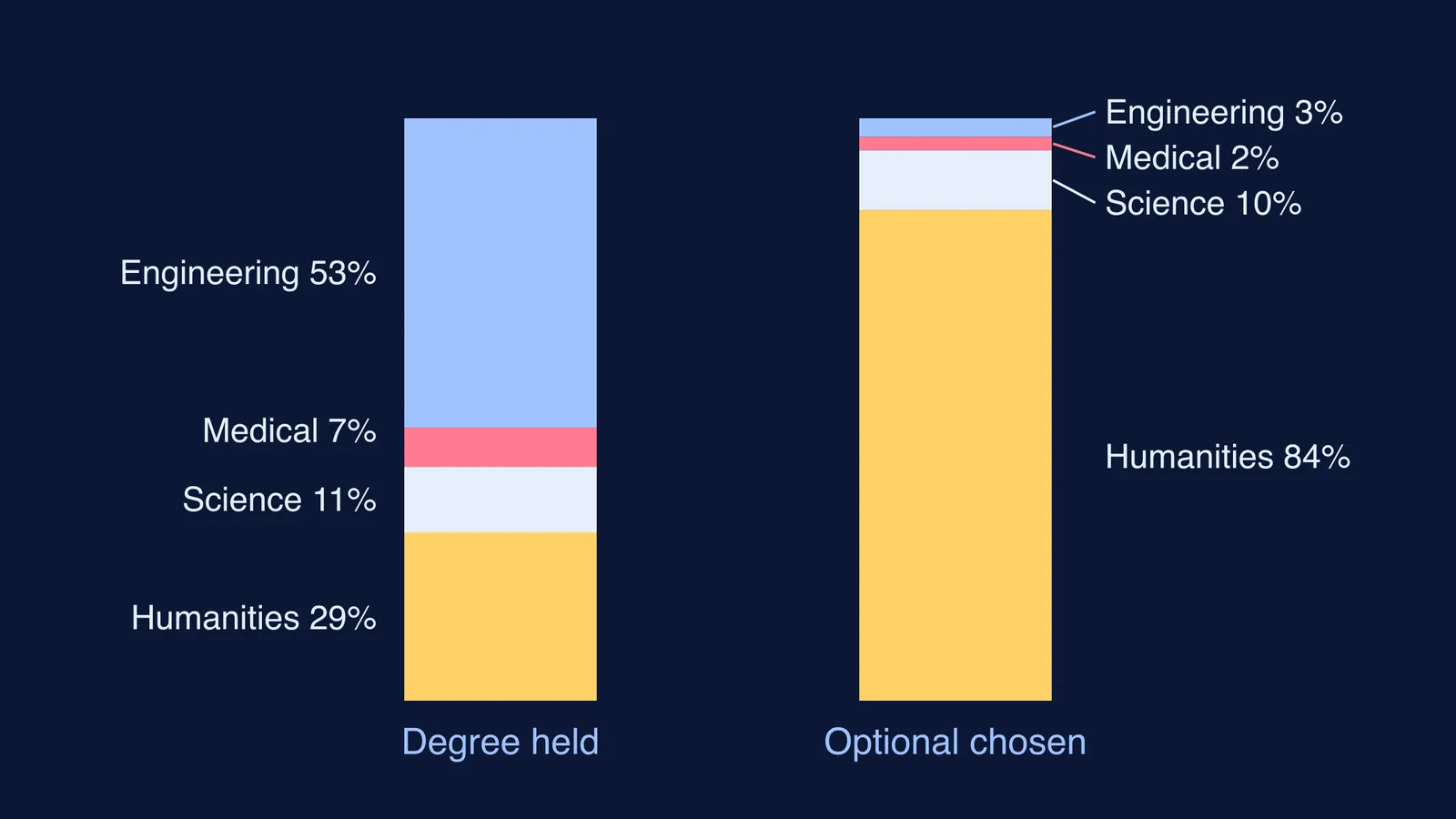
Most successful candidates do not stick to their degree subject. In CSE 2022, 53.1% of recommended candidates had engineering degrees, 29.0% humanities, 11.2% science and 6.7% medical, according to the UPSC 74th Annual Report. Yet 84.1% of the optionals those candidates chose were humanities subjects or literature, and only 3.4% were engineering subjects. The report says most candidates "have made a cross domain shift from their original stream".
At the interview stage, no stream dominated. Of bachelor's-degree holders interviewed in CSE 2022, 41.5% of humanities, 42.0% of science, 49.6% of medical and 37.6% of engineering graduates were recommended, per the same report.
Which degree gives you a good backup career?
This is where your choice counts. UPSC recruits by subject through other exams: exams it held in 2023-24 included Engineering Services (486 posts), Combined Medical Services (1,261), Combined Geo-Scientist (269) and the Indian Economic and Statistical Services (53), per the 74th Annual Report. Each exam's notice lists which degrees qualify, and some need a master's.
Here is a decision guide for common choices:
BA in history, political science, sociology or geography: optional is usually the same subject, and these are popular ones (2,378 candidates wrote political science and international relations in the 2022 Main exam). Backup: teaching, state PSC exams, journalism, policy work or law, often after a postgraduate degree.
BA or BSc economics: optional is economics. Backup: banking and analytics, or the Indian Economic Service exam once you add a master's, since the 2026 IES/ISS notice asks for a postgraduate degree in economics.
BSc maths, statistics, physics, chemistry, botany, zoology or geology: keep the same optional or switch. Backup: the Indian Statistical Service (the same notice asks for statistics in every year of the bachelor's), the Geo-Scientist exam after a master's (per its 2027 notice), research, teaching or data roles.
BTech or BE: civil, mechanical and electrical engineering optionals exist, but few recommended candidates use them. Backup: the Engineering Services exam and industry jobs.
BCom or BBA: commerce and accountancy, or management. Backup: CA, CS, banking or finance jobs.
MBBS or BDS: medical science optional. Backup: practising, or Combined Medical Services. The longest route.
One more safety net: the 2026 notice says candidates who reach the interview but are not recommended can consent to the Pratibha Setu portal, which shares their biodata with registered employers.
How do you choose? A four-question check
Would you be happy working in this field for five years if UPSC does not happen?
Can you score well and finish on time? A failed semester can delay your eligibility.
Is there a subject you would enjoy studying in depth for two papers? If it matches your degree, you save time; if not, switching is normal.
Does the timetable leave an hour a day for general studies?
Worked example: Aditi took PCM, enjoys maths and is curious about society. A BSc in maths keeps data jobs open, and she can still pick sociology as her optional. A BA in economics plus a master's keeps the Economic Service open. Either works; the backup she prefers decides it.
If you choose a science degree and plan to keep physics or maths as your optional, the Fermi Concept Library has a lesson for every concept in physics, chemistry, biology, mathematics and computing.
For the money and attempts side of the plan, read our parents' guide to a child who wants UPSC after graduation, and for engineers, what the data says about engineers becoming IAS officers.