

On this page
Many engineering students eventually look beyond technical roles and wonder if they can transition into administration. The short answer is yes: engineers can absolutely become Indian Administrative Service (IAS) officers, and the data shows they are highly successful at it.
Here is how the Civil Services Examination (CSE) fits into an engineering path, from eligibility rules to the data on optional subjects.
Are engineers eligible for the IAS?
To become an IAS officer, you must pass the UPSC Civil Services Examination (CSE). The core requirement is a graduation degree in any discipline from a recognised university (Next IAS). A B.E. or B.Tech degree fully meets this criteria.
If you are in your final year of engineering, you can sit for the Preliminary exam, provided you have proof of passing when the Main examination comes around. The standard age bracket for the exam is 21 to 32 years as of the first of August of the exam year, with relaxations depending on category. General category candidates are permitted six attempts. For the two premier services, the IAS and the IPS, you must also be a citizen of India.
How many engineers clear the UPSC exam?
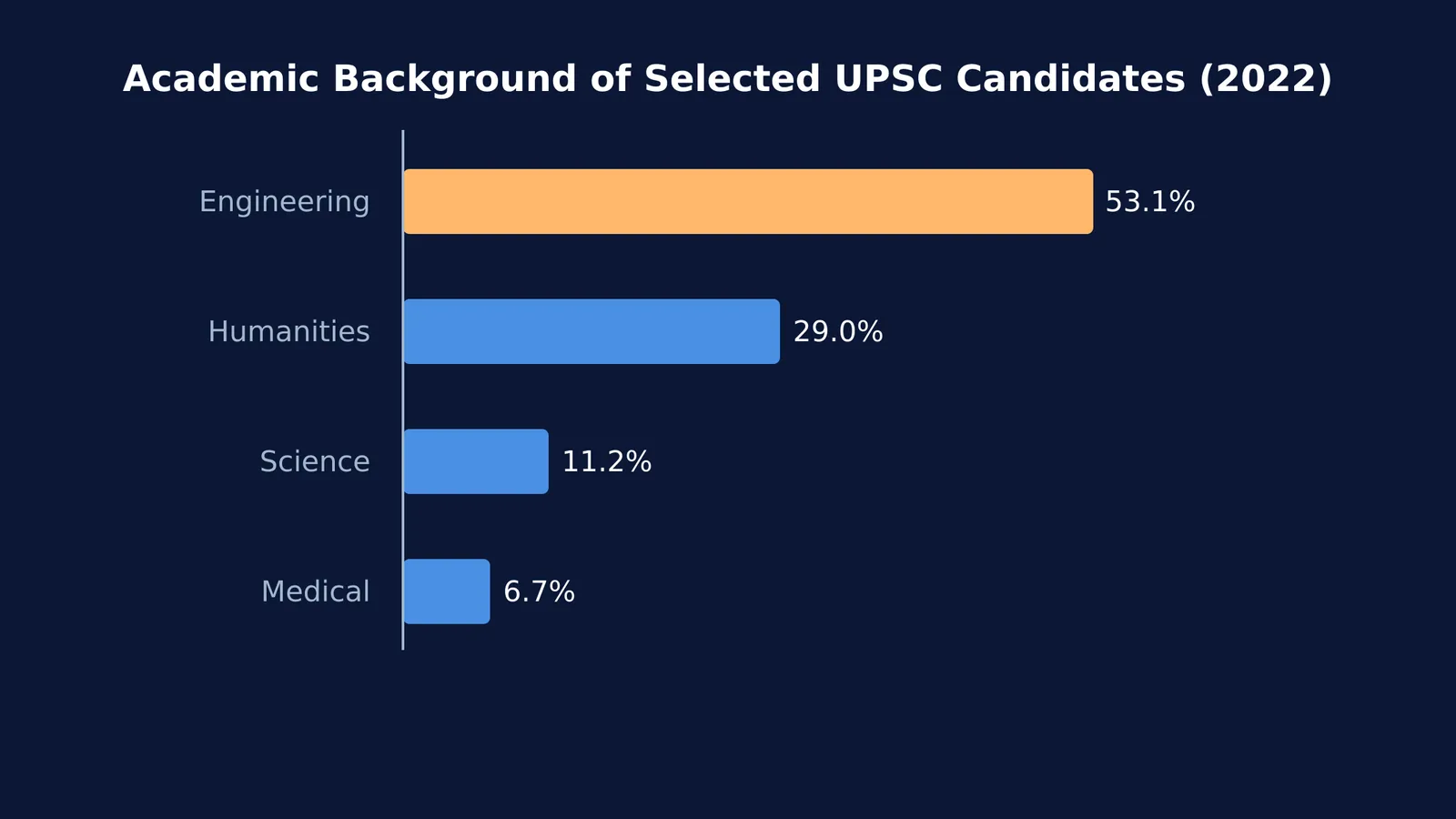
Engineers consistently form the largest academic group among successful candidates. According to the UPSC 74th Annual Report covering the 2022 exam, engineers accounted for 53.1% of the recommended candidates (Decode Civils).
This is part of a long-term trend. Between 2017 and 2021, up to 63% of successful candidates came from an engineering background (Times of India). The analytical problem-solving skills developed during an engineering degree—often tested first in competitive entrance exams like JEE or GATE—help candidates tackle the logical reasoning, mathematics and data interpretation demands of the UPSC Preliminary exam's CSAT paper. This rigorous background means they often need less dedicated time for the aptitude sections compared to candidates from non-technical streams.
Because engineering degrees rely heavily on foundational concepts and derivations, students develop a methodical approach to breaking down complex systems. If you are currently studying engineering and trying to build strong analytical habits, the Fermi Problem Library has worked problems with a step-by-step solver that explains the reasoning rather than printing an answer.
Why do engineers choose humanities optional subjects?
When it comes to the Main examination, candidates must choose one optional subject (comprising two papers, 500 marks total). Here, the data reveals a stark pivot in how engineers approach the exam.
While over half of the selected candidates are engineers, only 3.4% actually choose an engineering optional like Civil, Mechanical, or Electrical Engineering (Decode Civils). A vast majority of successful candidates—84.1%—switch to humanities subjects such as Political Science and International Relations (PSIR), Sociology, or Anthropology.
There are clear reasons for this shift:
Syllabus overlap: Humanities subjects overlap heavily with the General Studies (GS) papers, saving preparation time across the four mandatory GS papers.
Vast syllabus: The UPSC engineering syllabus is often wider than a standard university B.Tech curriculum, requiring significant extra reading beyond graduation.
However, for those who do stick with their technical background, the success rates can be strong. In 2022, the success rate for Electrical Engineering was 12.0%, well above the overall average of around 8% (Decode Civils). Mechanical Engineering saw a success rate of 4.3% in the same year, demonstrating that performance in technical optionals can fluctuate based on the specific paper. Engineering papers are objective—answers are either right or wrong—meaning candidates with a strong command of their field can score predictably high marks, reducing the subjectivity found in humanities marking.
How can you balance engineering studies and UPSC preparation?
Starting UPSC preparation during an engineering degree requires a careful routine. The key is to avoid letting either your technical degree or your exam preparation suffer. Learning how to build a study routine that lasts is more effective than attempting extreme study hours right before an exam. Consistency over years is what builds the broad knowledge base required for the civil services.
If you find yourself stuck on foundational science concepts while trying to clear time for UPSC reading, the Fermi Concept Library contains every concept in physics, chemistry, biology, mathematics and computing, each with its own lesson and its place in the map. This can accelerate your university coursework and keep your grades up without sacrificing civil services preparation.
Many candidates use their early university years to build a reading habit—starting with daily newspapers and NCERT textbooks—before taking on the heavy GS subjects and their chosen optional in the final year. Whether you choose to use your engineering degree as an optional subject or pivot to the humanities, the analytical foundation you have built is a proven advantage in the civil services. If you feel overwhelmed during the process, treating exam nerves as energy can help you maintain focus over the long preparation cycle.


