On this page
Chapter 3 of the new NCERT Class 9 Social Science book, *Understanding Society: India and Beyond* Part I (first edition, June 2026), is where geography moves from rocks to air. It covers the air's makeup and layers, weather and climate, India's seasons, the monsoon and climate change; the full chapter is free on the NCERT textbook site. Here are the numbers to know, the mistakes that cost marks, and a revision plan.
What is the atmosphere made of?
According to the NCERT chapter, the atmosphere is about 78% nitrogen and 21% oxygen. Argon is about 0.93% and carbon dioxide about 0.04%, with other gases making up roughly 0.03%. Water vapour is extra and changes from place to place; the chapter puts it at 0.1% to 0.4%. It is what makes clouds and rain possible.
What are the layers of the atmosphere in Class 9?
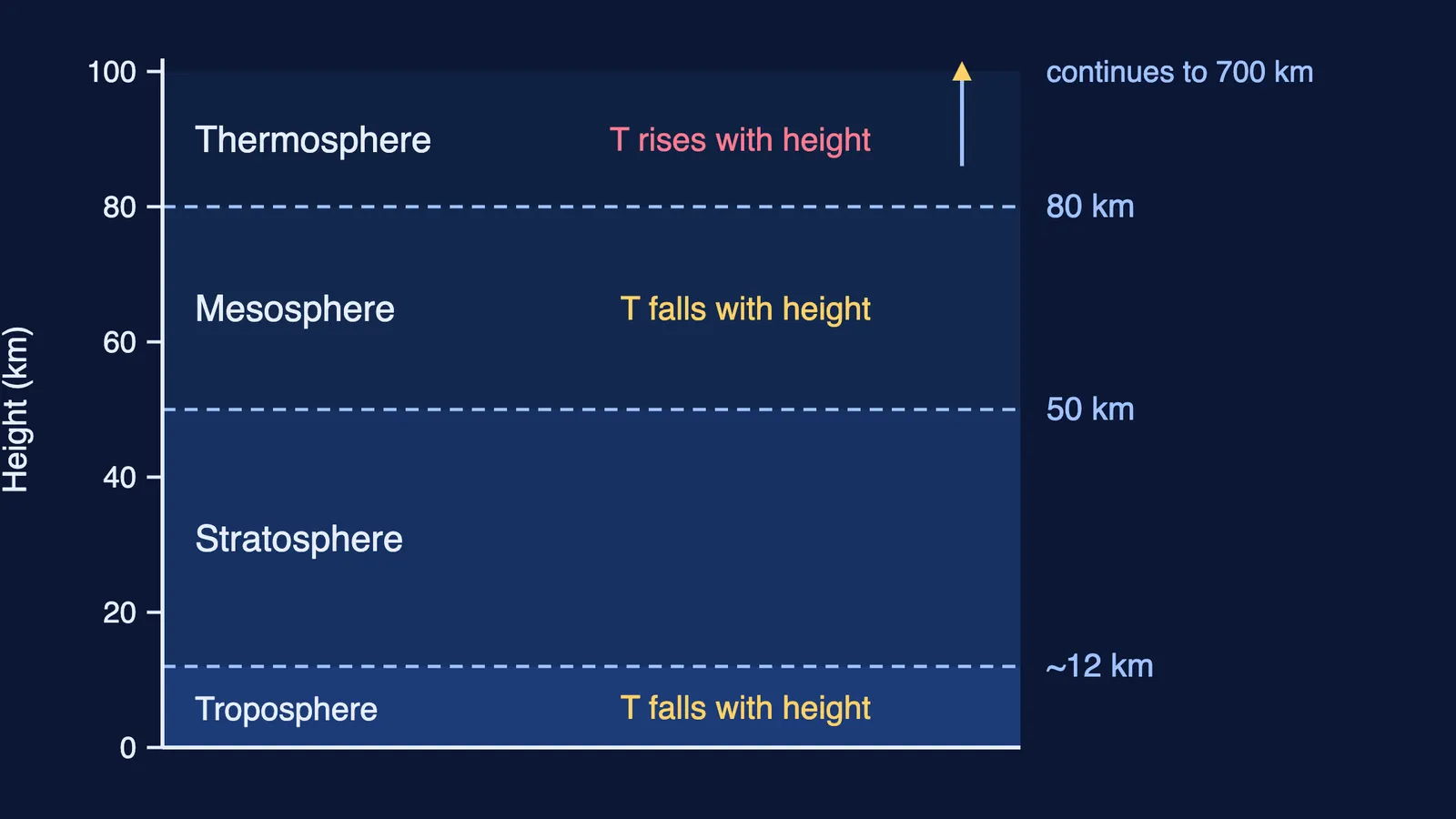
The book splits the atmosphere into five layers by how temperature and density change with height. Use these heights from the NCERT chapter in your answers.
Troposphere, from the ground to about 12 km on average. Almost all weather, clouds and the air we breathe are here, and it cools as you climb. Its top is the tropopause.
Stratosphere, up to about 50 km. It holds the ozone layer, which filters harmful ultraviolet light, and its calm, cloud-free air suits aeroplanes. Its top is the stratopause.
Mesosphere, up to about 80 km. Temperature falls with height again, and most meteors burn up here.
Thermosphere, from 80 km to about 700 km. Temperature rises fast because gases absorb X-rays and short-wave ultraviolet from the Sun. It holds the ionosphere, bounces radio waves back to Earth and hosts auroras.
Exosphere, the outermost layer, with very thin air from which light gases such as hydrogen and helium escape to space.
The 12 km figure is an average. The US weather agency NOAA notes that the troposphere reaches about 18 to 20 km over the equator but only about 6 km over the poles (NOAA JetStream). Other sources give slightly different upper heights; in the exam, use the textbook's.
How is weather different from climate?
Weather is the condition of the air hour to hour and day to day. Climate is the long-term average of that weather over a large area, which the chapter says is usually taken over thirty years or more. Both are described by five elements: temperature, humidity, precipitation, air pressure and wind.
Learn the chain that links them as one sentence: warm air rises and leaves low pressure behind, cool air sinks and makes high pressure, and air flows from high to low pressure as wind. Sea and land breezes are this chain in miniature. If pressure and moving air are hard to picture, the Fermi Simulation Lab has interactive simulations for the ideas that are easier to see than to read. For how the Sun heats land and air, see our guide to Earth as a System in Class 9 science.
How does the monsoon work?
The NCERT chapter describes the south-west (summer) monsoon as winds from the sea between June and September: land heats faster than the ocean, low pressure forms over the subcontinent, and moist ocean air moves in and brings most of India's rain. From October to February the pattern flips. Land cools faster, high pressure sits over land, and dry north-east winds blow out to sea. Over the Bay of Bengal they gather moisture and bring winter rain to Tamil Nadu, Andhra Pradesh and parts of Karnataka. The word comes from the Arabic *mausim*, season.
Rain does not fall every day of the season; read what a break in monsoon is and how to spot one.
Which mistakes cost marks in this chapter?
Writing that temperature falls in every layer. It falls with height only in the troposphere and the mesosphere.
Mixing up weather (today) and climate (decades).
Saying wind blows from low to high pressure. It is always high to low, and winds are named for where they come from: a westerly blows from the west.
Drawing layers with no heights. Label the chapter's 12, 50, 80 and 700 km on your sketch.
How should you prepare for CBSE 2026-27?
The CBSE Class IX Social Science curriculum for 2026-27 gives this theme 7 teaching hours and asks you to explain the layers using sketches and diagrams, analyse local winds, understand how the monsoon shapes life and farming, explain climate change, and show climate data as graphs or charts. The same document says the full course structure will be provided later, so chapter-wise marks are not yet published.
A four-day plan:
Day 1: draw the layer diagram from memory with all four heights, then the composition pie.
Day 2: write the pressure-to-wind chain, then draw sea breeze, land breeze and both monsoons with arrows.
Day 3: log your local weather for a week and plot temperature as a line graph.
Day 4: list five habits that add to your carbon footprint and one change for each.
Then check yourself with our 20-minute Sunday study review.