On this page
This chapter stops feeling like a list of names once you sort it by who, where, what they rejected, how they organised, and how we know.
What does CBSE ask from Bhakti-Sufi Traditions in 2026-27?
In the CBSE History curriculum for 2026-27, Bhakti-Sufi Traditions: Changes in Religious Beliefs and Devotional Texts (c. eighth to eighteenth centuries) is Theme 6 of Themes in Indian History Part II.
The 25 marks for Part II are shared across Themes 5 to 8, so there is no separate figure for this chapter. Each part is set as 7 one-mark MCQs, 2 three-mark short answers, 1 eight-mark long answer and 1 four-mark source-based question, per the same document. The 2026-27 sample paper asks for 60 to 80 words in a short answer and 300 to 350 in a long one.
Who were the bhakti saints in this chapter?
The current NCERT chapter (Reprint 2026-27) draws one distinction first: saguna bhakti worships a deity with attributes, such as Shiva or Vishnu; nirguna bhakti worships an abstract, formless god.
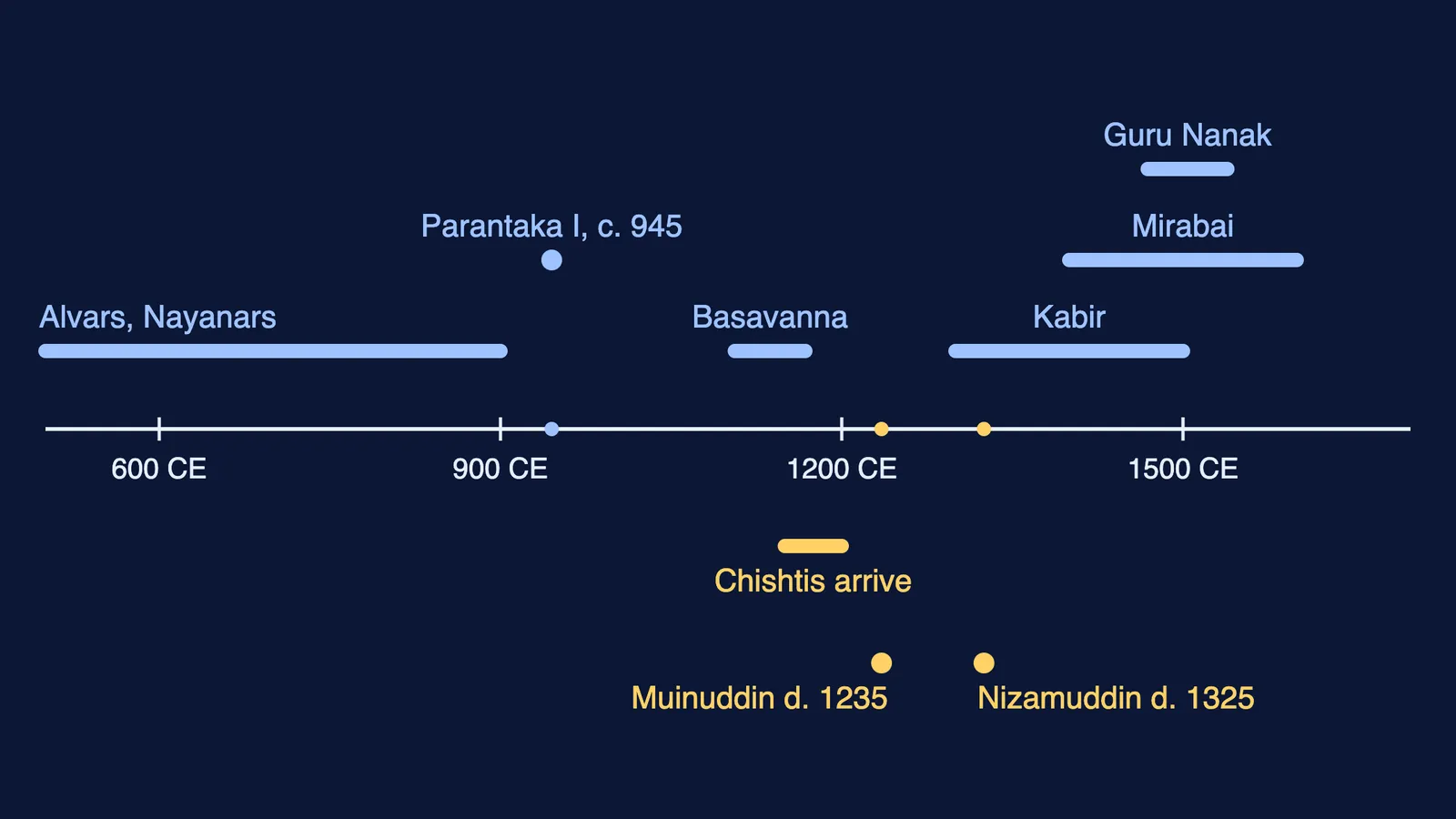
Alvars and Nayanars (Tamil Nadu, from c. sixth century). Alvars were devotees of Vishnu, Nayanars of Shiva. They sang Tamil hymns, came from many castes, and included women such as Andal and Karaikkal Ammaiyar. Their hymns were later collected in the Nalayira Divyaprabandham and the Tevaram.
Virashaivas or Lingayats (Karnataka, twelfth century). Led by Basavanna (1106-68), a minister at a Kalachuri court. They challenged caste and the idea of rebirth, buried their dead, and encouraged widow remarriage. We know them through Kannada vachanas.
Kabir (c. fourteenth-fifteenth centuries). A nirguna poet drawing on Islam, Vedanta and yoga. His verses survive in the Bijak, the Granthavali and the Adi Granth Sahib.
Guru Nanak (1469-1539). Rejected sacrifices, ritual baths and image worship, and taught remembering the Divine Name through Punjabi hymns called shabad. He set up congregational worship (sangat) and named Angad his successor.
Mirabai (c. fifteenth-sixteenth centuries). According to bhajans attributed to her, a Rajput princess from Merta, married into Mewar's Sisodia clan, who took Krishna as her lover.
How did the Chishti silsila work?
A silsila is a chain linking master and disciple back to the Prophet Muhammad, according to the NCERT chapter. The shaikh (or pir) lived in a hospice called a khanqah, took disciples and named a successor. After his death his tomb, the dargah, drew pilgrims, especially on his death anniversary, the urs.
Arriving in the late twelfth century, the Chishtis became the most influential sufi group by adapting to local traditions:
Shaikh Nizamuddin Auliya's khanqah in Delhi ran an open kitchen (langar) on unasked-for charity and welcomed everyone.
Music (sama') and qawwali were central; Amir Khusrau introduced the qaul, a hymn that opens or closes a qawwali.
They spoke Hindavi, and Baba Farid's verses entered the Guru Granth Sahib.
Muinuddin's dargah at Ajmer became the most revered; Akbar visited it fourteen times and kept the practice up until 1580.
How are bhakti and sufi traditions alike and different?
Language: both used the language of ordinary people, from Tamil and Kannada to Punjabi and Hindavi.
Ritual: Basavanna, Kabir and Guru Nanak questioned ritual; the Chishtis adopted sama' and local practices such as bowing before the shaikh.
Organisation: bhakti saints led communities of devotees, from Lingayats to Guru Nanak's sangat; sufis organised around khanqahs and silsilas.
Rulers: Chola rulers built Shiva temples, and around 945 Parantaka I consecrated images of three Nayanar saints in one; Sultans gave hospices tax-free land, which the Chishtis used rather than stored.
How we know: compositions compiled by followers long after the saint died, plus hagiographies that may not be literally accurate.
How do you answer source-based questions on this chapter?
The chapter's sources include a Nayanar's self-portrait, a Basavanna vachana on rituals, an Akbar farman about a church at Khambat, Jahanara's account of her 1643 pilgrimage to Ajmer, and a Chishti account of a refused land grant. A method for the three sub-parts:
Name the author, date and type of text (hymn, vachana, farman, biography).
Answer each sub-part in the source's terms, then add one point from the chapter.
More practice: our guide to history source-based questions.
Practice questions for Theme 6
(1 mark) The anthology of the Alvars' compositions is called: (a) Tevaram (b) Nalayira Divyaprabandham (c) Bijak (d) Adi Granth Sahib.
(3 marks) Give two Lingayat practices that the Dharmashastras disapproved of, and say why each mattered.
(3 marks) How did the Chishtis use the donations they received, and how did this affect the standing of the shaikhs?
(8 marks) Compare how Guru Nanak's sangat and a Chishti khanqah organised followers.
(4 marks) A Mughal princess records going barefoot from the doorway to a sufi shaikh's tomb. Name the practice, explain why tombs were thought special, and give one other sign of devotion.
Answer key for Q1: (b).
Revise it alongside other Part II themes: Vijayanagara and peasants, zamindars and the state. If you are not sure where to begin, Fermi's AI tutor works out what you already know and builds a plan for the session.