

On this page
This chapter asks one question: who got a share of the harvest in Mughal India, and how do we know? The answer runs through three groups, peasants, zamindars and the state, and one big source, the *Ain-i-Akbari*. Everything below is drawn from the NCERT chapter Peasants, Zamindars and the State (Themes in Indian History Part II), so you can check each line against your textbook. For a refresher, see our Class 7 notes on Mughal emperors, mansabdars and zabt and the Mughal rulers from Akbar to Aurangzeb.
What is the chapter Peasants, Zamindars and the State about?
It covers agrarian society in the sixteenth and seventeenth centuries. According to NCERT, about 85 per cent of India's population lived in villages in this period. Peasants and landed elites both claimed a share of the produce, and the Mughal state took the bulk of its income from agriculture.
Peasants did not write about themselves. What we know comes mainly from Mughal court chronicles, supplemented by seventeenth- and eighteenth-century revenue records from Gujarat, Maharashtra and Rajasthan and by East India Company records.
Who were the peasants and the zamindars?
Indo-Persian sources called a peasant *raiyat* (plural *riaya*) or *muzarian*; the words *kisan* and *asami* also appear. Seventeenth-century sources describe two kinds:
Khud-kashta: peasants who lived in the village where they held land.
Pahi-kashta: non-resident cultivators who farmed land elsewhere on contract, by choice (better revenue terms) or by compulsion (distress after a famine).
Holdings were small. The NCERT chapter notes that in Gujarat a peasant with about six acres was considered affluent, while in Bengal five acres was the upper limit of an average farm.
Zamindars were landed proprietors who lived off agriculture but did not farm themselves. Their power came from personal lands (*milkiyat*) they could sell, bequeath or mortgage, from collecting revenue for the state, and from forts (*qilachas*) and armed men. The Ain put the zamindars' combined strength at 384,558 cavalry and 4,277,057 infantry, as quoted in the NCERT chapter. NCERT calls them exploitative but notes reciprocity: in many seventeenth-century uprisings in north India, peasants backed zamindars against the state.
How did the Mughal state collect land revenue?
*Jama* was the amount assessed; *hasil* was the amount actually collected. Akbar told the revenue collector (*amil-guzar*) to prefer cash but keep payment in kind open, through methods such as *kankut* (estimating the crop) and *batai* (dividing the reaped crop).
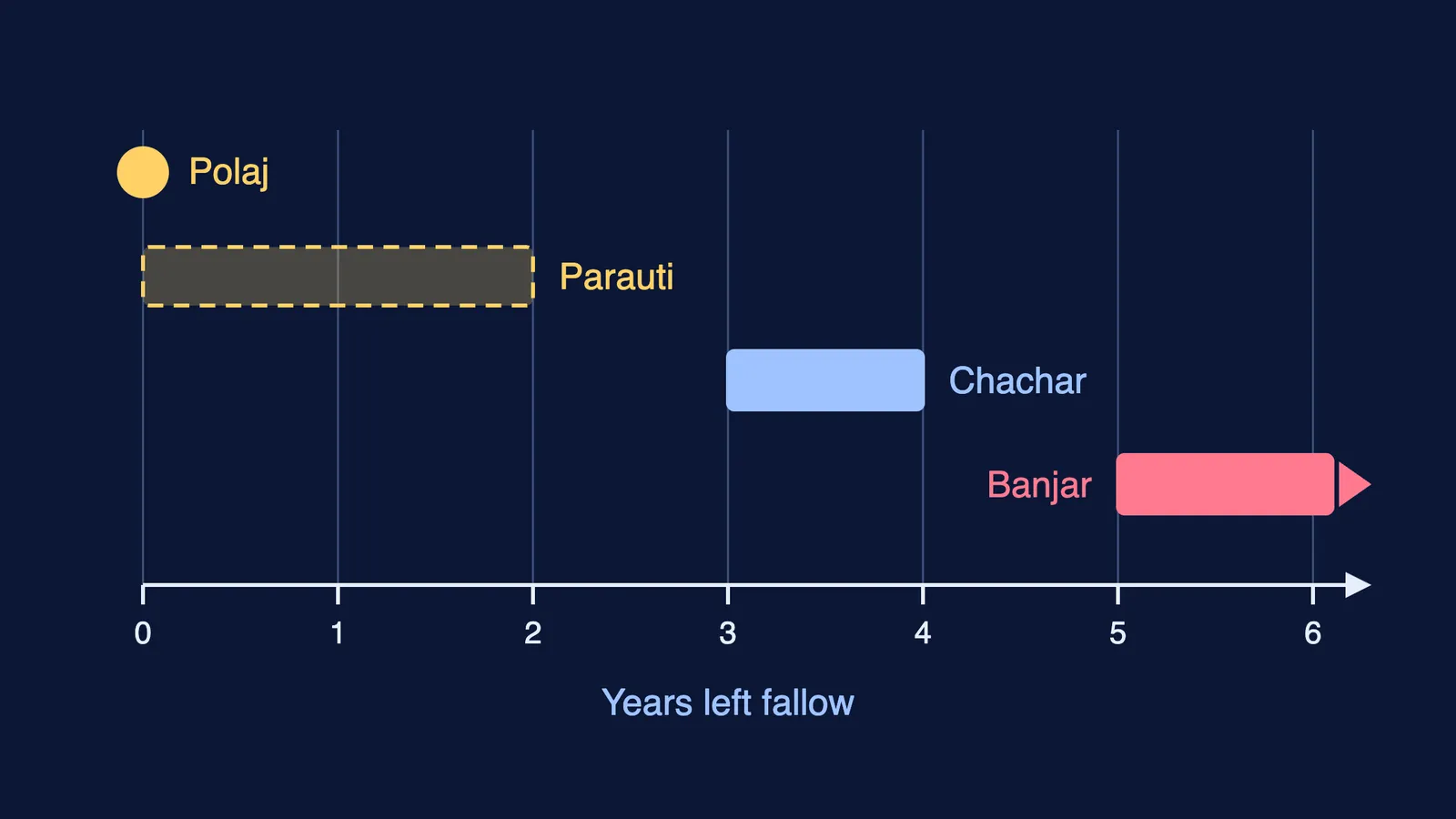
The Ain classified land by how long it lay fallow, as quoted in the NCERT chapter:
*Polaj*: cultivated every year, never left fallow.
*Parauti*: left fallow for a time to recover.
*Chachar*: fallow for three or four years.
*Banjar*: uncultivated for five years or more.
For polaj and parauti, land was graded good, middling and bad. The produce of the three grades was added, a third of that total was taken as the medium produce, and one-third of the medium produce was the royal due.
Worked example. Suppose (made-up numbers, for practice only) one bigha yields 18 maunds of wheat on good land, 12 on middling and 6 on bad. Add them: 36 maunds. A third of 36 is 12 maunds, the medium produce. One-third of 12 is 4 maunds per bigha, the state's share. Writing the rule out like this shows you understand it, not just the four names.
Why is the Ain-i-Akbari an important source, and what are its limits?
The NCERT chapter states that Abu'l Fazl completed the *Ain-i-Akbari* in 1598, Akbar's forty-second regnal year, after five revisions. It is the third book of the *Akbar Nama* and has five books (*daftars*) of its own:
*Manzil-abadi*: the imperial household.
*Sipah-abadi*: military and civil administration.
*Mulk-abadi*: revenue rates and the "Account of the Twelve Provinces", with tables of measured area, revenue and zamindars' castes and troops.
Books four and five: religious, literary and cultural traditions.
Its limits matter too. The Ain is a view from the top that presents Akbar's empire as harmonious. Historians have found totalling errors, though NCERT calls them generally minor. Caste details of zamindars are missing for Bengal and Orissa, and prices and wages come mostly from around Agra.
How do you answer a source-based question on this chapter?
Use this five-step check on any extract:
Who wrote it, and for whom? Abu'l Fazl wrote for Akbar; Babur wrote memoirs.
What does it describe? Name the system: land classes, cash or kind, jama.
One term, one definition. Polaj, pahi-kashta, milkiyat, hasil.
What can it not tell us? Peasants' own view, regions far from Agra.
What fills the gap? Gujarat, Maharashtra and Rajasthan revenue records; Company records.
Revise the chapter as pairs: khud-kashta and pahi-kashta, jama and hasil, the Ain's strengths and its limits.
If you are not sure where to begin revising, Fermi's AI tutor can work out what you already know and build a plan for the session. To link causes and effects across this chapter, try our guide to making a cause-and-effect chart for a history chapter.


