

On this page
The Mughals is the chapter where Class 7 history moves from kings to systems. Dates earn a few marks; the longer questions ask how the empire ran. These notes follow the NCERT chapter The Mughals (16th to 17th century) from the Class 7 book Our Pasts II, and end with a model answer and a three-day plan.
In April 2025, Outlook reported that NCERT had removed the Mughals and the Delhi Sultanate from the new Class 7 social science book, with its second part still to come. Unsure what was dropped from your book? See how to check the deleted NCERT syllabus.
Who were the six great Mughal emperors, in order?
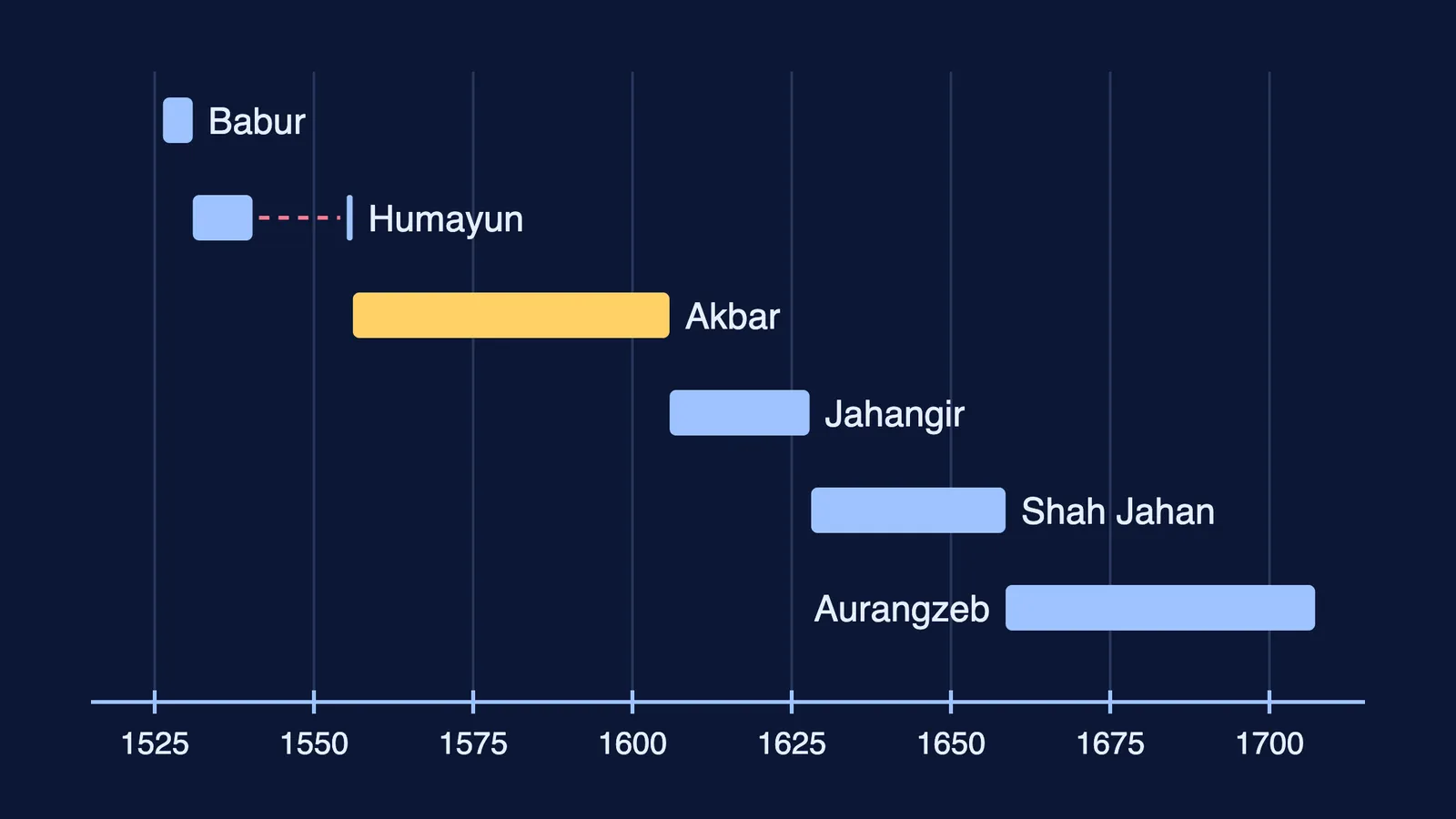
NCERT calls Babur "the first Mughal emperor (1526-1530)" and says that in 1526 he defeated Ibrahim Lodi, the Sultan of Delhi, at Panipat and captured Delhi and Agra (NCERT Class 7, The Mughals). The reign years below come from the Wikipedia article on the Mughal Empire:
Babur: 1526-1530
Humayun: 1530-1540, then 1555-1556, with a 15-year gap between
Akbar: 1556-1605
Jahangir: 1605-1627
Shah Jahan: 1628-1658
Aurangzeb: 1658-1707
To remember the order: Big Hungry Ants Jump Sideways Always.
What were mansabdars and jagirdars?
A mansabdar was "an individual who holds a mansab, meaning a position or rank", according to NCERT. The mansab fixed rank, salary and military responsibilities.
Zat: a number that set rank and salary. The higher the zat, the more prestigious the noble's position at court and the larger his salary.
Sawar: the number of cavalrymen a mansabdar had to maintain. He brought them for review, got them registered, had their horses branded, and then received money to pay them.
Jagir: the revenue assignment that paid his salary. Most mansabdars did not live in or govern their jagirs; servants collected the revenue while they served elsewhere.
From about 1595 a mansab was written as two numbers, such as 2,500 zat and 1,000 sawar, says the Wikipedia article on mansabdars.
Numbers worth a mark, from the NCERT chapter: Akbar had 29 mansabdars with a zat of 5,000; by Aurangzeb's reign there were 79. In Shah Jahan's twentieth year, the 445 highest-ranking mansabdars, 5.6 per cent of 8,000, received 61.5 per cent of the empire's estimated revenue as salaries for themselves and their troopers.
Why did the jagir system run into trouble?
Under Akbar, a jagir's revenue roughly equalled the mansabdar's salary. By Aurangzeb's reign, NCERT says, the revenue collected was often less than the granted sum, mansabdars had multiplied, and men waited a long time for a jagir. Many jagirdars then extracted as much revenue as they could while they held one, and the peasantry suffered.
What was zabt, and who were the zamindars?
Zabt was Akbar's revenue system in which tax was fixed in cash on each crop, based on his revenue minister Todar Mal's survey of crop yields, prices and areas cultivated from 1570 to 1580 (NCERT). Each province had revenue circles with their own rates. Zabt worked only where officials could survey land and keep careful accounts, which was not possible in Gujarat and Bengal. Zamindar was the one term the Mughals used for every intermediary, from a village headman to a powerful chieftain.
What were Akbar's main policies?
Sulh-i kul, "universal peace": Jahangir wrote that under his father "the road to intolerance was closed" (NCERT).
Rajput alliances: many Rajputs married daughters into Mughal families and received high positions; the defeated Sisodiyas of Mewar got their lands back as watan jagir.
Records: Abul Fazl wrote the three-volume Akbar Nama; its third volume, the Ain-i Akbari, records crops, yields, prices, wages and revenues.
Debates: the Ibadat Khana was created at Fatehpur Sikri in 1575 (Wikipedia).
How do you answer "mansabdar and jagir" in an exam?
NCERT's question 4 asks for the relationship between the mansabdar and the jagir. A five-point answer:
A mansabdar held a mansab, a rank in Mughal service.
His zat fixed his rank and salary.
His sawar fixed the cavalrymen he had to keep.
He was paid through a jagir, an assignment of land revenue collected by his servants.
Under Akbar jagir revenue matched the salary; under Aurangzeb jagirs ran short and peasants suffered.
A three-day plan:
Day 1: draw the six-emperor timeline from memory, then check it.
Day 2: write one card each for mansab, zat, sawar, jagir, zabt, zamindar and sulh-i kul.
Day 3: say the answer above aloud in two minutes, then turn the jagir crisis into a cause-and-effect chart for a history chapter.
For buildings and a wider overview, read our Mughal empire Class 7 summary. When your science chapters are next, Fermi's AI tutor can work out what you already know and build a plan for the session.


