On this page
Zinc is in every brass lamp, yet it was one of the last major metals people learned to make. Among the first places to make it on an industrial scale was Zawar, in the Aravalli hills near Udaipur, and its smelters did it by turning the retorts upside down.
Why is zinc so hard to extract?
Most metals can be smelted in an open furnace: heat the ore with charcoal and molten metal collects at the bottom. Zinc refuses. As the British Museum archaeologist Paul Craddock explains in a 2018 review in the Indian Journal of History of Science, smelting zinc ore in a conventional furnace gives not a molten ingot but "a cloud of highly reactive vapour above the furnace".
Two temperatures from the same review explain why. Zinc becomes a vapour above 907 °C. The Zawar retorts were fired at a maximum of about 1,100 °C, roughly 200 degrees hotter, so when carbon monoxide from the charcoal strips the oxygen from zinc oxide, the zinc comes off as a gas.
Worse, hot zinc vapour that meets air burns straight back into white zinc oxide. A zinc smelter must keep air out, catch a gas, and cool it into metal before it reoxidises. The modern version of this chemistry is in our explainer on extracting zinc from zinc blende.
How did the Zawar retorts work?
Craddock's review reconstructs the process from the excavated remains:
The ore was sphalerite, zinc sulphide. It was roasted first to drive off the sulphur, and mounds of white roasting debris still surround the smelting areas.
The roasted ore was made into small balls with a sticky organic binder, very likely cow dung, plus charcoal and a little salt, and packed into a clay retort.
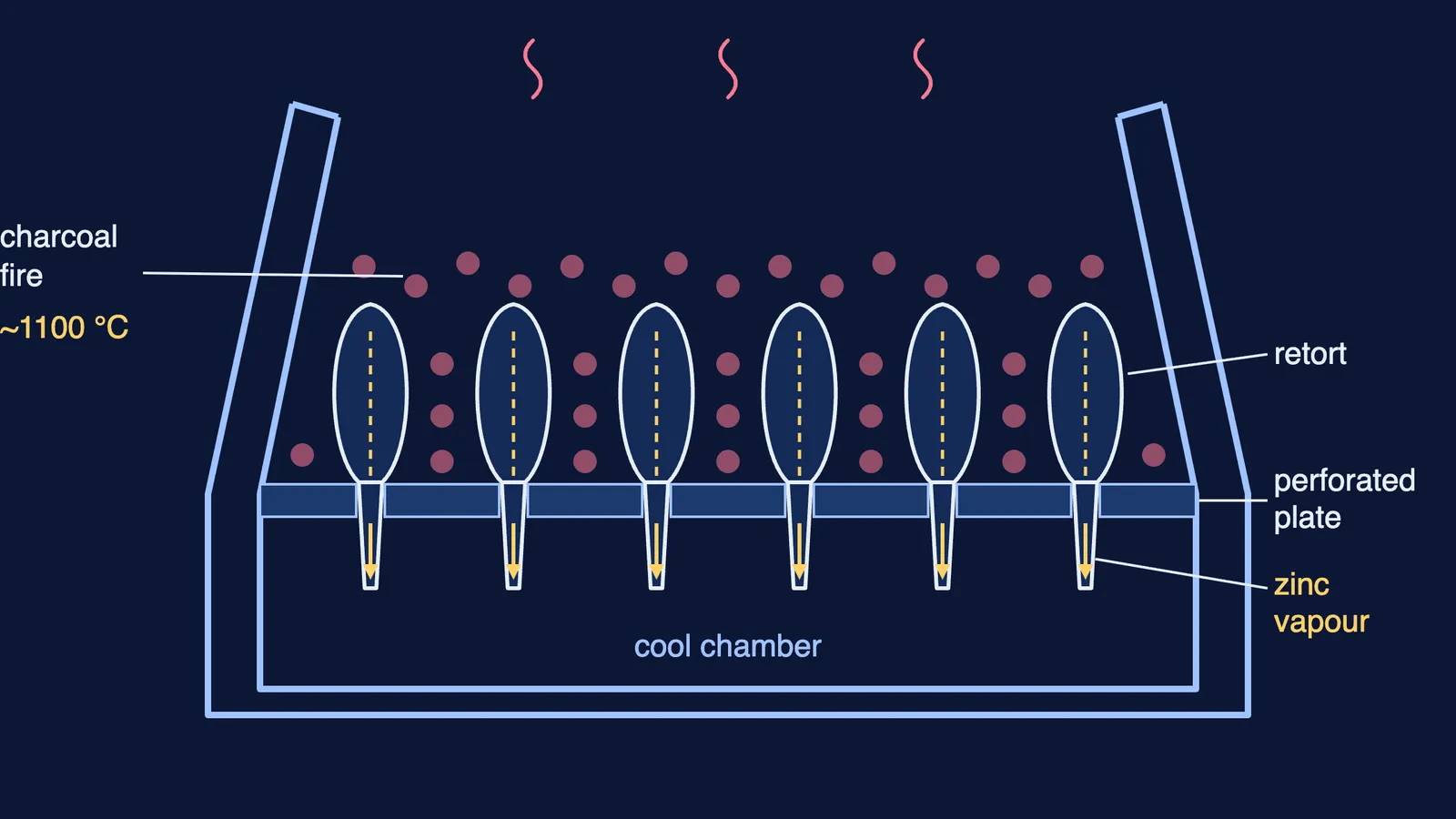
A conical clay condenser was sealed onto the open end. A stick pushed through it held the charge in place and, once it charred away, left a central channel for the vapour.
The retorts were stood upside down in a six-by-six grid, 36 to a furnace, with their condensers sitting in holes in perforated bricks and their tips poking into a cool chamber underneath.
The retorts were heated from the upper chamber. At the peak of about 1,100 °C a smelt took an estimated three to five hours, and the whole process about 24 hours.
Why upside down? With the fire above, the chamber below stayed cool. Zinc vapour flowed down the condenser and condensed there, sealed from the air. A late medieval Sanskrit text, the Rasaratna Samuccaya, calls this tiryakpatana yantram, distillation by descending. It describes a retort shaped like a brinjal, and some of its recipes have the neck pointing down, as at Zawar.
What did archaeologists find at Zawar?
Craddock's review illustrates a furnace still holding its last load of retorts, a retort broken in half to show the vapour channel, and a perforated plate, one of four per furnace. The furnaces were built in blocks: seven to a block in the 14th to 16th centuries and three to a block from the 16th to the 19th. A typical block held 252 retorts fired together and would have produced between 50 and 100 kg of zinc per smelt, by Craddock's estimate.
The start date is less certain: Zawar was still making zinc oxide in the 7th century, and a single early radiocarbon date suggests commercial zinc production began about a hundred years later. Industrial production ran from the 14th to the 18th century. It was curtailed by the Mughal wars, much reduced afterwards, possibly because cheaper Chinese zinc was reaching Indian ports, disrupted again by the Marathas, and had stopped by 1812, as James Tod recorded.
China's industry came later, with a completely different design. The same review describes excavated production units in Chongqing, dated to the 16th century, where zinc vapour rose and condensed inside the top of the retort itself.
How do you explain downward distillation in an exam answer?
Start with a quick worked example using the numbers from Craddock's review. A block of seven furnaces held 7 × 36 = 252 retorts and yielded 50 to 100 kg per smelt. 50,000 g ÷ 252 is about 200 g, and 100,000 g ÷ 252 is about 400 g. So each retort gave only about 200 to 400 g per firing.
Then build the answer in four lines:
Problem: at smelting heat (about 1,100 °C at Zawar) zinc, which boils at 907 °C, leaves the charge as vapour.
Risk: the vapour reoxidises to zinc oxide the moment it meets air.
Fix: a sealed retort and condenser, heat above, cool chamber below.
Evidence: Zawar's furnaces, 36 inverted retorts each, fired to about 1,100 °C.
The same reasoning decides how metals are purified; our guide to liquation, poling and distillation sets out which metal gets which. If the link between boiling point and extraction still feels shaky, the Fermi Concept Library has a lesson for every concept in chemistry, each with its place in the map.
For another piece of Indian metallurgy that chemistry explains, read why the Delhi iron pillar doesn't rust.