On this page
Zinc blende is zinc sulphide, ZnS. Extracting zinc from it takes four steps: concentrate the ore, roast it to zinc oxide, reduce the oxide with coke, then refine the crude metal. The part students often miss: in the furnace, zinc comes off as a gas, not a liquid.
What are the steps in the extraction of zinc from zinc blende?
Concentration by froth flotation. The ore is powdered and stirred into water with collectors and froth stabilisers, as BYJU'S explainer on zinc extraction describes. The sulphide particles rise with the froth and the gangue is left behind. For mixed ores, see how NaCN separates ZnS from PbS in froth flotation.
Roasting. The concentrate is heated strongly in excess air: 2ZnS + 3O₂ → 2ZnO + 2SO₂. The NCERT Class 10 chapter on metals and non-metals gives this equation and the reason for the step: it is easier to obtain a metal from its oxide than from its sulphide.
Reduction with coke. The zinc oxide is mixed with coke and heated: ZnO + C → Zn + CO, the reaction NCERT gives for zinc oxide heated with carbon.
Refining. NCERT lists zinc among the metals refined electrolytically.
Why roast instead of calcine? Calcination means heating in limited air and suits carbonate ores such as ZnCO₃. Roasting, in excess air, is for sulphides, because oxygen must carry the sulphur away as SO₂.
Why is ZnO reduced at 1673 K?
The usual textbook figure is 1673 K, which is 1400 °C. The BYJU'S zinc extraction page gives it as the temperature at which zinc oxide and coke are heated together in fire-clay containers.
The reaction also absorbs a lot of heat. A 2015 paper in *JOM* by Tzouganatos and colleagues (doi:10.1007/s11837-015-1356-1) describes ZnO(s) + C(s) = Zn(g) + CO as a highly endothermic reaction, with ΔH° of 239.9 kJ mol⁻¹ at 298 K.
The Ellingham diagram explains the number: carbon can pull oxygen away from zinc only at high temperatures. Our guide to reading an Ellingham diagram shows how to find where two lines cross.
Why is zinc collected as vapour?
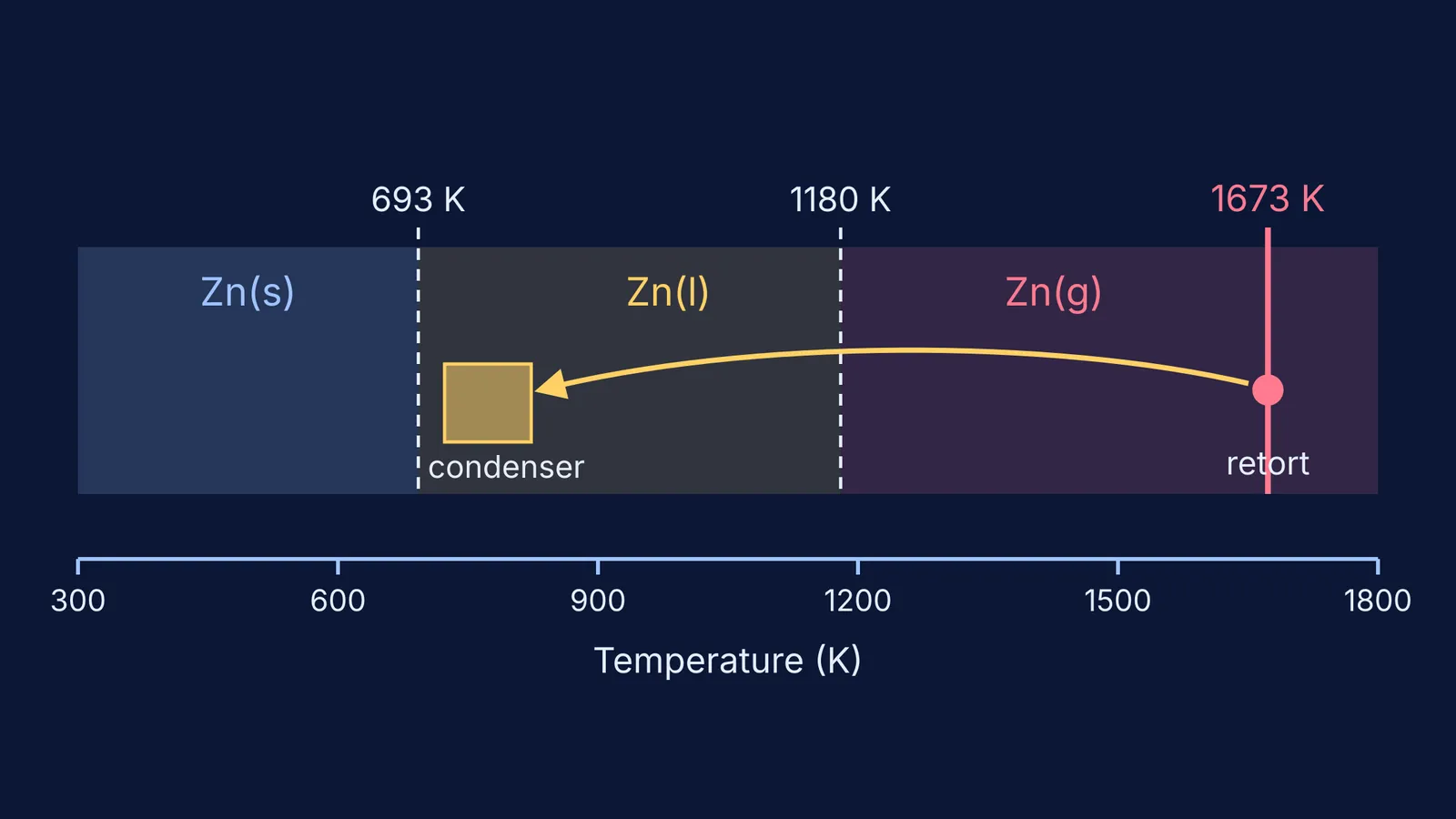
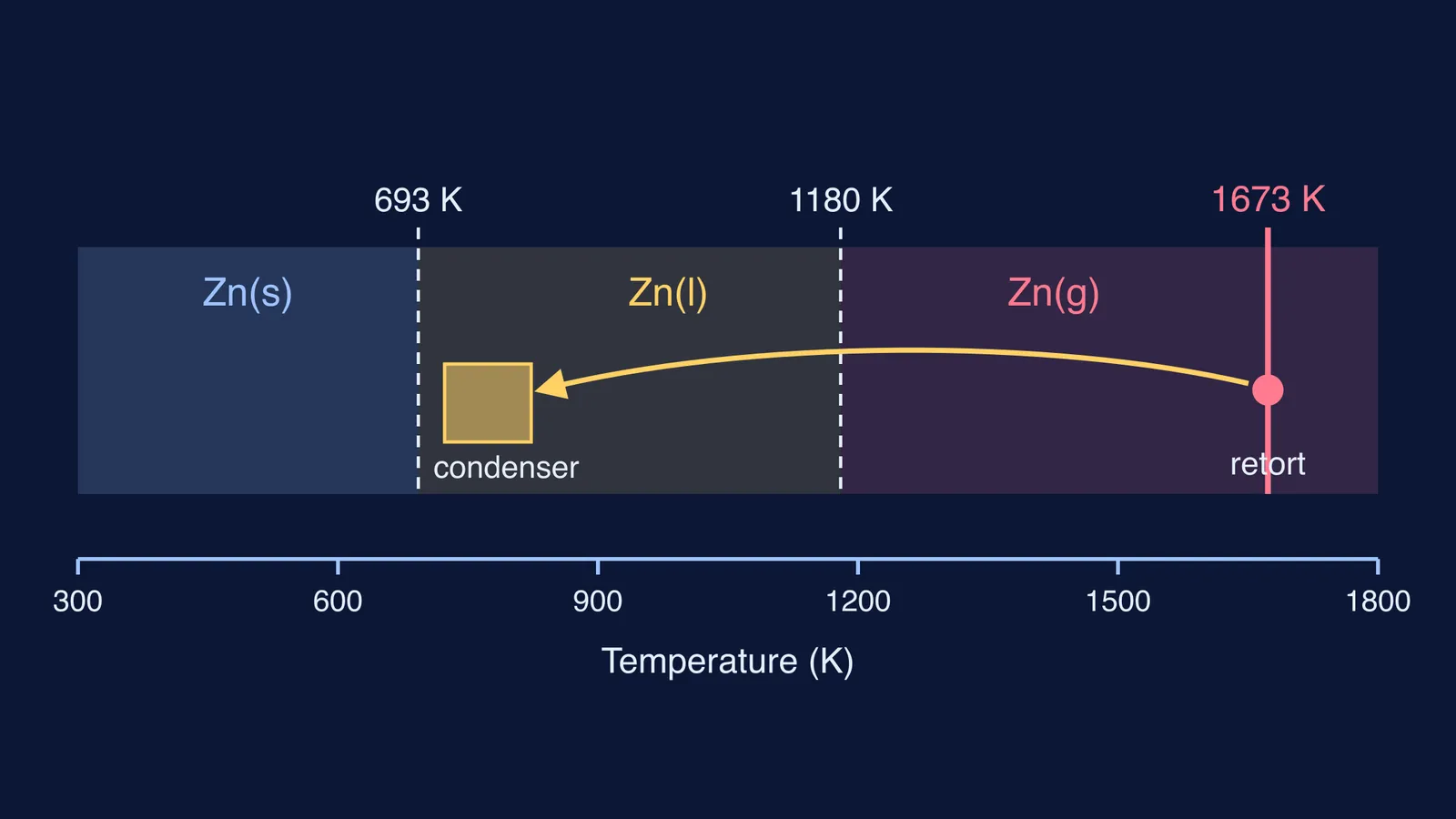
Zinc boils at 1180 K and melts at 692.68 K, according to the PubChem periodic table data.
So at 1673 K the furnace is about 490 K above zinc's boiling point. The metal is a gas the moment it forms. BYJU'S puts it this way: the zinc "immediately vaporises and distils over", leaving behind impurities such as lead and iron.
That vapour is fragile. The JOM paper explains that because process temperatures "far exceed its boiling point (1180 K)", zinc is produced as vapour and "has to be rapidly condensed" to stop it reacting back: Zn(g) + CO₂ = ZnO(s) + CO. A US patent on quenching zinc vapour from a zinc oxide–char process (US4382915A) describes what goes wrong otherwise: zinc oxide coats the zinc droplets and settles as "blue powder" in the collection chambers.
In the conventional Imperial Smelting Process, the JOM authors write, zinc vapour is caught in a spray of molten lead droplets in a splash condenser. The zinc then separates from the lead as the alloy cools from 550 °C to 450 °C.
India has a long history here. Xiao and colleagues, writing in *Materials* in 2021 (doi:10.3390/ma14082087), cite archaeological evidence that metallic zinc was distilled and condensed in specially designed retorts about 1000 years ago at Zawar, in north-west India.
Worked example: one tonne of pure zinc blende
Molar masses from the PubChem periodic table: Zn 65.4, S 32.07, O 15.999, C 12.011 g mol⁻¹. So ZnS = 97.47, ZnO = 81.40, SO₂ = 64.07 and CO = 28.01.
Moles of ZnS in 1000 kg: 1000 ÷ 97.47 = 10.26 kmol.
Roasting gives 10.26 kmol ZnO = 835 kg, and 10.26 kmol SO₂ = 657 kg.
Reduction (ZnO + C → Zn + CO) needs at least 10.26 kmol C = 123 kg of carbon.
It yields 10.26 kmol Zn = 671 kg, plus 287 kg of CO.
Check: 835 + 123 = 958 kg in, and 671 + 287 = 958 kg out.
So pure zinc blende is about 67% zinc by mass, and every tonne roasted sends about 657 kg of SO₂ into the gas stream. Real ores are never pure, so 671 kg is a ceiling.
How should you revise this for exams?
Learn the chain as cause and effect, not as a list: sulphide → oxide (easier to reduce) → high temperature (Ellingham) → vapour (boiling point) → rapid chilling (re-oxidation). Copper from copper pyrites takes a different route; compare it with our post on how self-reduction extracts copper.
If the mole arithmetic in the worked example is where you slip, the Fermi Problem Library has worked problems with a step-by-step solver that explains the reasoning rather than printing an answer. If roasting or Ellingham lines still feel hazy, the Fermi Concept Library gives each chemistry concept its own lesson and its place in the map.
Try it now: write the four steps and their equations from memory, then check them against the list above.