On this page
Refining is the last step of extraction. You already have a crude metal, and the job is to remove what is left in it. The NIOS senior secondary chemistry lesson on occurrence and extraction of metals lists four kinds of impurity: other metals, unreduced oxide of the metal, non-metals such as carbon, silicon, phosphorus and sulphur, and flux or slag.
Each classic refining method works because of one property of the metal. Learn the property and you will not need to memorise the pairings. If you want the earlier stages first, our guide to how metals are extracted from their ores covers concentration, roasting and reduction.
Which metals are refined by liquation, poling and distillation?
Here is the textbook matching from the NIOS lesson, with the property that makes each method work.
Liquation: tin (and lead). Property: a low melting point.
Poling: copper (and tin). Property: the impurity is the metal's own oxide, which can be reduced back to metal.
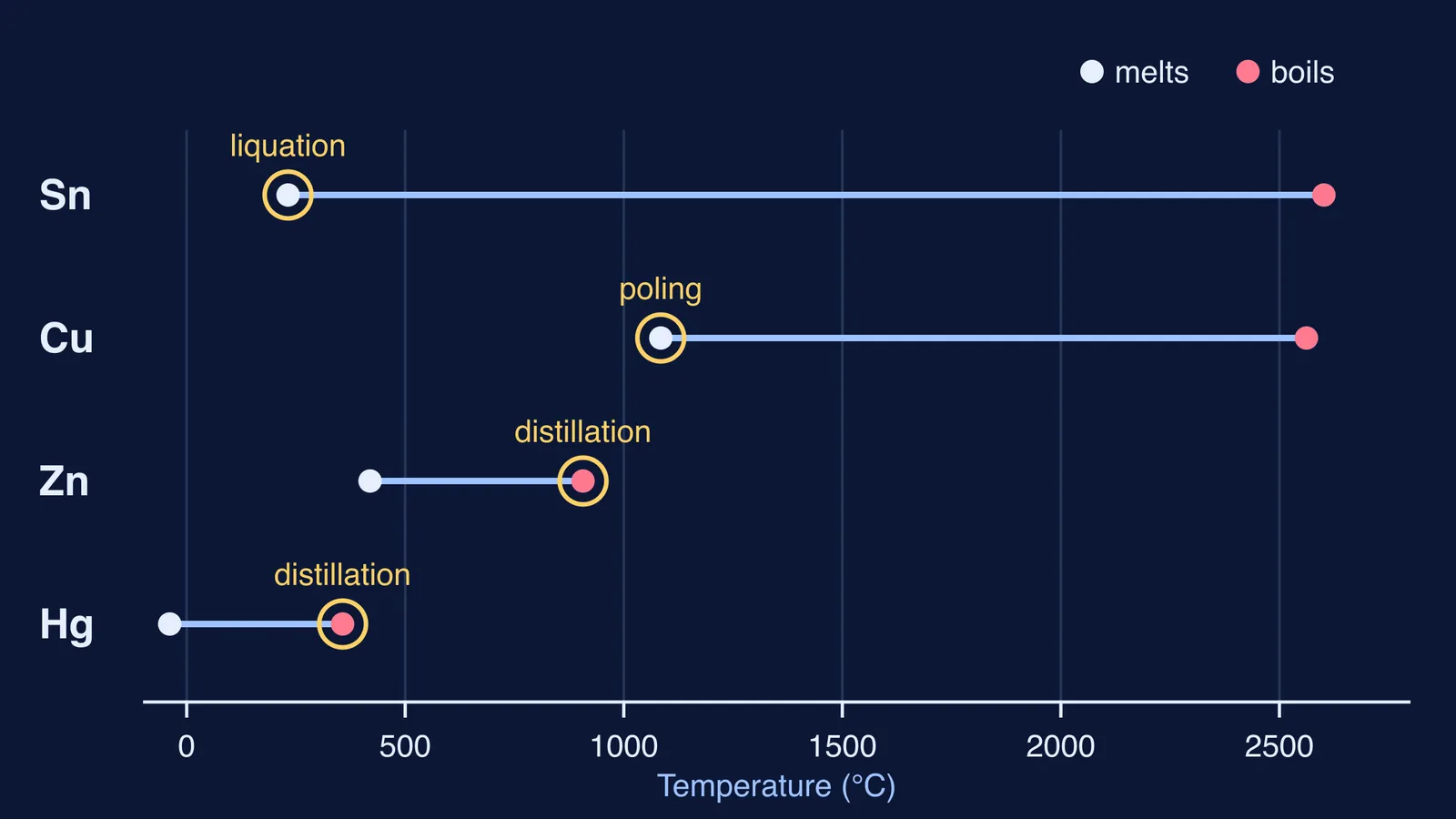
Distillation: zinc and mercury. Property: volatility. The metal boils far below its impurities.
Why is tin refined by liquation?
In liquation, the impure metal is placed on the sloping hearth of a reverberatory furnace and heated slowly to a little above its melting point, so the pure metal drains out and leaves infusible impurities behind (NIOS).
Tin melts at 231.93 °C, according to PubChem's periodic table data. Copper melts at 1084.62 °C and iron at about 1538 °C, from the same source. Keep the hearth just above 232 °C and the tin runs downhill as a liquid, while impurities with higher melting points stay behind as solid lumps. Lead, the other metal NIOS names, melts at 327.46 °C (PubChem), which is also low.
The test for liquation: the metal must melt at a far lower temperature than its impurities.
How does poling purify copper?
Copper made by self-reduction is called blister copper, because escaping sulphur dioxide leaves blisters on its surface (NIOS). Poling means stirring the impure molten metal with green logs or bamboo, and the hydrocarbons in the wood reduce any metal oxide present as an impurity (same NIOS lesson).
Wikipedia's article on poling fills in the details: the impure copper, usually molten blister copper, contains copper oxide, and the heat of the copper makes the pole give off wood gas, which reduces cuprous oxide back to copper. The name comes from those green-wood poles; modern furnaces normally use natural gas or diesel instead.
So the property here is chemical, not thermal. The main impurity is the metal's own oxide, and a reducing agent turns it back into metal. The copper must be molten for this, which means above 1084.62 °C (PubChem). NIOS also uses blister copper as its example of electrolytic refining, which we explain step by step in how electrolytic refining of copper works.
Why are zinc and mercury purified by distillation?
NIOS states that volatile metals like zinc and mercury are purified by distillation: the pure metal distils over and the non-volatile impurities are left behind (NIOS).
Mercury boils at 356.73 °C and zinc at about 907 °C, according to PubChem. Copper boils at about 2562 °C and tin at about 2602 °C (same source). Heat crude zinc a little above 907 °C and zinc vapour rises while copper or iron stays in the vessel, and the condensed vapour is purer zinc.
The test for distillation: the metal has a boiling point you can reach, and its impurities boil far higher.
How do you pick the refining method in an exam question?
Run these checks on whichever metal the question names.
Is the metal volatile, with non-volatile impurities? Distil it (zinc, mercury).
Does it melt at a low temperature while its impurities stay solid? Liquate it (tin, lead).
Is the main impurity the metal's own oxide? Pole it (copper, tin).
None of these? Think about electrolytic refining, zone refining or vapour-phase refining.
Worked example. Question: crude tin contains iron and some tin oxide. Which two methods would clean it, and why?
Iron melts at about 1538 °C and tin at 231.93 °C (PubChem), so liquation runs the tin off and leaves the iron as a solid.
Tin oxide is the metal's own oxide, so poling the molten tin reduces it back to tin.
Answer: liquation for the iron, poling for the oxide.
When a question asks for very high purity, as for semiconductors, the answer moves on to a different idea. Our story on William Pfann and zone refining explains how it works.
If the gap is in the ideas underneath, such as oxidation and reduction or why boiling points differ, the Fermi Concept Library has every concept in chemistry, each with its own lesson and its place in the map. To practise, the Fermi Problem Library has worked problems with a step-by-step solver that explains the reasoning rather than printing an answer.