

On this page
"In the earliest cities" means the Harappan civilisation, the first cities of the Indian Subcontinent. The current NCERT Class 6 book, Exploring Society: India and Beyond, covers it in Chapter 6, "The Beginnings of Indian Civilisation" (NCERT chapter PDF).
When and where were the earliest cities built?
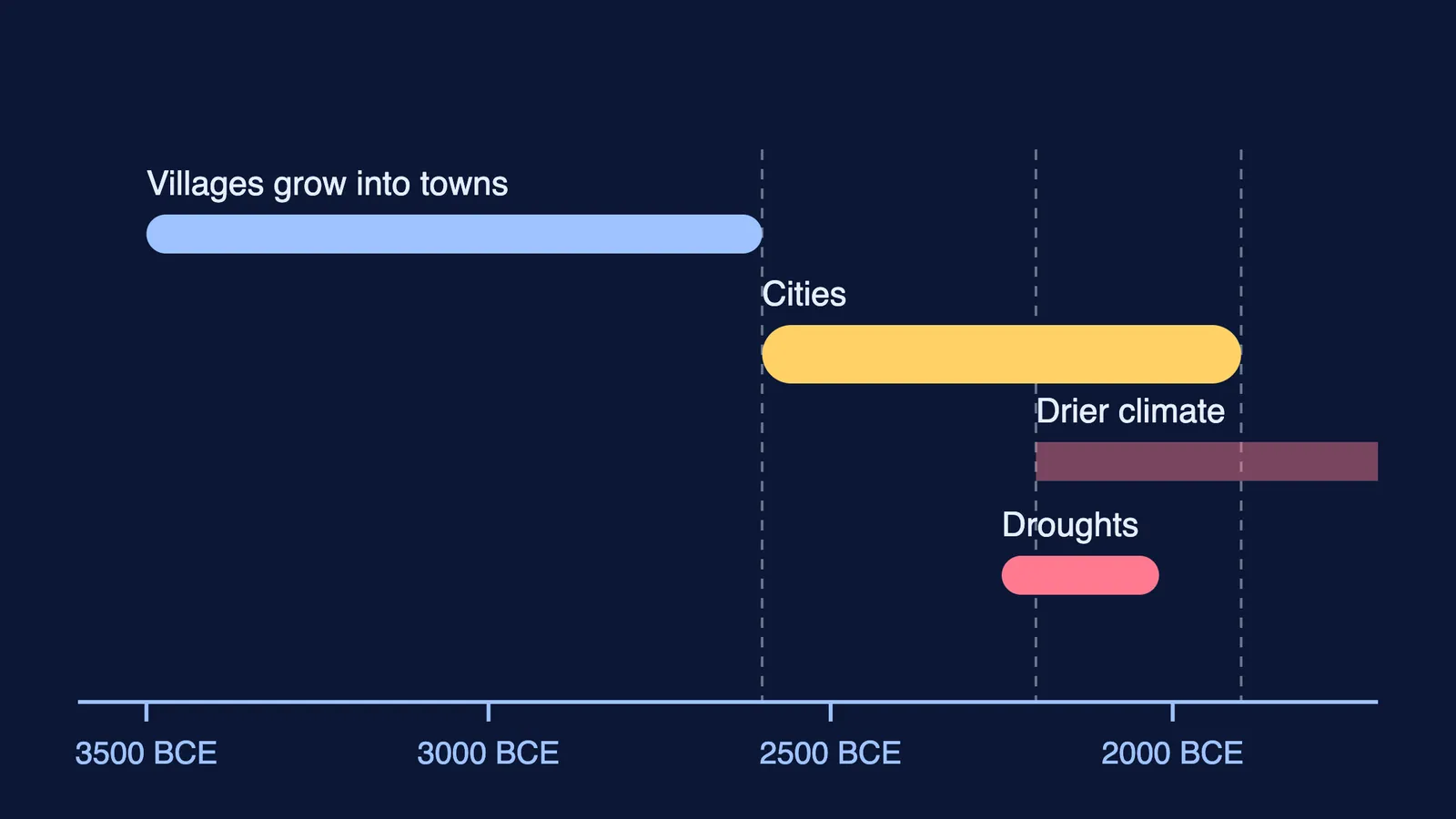
Villages in the plains of the Indus, its tributaries and the Sarasvatī grew into towns from about 3500 BCE, and those towns became cities around 2600 BCE, according to the NCERT Class 6 chapter. NCERT calls this the "First Urbanisation of India".
Harappa, in today's Pakistani Punjab, was excavated first, in 1920–21, which is why the people are called Harappans. Other major cities include Mohenjo-daro in Sindh, Dholavira in Gujarat and Rakhigarhi in Haryana. NCERT calls the word "Valley" in "Indus Valley civilisation" obsolete, because the civilisation extended far beyond the Indus region.
How were the earliest cities planned?
The larger Harappan cities were built to precise plans, with wide streets often aligned to the cardinal directions (NCERT). Most had a fortification wall and two parts: an upper town, where the elite probably lived, and a lower town for common people. Small and big houses were built of brick to the same quality.
Homes often had bathing areas connected to drains that generally ran below the streets. About 700 brick wells have been counted in Mohenjo-daro, and NCERT notes they seem to have been maintained and used for several centuries.
The Great Bath of Mohenjo-daro is a tank of about 12 × 7 metres, its bricks waterproofed with natural bitumen, surrounded by small rooms (one with a well) and emptied through a drain in one corner (NCERT). Its purpose is debated. Archaeologists have suggested a public bath, a bath for the royal family, or a tank for religious rituals; NCERT says the first idea is now ruled out because most houses in the city had their own bathrooms.
For the drains in detail, see our explainer on Harappan cities and their drains for Class 6.
What did Harappan craftspeople make and trade?
Harappans worked copper and added tin to make bronze, a harder metal they used for tools, pots, pans and some figurines (NCERT). Their favourite ornaments were beads of carnelian, a reddish stone found mostly in Gujarat, which craftspeople learned to drill and decorate. They cut conch shell into bangles and were the first in Eurasia to grow cotton.
Trade went by land, by river and by sea. Harappan carnelian beads have been excavated at Susa in present-day Iran, and a Harappan ivory comb was found on the coast of Oman. At Lothal in Gujarat, a basin 217 metres long and 36 metres wide was probably a dockyard for boats (NCERT). Thousands of small seals, generally of steatite and carved with animals and signs of a script nobody has yet read, seem to have helped traders identify their goods. Copper was probably an import.
Why did the Harappan cities decline?
Around 1900 BCE the civilisation began to fall apart: the cities were abandoned one by one, and people scattered into small rural settlements (NCERT). The old idea of an invasion has no support: NCERT notes there is no trace of warfare.
NCERT names two causes that are currently agreed: a climate change from 2200 BCE that brought less rain and made farming harder, and the drying of the Sarasvatī in its central basin, after which cities such as Kalibangan were abandoned.
A 2012 study in PNAS led by Liviu Giosan found that as the monsoon weakened, monsoon-fed rivers dried or became seasonal, and that from about 3,900 years ago settlements shrank, many sites were abandoned and settlement shifted east towards upper Punjab, Haryana and Uttar Pradesh (Giosan et al., PNAS). A 2023 study led by Alena Giesche found a 230-year period of more frequent summer and winter droughts in north India between 4,200 and 3,970 years ago (Giesche et al., Communications Earth & Environment); the authors say these dry spells prompted flexible, drought-resistant farming strategies.
Compare other ancient water engineering in our piece on how Machu Picchu and Angkor were engineered.
How do you revise this chapter quickly?
Fold a sheet into four boxes, fill each from memory, then check against the NCERT chapter:
Layout: upper town and lower town, planned streets, bricks, drains under the streets, about 700 wells at Mohenjo-daro.
Great Bath: about 12 × 7 metres, bitumen, a well, a corner drain; three theories, one ruled out.
Crafts and trade: carnelian beads, shell bangles, bronze, cotton, seals; the Lothal dockyard; beads found at Susa.
Decline: around 1900 BCE; a drier climate from 2200 BCE; the Sarasvatī drying; no evidence of invasion.
Then close the book and answer aloud: "How do we know Harappan cities were planned?" Give two pieces of evidence, such as aligned streets and underground drains. If you get stuck, reopen only that box.
Chapter names differ between NCERT editions, so confirm what your school expects with our guide on how to check the NCERT rationalised syllabus. For science subjects, Fermi's AI tutor works out what you already know and builds a plan for the session.


