On this page
You open the answer key, count the marks, and your stomach drops. The evening after a bad paper usually goes one of two ways: you replay every mistake and call yourself names, or you shut the books and avoid them for days. Research on self-compassion points to a third way, and it tends to get you back to your desk sooner.
What is self-compassion, exactly?
Self-compassion means treating yourself with the same kindness, concern and support you would show a good friend, according to psychologist Kristin Neff (Neff and Dahm, University of Texas at Austin). In Neff's model it has three parts:
Kindness: talking to yourself the way you would talk to a friend who did badly, not "you're so stupid".
Common humanity: remembering that bad papers happen to everyone, so you are not uniquely broken.
Mindfulness: noticing that it hurts without getting carried off by the story ("I'll never get into any college").
Self-compassion is not the same as self-esteem. Self-esteem tells you that you are good or smart; self-compassion, as Breines and Chen put it, is "nonevaluative" (Breines and Chen, 2012). It does not rate you at all. In your own words it might sound like: this went badly, it hurts, and that is part of being human.
Does being kind to yourself make you lazy?
If you go easy on yourself, won't you stop trying? Juliana Breines and Serena Chen at the University of California, Berkeley tested exactly that, in a paper in Personality and Social Psychology Bulletin (Breines and Chen, 2012).
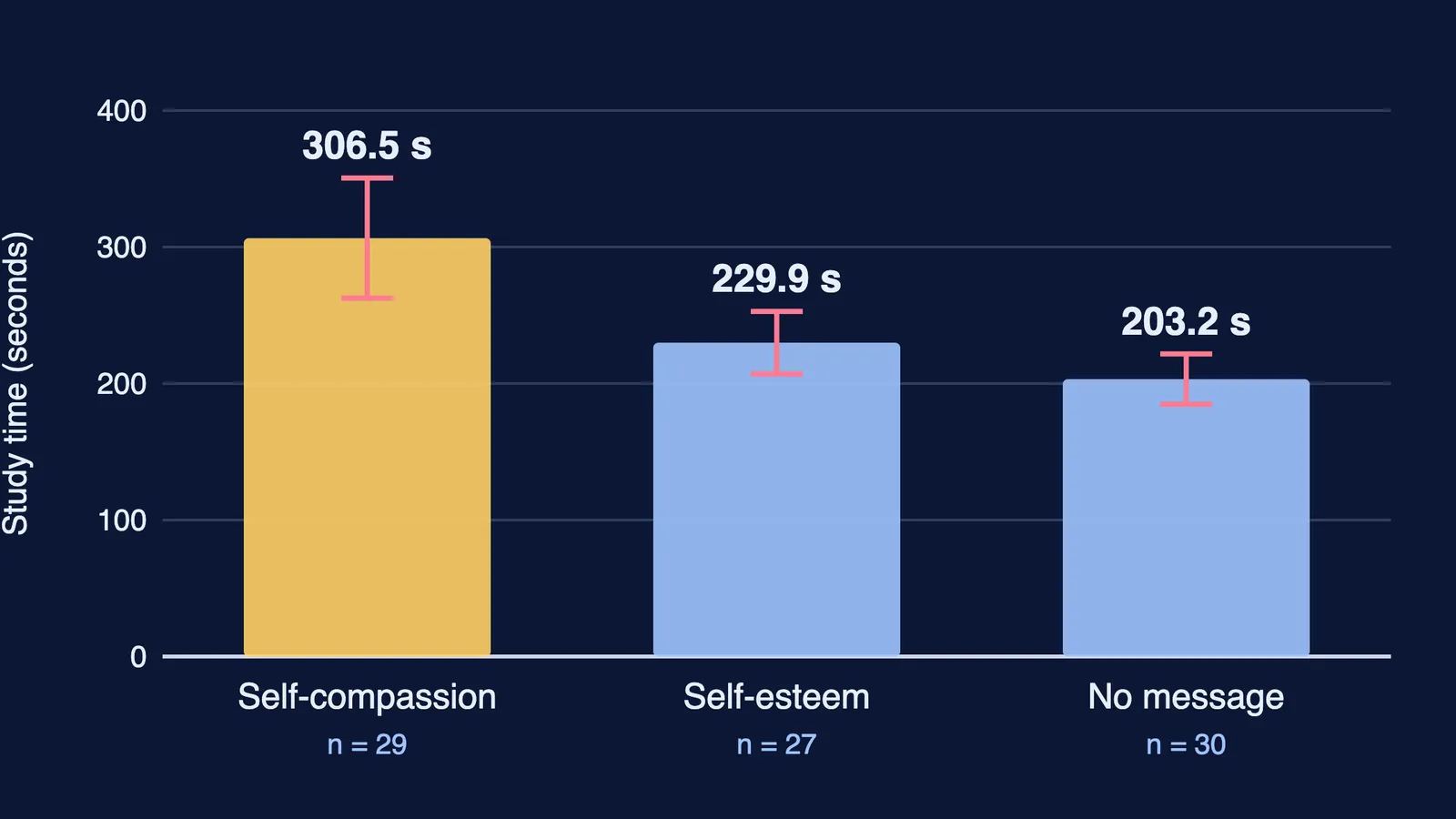
In their third experiment, 86 undergraduates took a deliberately hard 10-item vocabulary test, and the average score was 4 out of 10. Before studying for a second test, one group read a short note saying difficulty was common and to "try not to be too hard on yourself." A second group read a self-esteem boost: they must be intelligent if they got into Berkeley. A third group read nothing extra. Everyone could study the words for as long as they liked.
Self-compassion note: 306.5 seconds of study on average.
Self-esteem note: 229.9 seconds.
No note: 203.2 seconds.
The self-compassion group studied about 50% longer than the group with no note, and longer study time went with better scores on the second test (Breines and Chen, 2012).
Neff's own review of the research adds that self-compassionate people fear failure less and are more likely to try again when they do fail (Neff and Dahm).
What should you do the evening after a bad exam?
Here is a 3-step script, about 30 minutes in all. Do it once the first wave of feeling has passed.
Name it (5 minutes). Write one honest sentence: "I got 38 out of 80 in the physics test and I feel awful." No "always", no "never". That is the mindfulness part.
Write to yourself like a friend (5 minutes). For example: "This was a hard paper and plenty of people struggled. It stings because I care about doing well. One test is not the whole story." Skip "but I'm still smart"; that is the self-esteem message, and in the study it did not help as much.
Pick one fix for tomorrow (20 minutes). Open the paper and choose the three questions that cost you the most marks. Label each one: concept gap, wrong method, or silly slip. Write one small action for each, then put the paper away, eat dinner and sleep.
If a question went wrong because of the method, the Fermi Problem Library has worked problems with a step-by-step solver that explains the reasoning rather than printing an answer, so you can redo a similar one tomorrow. For the full post-mortem once you are calmer, use our 60-minute review for bouncing back after a bad test, and read why mistakes help you learn.
What should you stop saying to yourself after a bad result?
Swap the harsh line for one that is kind and still honest:
"I'm useless at physics" becomes "I lost marks in rotation; that is one chapter, not my whole brain."
"Everyone else did fine" becomes "Lots of people found this hard; I'll check with two friends."
"I'll never crack JEE" becomes "One mock is one data point. What is it telling me to fix?"
None of these pretend the result was good; they keep you looking at the mistake instead of running from it. If nerves before the next paper are the bigger problem, try treating exam nerves as energy.
When is it more than a bad day?
Feeling low after a bad paper is normal and usually eases within a day or two. If low mood, poor sleep or hopeless thoughts last for weeks, or you ever feel unsafe, talk to a parent, teacher or school counsellor. You can also call Tele MANAS, the government's 24x7 tele-mental health helpline, on 14416 or 1800-89-14416 (DGHS, Ministry of Health and Family Welfare).