On this page
This NEET unit spans two NCERT chapters, Class 11 and Class 12. It rewards three habits: count electrons before balancing, get n right in the Nernst equation, and combine limiting molar conductivities cleanly. Here is the coverage, worked examples, traps and a plan.
What does the NEET-UG syllabus include in Redox Reactions and Electrochemistry?
In the National Medical Commission's Syllabus for NEET (UG)-2026, linked from NTA's NEET page, Redox Reactions and Electrochemistry is Unit 7 of Chemistry. It lists:
Redox: electronic concepts of oxidation and reduction, oxidation number, balancing.
Conductance: electrolytic and metallic conduction, molar conductivity versus concentration, Kohlrausch's law.
Cells: electrolytic and galvanic cells, electrode potentials, emf and the Nernst equation, cell potential and Gibbs energy, dry cell, lead accumulator, fuel cells.
Read Unit 7, Redox Reactions, in NCERT Class 11 Chemistry Part II (sections 7.1 to 7.4) and Unit 2, Electrochemistry, in NCERT Class 12 Chemistry Part I (sections 2.1 to 2.8), both Reprint 2026-27. Nothing in the syllabus has been cut. Corrosion (NCERT 2.8) is not named in the syllabus text; skim its half-reactions.
How are electrochemistry questions asked in NEET?
As in NEET-UG 2026, the information bulletin sets 180 compulsory multiple-choice questions in 180 minutes, 45 of them in Chemistry, each with a single correct option, marked +4 and −1. That is about a minute a question, with no numerical-value section. So:
Recall the formulas cold: E = E° − (0.059/n) log Q at 298 K, ΔG° = −nFE°, E° = (0.059/n) log K, Λm = 1000κ/c.
Eliminate first: a spontaneous cell has positive E and negative ΔG; a weak electrolyte has a much smaller Λm than its Λ°m.
Know the NCERT lines: electrode reactions of the dry cell, lead accumulator and H₂–O₂ fuel cell.
How do you solve redox and electrochemistry MCQs quickly?
Example 1: balance by electron count. Balance BrO₃⁻ + N₂H₄ → Br⁻ + N₂ in acid. Bromine falls from +5 to −1, gaining 6 electrons. Each nitrogen rises from −2 to 0, so one N₂H₄ loses 4. Match 12 electrons: 2BrO₃⁻ + 3N₂H₄. Six oxygens need 6H₂O, and hydrogen then balances: 2BrO₃⁻ + 3N₂H₄ → 2Br⁻ + 3N₂ + 6H₂O. Charge is −2 each side; no H⁺.
Example 2: Nernst equation and ΔG. Take Fe | Fe²⁺ (0.10 M) || Cu²⁺ (0.0010 M) | Cu. NCERT's table gives 0.34 V for Cu²⁺/Cu and −0.44 V for Fe²⁺/Fe, so E°cell = 0.78 V. With n = 2, Q = 0.10 ÷ 0.0010 = 100, so E = 0.78 − (0.059/2) × 2 = 0.721 V. Then ΔG = −2 × 96487 × 0.721 ≈ −139 kJ mol⁻¹. n = 1 gives 0.662 V, a likely distractor.
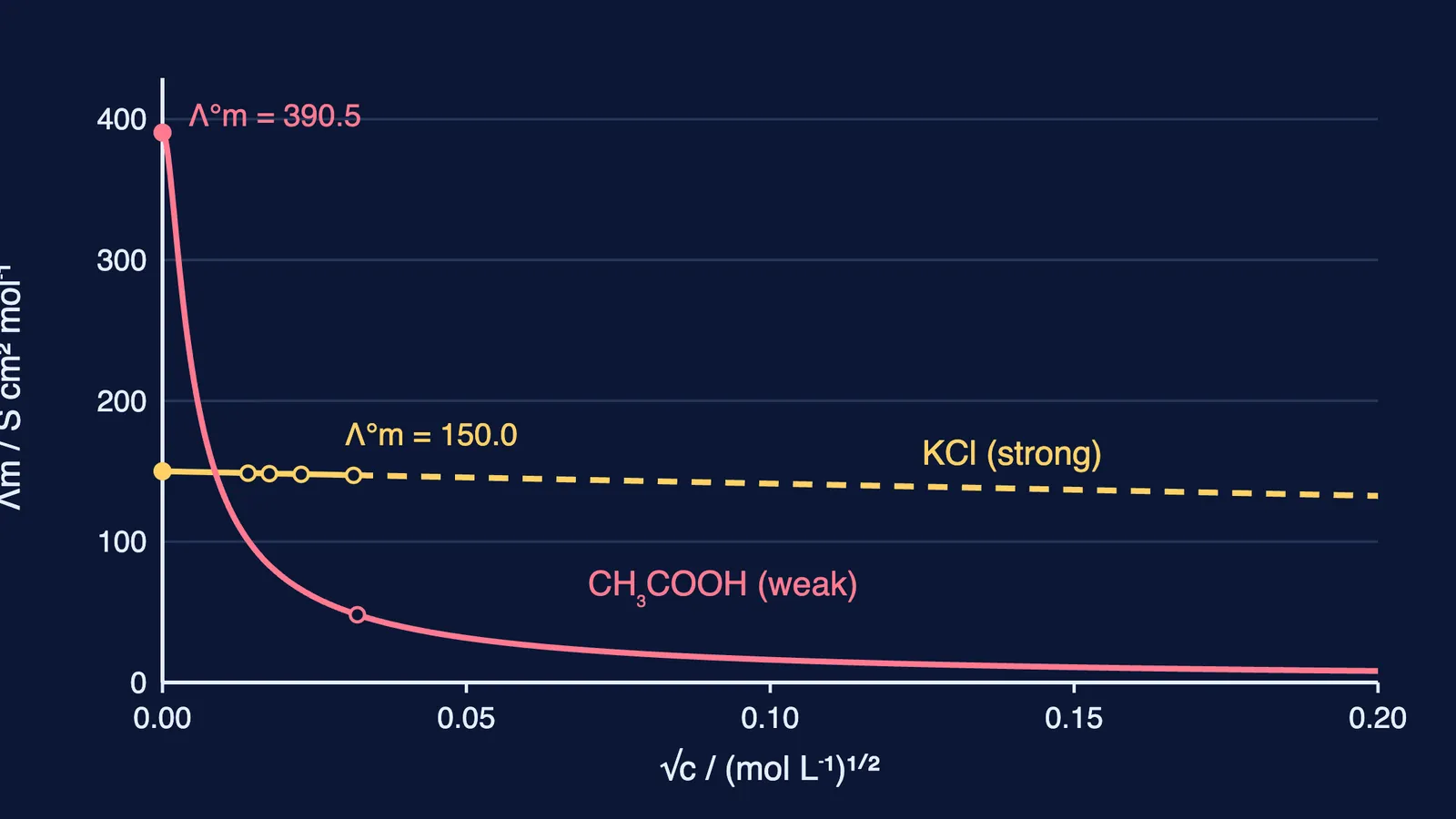
Example 3: Kohlrausch's law. Take Λ°m = 421 (HNO₃), 114 (KX) and 145 (KNO₃), in S cm² mol⁻¹. Then Λ°m(HX) = 421 + 114 − 145 = 390 S cm² mol⁻¹. A 0.0050 M solution has Λm = 39.0 S cm² mol⁻¹, so α = 39.0 ÷ 390 = 0.10 and Ka = cα² ÷ (1 − α) = 5.6 × 10⁻⁵. The diagram shows why weak electrolytes need this route: NCERT's KCl data (Example 2.6) extrapolate in a straight line to 150.0, while acetic acid shoots up towards 390.5 only near zero concentration.
For longer problems, see our Electrochemistry guide for JEE Main; for the redox basics, Redox Reactions for Class 11.
What are the common traps in this unit?
n counts electrons in the balanced cell reaction, not one ion's charge.
Multiplying a half-reaction scales ΔG°, not E°.
Conductivity falls on dilution; molar conductivity rises.
The anode is negative in a galvanic cell, positive in an electrolytic one; oxidation happens there in both.
Stuck on a step? The Fermi Problem Library has worked problems with a step-by-step solver that explains the reasoning rather than printing an answer.
What is a two-week practice plan for this unit?
Days 1-3: Class 11 Unit 7; balance ten equations by both methods.
Days 4-6: Class 12 sections 2.1 to 2.3; write the Nernst equation for five cells you invent.
Days 7-8: sections 2.4 and 2.5; one formula sheet.
Days 9-10: sections 2.6 to 2.8; battery reactions from memory.
Days 11-14: 25 timed MCQs a day; redo wrong ones next morning. For written answers, see our Electrochemistry Class 12 board guide.
Practice questions (our own)
In 3HNO₂ → HNO₃ + 2NO + H₂O, nitrogen is: (a) only oxidised (b) only reduced (c) both oxidised and reduced (d) neither.
A cell reaction with n = 2 has E°cell = 0.118 V at 298 K. Its equilibrium constant is about: (a) 10² (b) 10⁴ (c) 10⁸ (d) 4.
A 0.020 M solution has κ = 2.5 × 10⁻³ S cm⁻¹. Its Λm is: (a) 12.5 (b) 50 (c) 125 (d) 1250 S cm² mol⁻¹.
Answers: 1 (c), since N goes from +3 to +5 and +2; 2 (b); 3 (c), since Λm = 1000κ/c.