On this page
Chemical Kinetics is a short chapter built on a few equations. Most questions turn on reading one unit, graph or half-life correctly, so learn the relations cold and identify the order before you calculate.
What does the NEET-UG syllabus include in Chemical Kinetics?
In the NEET (UG) syllabus notified by the National Medical Commission for NEET (UG) 2026, dated 22 December 2025, Chemical Kinetics is Unit 8 under Physical Chemistry. It lists:
Rate of reaction and its factors: concentration, temperature, pressure and catalyst.
Elementary and complex reactions, order and molecularity, rate law, rate constant and its units.
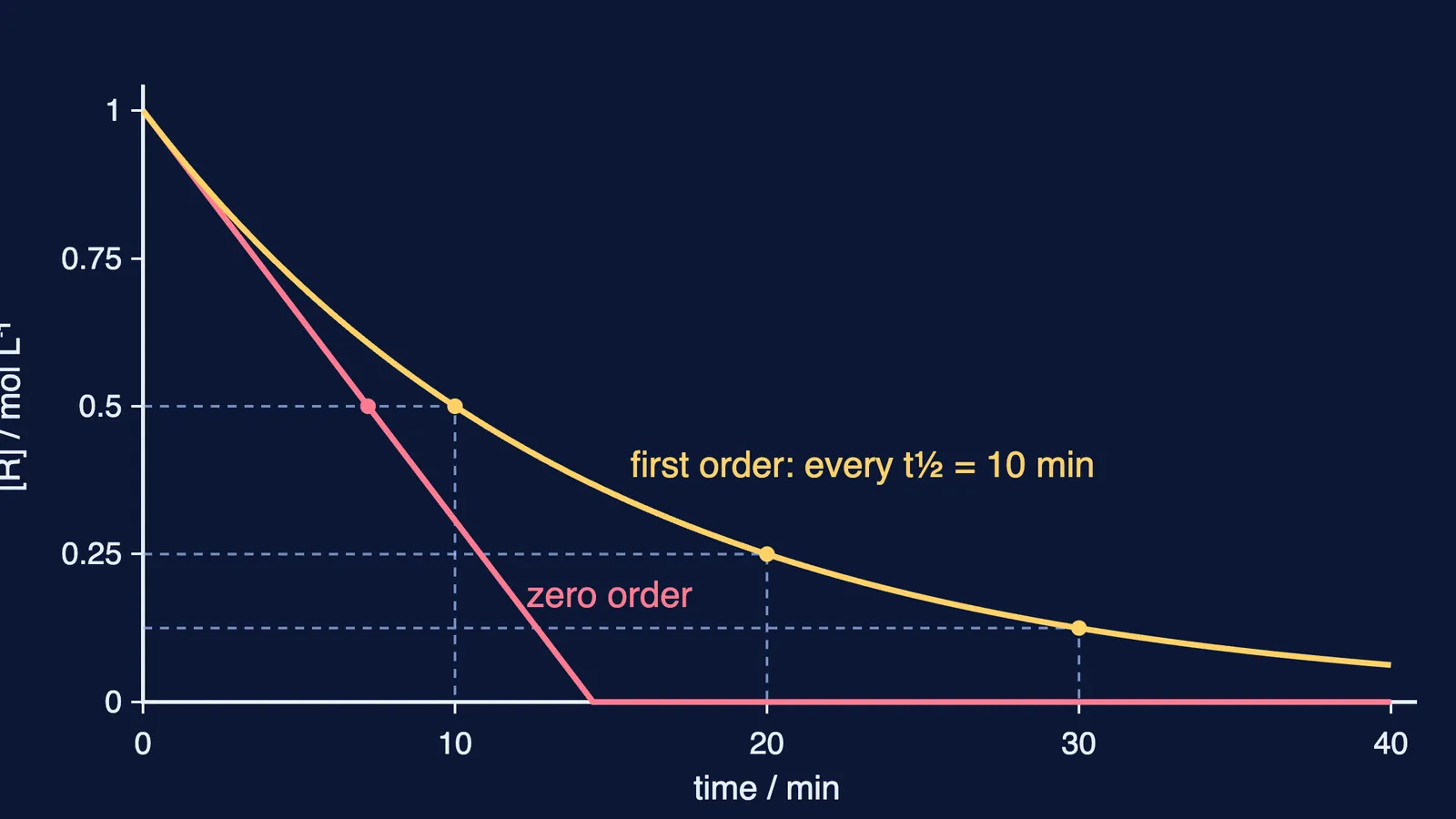
Differential and integral forms of zero and first-order reactions, their characteristics and half-lives.
Effect of temperature, Arrhenius theory, activation energy and its calculation, and collision theory of bimolecular gaseous reactions (no derivation).
All of it is in NCERT Class 12 Chemistry Part I, Unit 3 Chemical Kinetics (Reprint 2026-27), from rate of a reaction (3.1) to collision theory (3.5). We found no listed sub-topic missing from the current chapter; NCERT also covers pseudo first order reactions.
How should you prepare Chemical Kinetics for NEET?
As in NEET-UG 2026, the NTA information bulletin sets 180 compulsory multiple-choice questions in 180 minutes, 45 of them in Chemistry, each with four options and a single correct or best answer. Marking is +4, −1 and 0 for a blank. That is about a minute a question, so:
Keep six relations ready: rate law, units of k, kt = [R]₀ − [R], k = (2.303/t) log([R]₀/[R]), t½ = 0.693/k, and log(k₂/k₁) = (Eₐ/2.303R)(1/T₁ − 1/T₂).
Read the unit of k first: it gives the order.
Eliminate options by size and sign before finishing the arithmetic.
Writing JEE Main too? Our Chemical Kinetics guide for JEE Main covers longer problems.
Three worked examples, solved quickly
Example 1 (rate law from initial rates). For A + B → P: with [A] = 0.05 and [B] = 0.05 mol L⁻¹ the initial rate is 2.0 × 10⁻⁴ mol L⁻¹ s⁻¹; doubling [A] to 0.10 gives 4.0 × 10⁻⁴; tripling [B] to 0.15 (with [A] = 0.05) gives 1.8 × 10⁻³. Find the rate law and k.
Doubling [A] doubles the rate, so the order in A is 1. Tripling [B] multiplies the rate by 9, so the order in B is 2. Rate = k[A][B]², third order overall. k = 2.0 × 10⁻⁴ / (0.05 × 0.05²) = 1.6 mol⁻² L² s⁻¹.
Example 2 (first-order half-life). A first-order reaction has t½ = 25 min. What fraction is left after 100 min, and when is 20% left?
100 min is four half-lives, so 1/16 (about 6.3%) remains. For 20% left, k = 0.693/25 = 0.0277 min⁻¹ and t = (2.303/k) log 5 = (2.303/0.0277) × 0.699 ≈ 58 min. Check: 20% lies between 25% (50 min) and 12.5% (75 min).
Example 3 (Arrhenius). A rate constant triples when the temperature rises from 300 K to 320 K. Estimate Eₐ.
log 3 = (Eₐ/2.303R)(1/300 − 1/320). The bracket is 20/96000 K⁻¹, so Eₐ = 2.303 × 8.314 × 0.477 × 4800 ≈ 43.8 kJ mol⁻¹.
What are the common traps in Chemical Kinetics?
Order from the equation. NCERT says the rate law is found by experiment, not from the balanced equation.
Order vs molecularity. Molecularity applies only to an elementary step and is 1, 2 or 3; order can be zero or a fraction.
Units of k. Zero order mol L⁻¹ s⁻¹, first order s⁻¹, second order mol⁻¹ L s⁻¹.
log vs ln. The 2.303 belongs with log; drop it when you use ln.
Rate of a 2A reaction. For 2A → products, the rate is −½ d[A]/dt.
Catalysts. They lower Eₐ; NCERT notes they change neither ΔG nor the equilibrium constant.
"10 degrees doubles k". NCERT says k is only nearly doubled; use Arrhenius when Eₐ is given.
Stuck on a step? The Fermi Problem Library has worked problems with a step-by-step solver that explains the reasoning rather than printing an answer.
A seven-day practice plan
Day 1: NCERT 3.1–3.2; rate expressions.
Day 2: order, molecularity, units of k.
Day 3: zero-order integrated law and half-life.
Day 4: first order and pseudo first order.
Day 5: Arrhenius, ln k vs 1/T, catalysts.
Day 6: 20 mixed questions, a minute each.
Day 7: redo every wrong answer; name its trap.
Try these original questions in four minutes:
k = 4.0 × 10⁻³ mol L⁻¹ s⁻¹. What is the order?
A zero-order reaction starts at 0.80 mol L⁻¹ with k = 0.010 mol L⁻¹ min⁻¹. Find t½, and t½ if the start is doubled.
A first-order reaction is 75% complete in 36 min. Find t½.
True or false: a catalyst raises the equilibrium constant.
Answers: 1. Zero. 2. 40 min, then 80 min. 3. 18 min. 4. False.
For the board-exam angle, see Chemical Kinetics Class 12: board answers, traps and a plan, and for pacing, read which NEET section to attempt first in 180 minutes.