On this page
This guide is about CBSE board answers in Chemical Kinetics: what the marking scheme rewards, which traps cost marks, and how to revise in a week. For entrance-exam work, see our Chemical Kinetics guide for JEE Main.
How many marks is Chemical Kinetics in the Class 12 board exam?
The CBSE Chemistry curriculum for 2026-27 prints Chemical Kinetics as Unit 3 with 7 marks out of 70 in the theory paper. It lists rate of reaction, factors affecting rate, integrated rate equations, temperature dependence and collision theory. The same document says no chapter-wise weightage is provided, so the 7 marks guide your time, not the exact questions.
The NCERT chapter, Unit 3 of Chemistry Part I (Reprint 2026-27), keeps all of this: zero- and first-order integrated equations, half-life, pseudo first order reactions, the Arrhenius equation, the effect of a catalyst, and section 3.5 on collision theory.
The 2026-27 sample paper states that log tables and calculators are not allowed, so practise with log values supplied in the question, as in the example below.
How do you set out 2-, 3- and 5-mark answers?
The sample paper has 2-mark questions in Section B, 3-mark questions in Section C, 4-mark case studies in Section D and 5-mark long answers in Section E. Its kinetics questions sit in Sections A, B and C.
2 marks: two separate points. The marking scheme for the sample question on constant rate gives 1 mark for saying it is true for zero order, and 1 for saying that for other orders the rate falls as concentration falls.
3 marks: formula, substitution, answer with unit. In the scheme's activation-energy question, half a mark goes to the log form of the Arrhenius equation, half to slope = −Ea/2.303R, 1 to the slope value, and half each to the answer and its unit.
5 marks: label each part, write the formula before the numbers, and box the final answer with its unit.
Our post on laying out CBSE chemistry numericals step by step shows this pattern across chapters.
A first-order numerical, solved twice
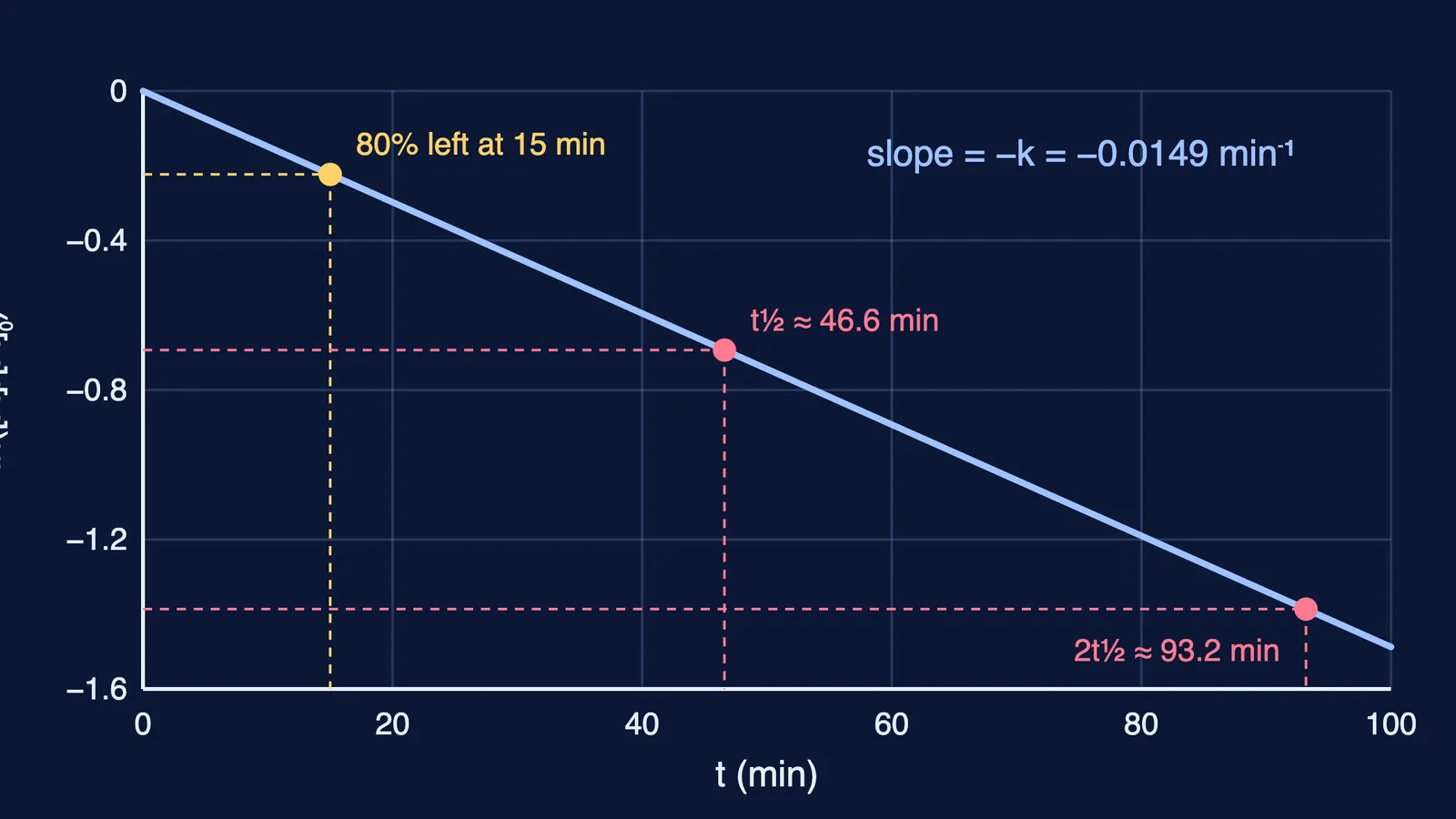
Question: A first-order reaction is 20% complete in 15 minutes. Find k and the half-life. (Given: log 1.25 = 0.0969, log 2 = 0.3010.)
Pass 1, through k. After 20% reacts, [A]₀/[A] = 100/80 = 1.25.
k = (2.303/t) log([A]₀/[A])
k = (2.303/15) × 0.0969 = 0.2232/15 = 0.01488 min⁻¹
t½ = 0.693/k = 0.693/0.01488 = 46.6 min
Pass 2, without k. Write the same equation for t½, where the ratio is 2, and divide one equation by the other. k and 2.303 cancel:
t½/15 = log 2 / log 1.25
t½ = 15 × 0.3010/0.0969 = 4.515/0.0969 = 46.6 min
Both routes give 46.6 min, so the answer stands. The graph above plots this reaction: ln([A]/[A]₀) against t is a straight line of slope −k.
Which traps cost marks in Chemical Kinetics?
Order vs molecularity. NCERT Unit 3 says order is found by experiment and can be zero or a fraction; molecularity is the number of species colliding in one elementary step, cannot be zero or fractional, and has no meaning for a complex reaction. Its own example: KClO₃ + 6FeSO₄ + 3H₂SO₄ looks tenth order but is second order.
Pseudo first order. Ethyl acetate hydrolysis with water in large excess is second order in reality but behaves as first order. The sample paper tests this with acetyl chloride and excess water.
Assertion-reason. Both statements can be true while the reason does not explain the assertion. "The rate constant nearly doubles for a 10° rise" and "a catalyst lowers activation energy" are both NCERT facts, but the second does not explain the first.
Case studies and graphs. Read the axes before the numbers. ln[A] against t has slope −k; log([A]₀/[A]) against t has slope +k/2.303; log k against 1/T has slope −Ea/2.303R. Watch for a dropped minus sign or a missing 2.303.
If a wrong method keeps repeating, the Fermi Problem Library has worked problems with a step-by-step solver that explains the reasoning rather than printing an answer.
A seven-day revision plan
Day 1: NCERT 3.1 and 3.2; write order vs molecularity from memory.
Day 2: Derive the zero- and first-order integrated equations and both half-life formulas.
Day 3: Five first-order numericals with given logs, each checked a second way.
Day 4: Arrhenius: the log form, the log k vs 1/T graph, and one two-temperature problem.
Day 5: Catalyst, collision theory and pseudo first order, as two-line reasons.
Day 6: The kinetics questions in the sample paper, marked against the marking scheme.
Day 7: Rewrite every answer you lost marks on, with the layout above.