On this page
Chemical Kinetics rewards method. Below is one original, checked numerical for each core skill, the common traps, and a two-week plan.
What does the JEE Main syllabus include in Chemical Kinetics?
The NTA's Syllabus for JEE (Main) - 2027 lists Chemical Kinetics as Unit 8, under Physical Chemistry. It covers rate and its factors, order and molecularity, rate law and units of k, zero- and first-order integrated forms with half-lives, Arrhenius theory and activation energy, and collision theory without derivation.
In NCERT this is Unit 3, Chemical Kinetics of Class 12 Chemistry Part I (2026-27 reprint). The syllabus names integrated forms only for zero and first order, so spend your practice time there.
How do you find a rate law from initial-rate data?
Take A + 2B → products:
[A] = 0.10 M, [B] = 0.10 M: rate = 3.0 × 10⁻⁴ M s⁻¹
[A] = 0.20 M, [B] = 0.10 M: rate = 1.2 × 10⁻³ M s⁻¹
[A] = 0.10 M, [B] = 0.20 M: rate = 3.0 × 10⁻⁴ M s⁻¹
Doubling [A] (1 to 2) quadruples the rate: order 2 in A. Doubling [B] (1 to 3) changes nothing: order 0 in B. So rate = k[A]², overall second order, and k = (3.0 × 10⁻⁴) ÷ (0.10)² = 3.0 × 10⁻² M⁻¹ s⁻¹. Check: 0.030 × (0.20)² = 1.2 × 10⁻³, matching experiment 2.
B has a coefficient of 2 but order 0, so the balanced equation does not give the order, and this reaction cannot be a single elementary step:
Order comes from experiment and can be zero or a fraction.
Molecularity is the number of reacting species taking part in one elementary step: always a whole number (1, 2, rarely 3), never zero, and meaningless for a complex reaction. For an elementary step, order equals molecularity.
The slowest step sets the rate law, so a reactant that enters only after that step can show order zero.
Units of k for overall order n are (mol L⁻¹)¹⁻ⁿ s⁻¹: mol L⁻¹ s⁻¹ for zero order, s⁻¹ for first, L mol⁻¹ s⁻¹ for second.
What are the zero- and first-order integrated rate equations?
Zero order: [A] = [A]₀ − kt, and t½ = [A]₀ / 2k. [A] against t is a straight line of slope −k.
First order: ln([A]₀/[A]) = kt, or k = (2.303/t) log([A]₀/[A]), and t½ = 0.693/k. t½ is independent of [A]₀, and ln[A] against t is a straight line of slope −k.
Zero-order example: [A]₀ = 0.80 M, k = 0.010 M min⁻¹. Then t½ = 0.80 ÷ 0.020 = 40 min, but falling from 0.40 M to 0.20 M takes only 20 min, and A runs out at [A]₀/k = 80 min.
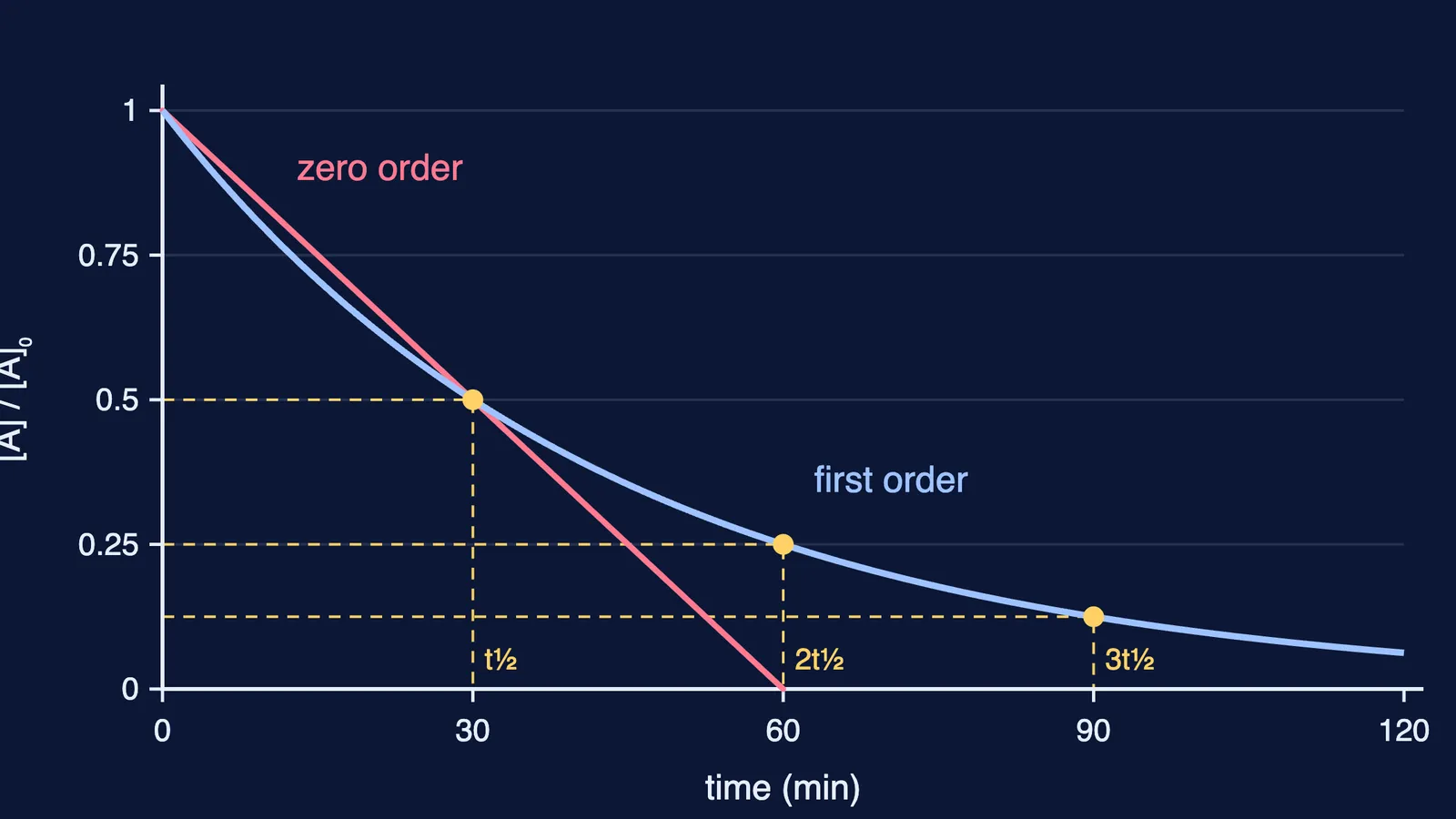
First-order example: t½ = 30 min, so k = 0.693 ÷ 30 = 0.0231 min⁻¹. After 90 min (three half-lives), 12.5% of A remains. To reach 10%: t = (2.303 ÷ 0.0231) × log 10 = 99.7 min. With ln, ln 10 ÷ 0.0231 gives the same 99.7 min.
The diagram above plots this example against a zero-order reaction with the same first half-life. Our guide to zero vs first order concentration-time graphs shows how to read such plots.
How do you solve an Arrhenius two-temperature numerical?
From k = A e^(−Ea/RT): log(k₂/k₁) = [Ea ÷ (2.303R)] × (T₂ − T₁) ÷ (T₁T₂).
Example: a rate constant becomes 4 times larger from 300 K to 320 K. Find Ea.
T₁T₂ ÷ (T₂ − T₁) = (300 × 320) ÷ 20 = 4800 K.
log 4 = 0.602.
Ea = 2.303 × 8.314 × 0.602 × 4800 = 55,300 J mol⁻¹, about 55.3 kJ mol⁻¹.
Check with ln: 8.314 × ln 4 × 4800 = 8.314 × 1.386 × 4800, again 55.3 kJ mol⁻¹, because ln x = 2.303 log x. Use log but drop the 2.303 and you get a wrong 24.0 kJ mol⁻¹. For what A means, see our explainer on the Arrhenius pre-exponential factor.
Which mistakes cost marks in Chemical Kinetics?
Reading order from the balanced equation; coefficients give order only for an elementary step.
Using t½ = 0.693/k for a zero-order reaction.
Putting °C instead of kelvin into the Arrhenius equation.
Flipping T₁ and T₂: if k rises with temperature, Ea must be positive.
Forgetting coefficients: for A + 2B → products, rate = −d[A]/dt = −½ d[B]/dt.
A two-week practice plan for Chemical Kinetics
Days 1-2: Read NCERT Unit 3; rederive both integrated equations and half-lives on blank paper.
Days 3-4: Ten initial-rate problems, writing the units of k each time.
Days 5-7: Zero- and first-order numericals, solved with log and checked with ln.
Days 8-9: Arrhenius problems and graphs (ln k against 1/T has slope −Ea/R).
Days 10-14: Catalysts and collision theory from NCERT, then timed mixed sets; log every error against the list above.
If you keep picking the wrong equation, the Fermi Problem Library has worked problems with a step-by-step solver that explains the reasoning rather than printing an answer.
When kinetics feels steady, move on with our Electrochemistry for JEE Main guide.