On this page
Some NEET marks are lost not to what you did not know but to time and bubbles spent badly. This plan, built on the NEET (UG) 2026 pattern, covers the order of sections, when to skip, what a wrong answer costs, and when to fill the OMR sheet.
What is the NEET pattern, and how much time does each question get?
The NTA information bulletin for NEET (UG) 2026 sets 180 compulsory questions to be attempted in 180 minutes, from 2:00 PM to 5:00 PM. Physics has 45 questions, Chemistry 45 and Biology (Botany and Zoology) 90, for 720 marks in all.
That is one minute per question on average, though not spread evenly. For the 21 June 2026 re-examination, an NTA public notice of 12 June 2026 widened the window to 195 minutes (2:00 PM to 5:15 PM) to cover formalities such as signing attendance sheets. The NEET 2027 bulletin was not out when we wrote this in November 2026, so check neet.nta.nic.in when it is, and plan on 180 minutes of real answering time.
Which section should you attempt first in NEET?
NTA sets no order. Biology carries 90 of the 180 questions and 360 of the 720 marks in the 2026 bulletin, so it is a strong place to start: for many students it goes faster than numericals, and finishing early banks marks and minutes. Physics often goes last because numericals take longer, and it then gets whatever time Biology saved.
Let your mocks decide: for your last three full mocks, divide each section's marks by its minutes, start with the highest and end with the lowest. A starting template for 180 minutes:
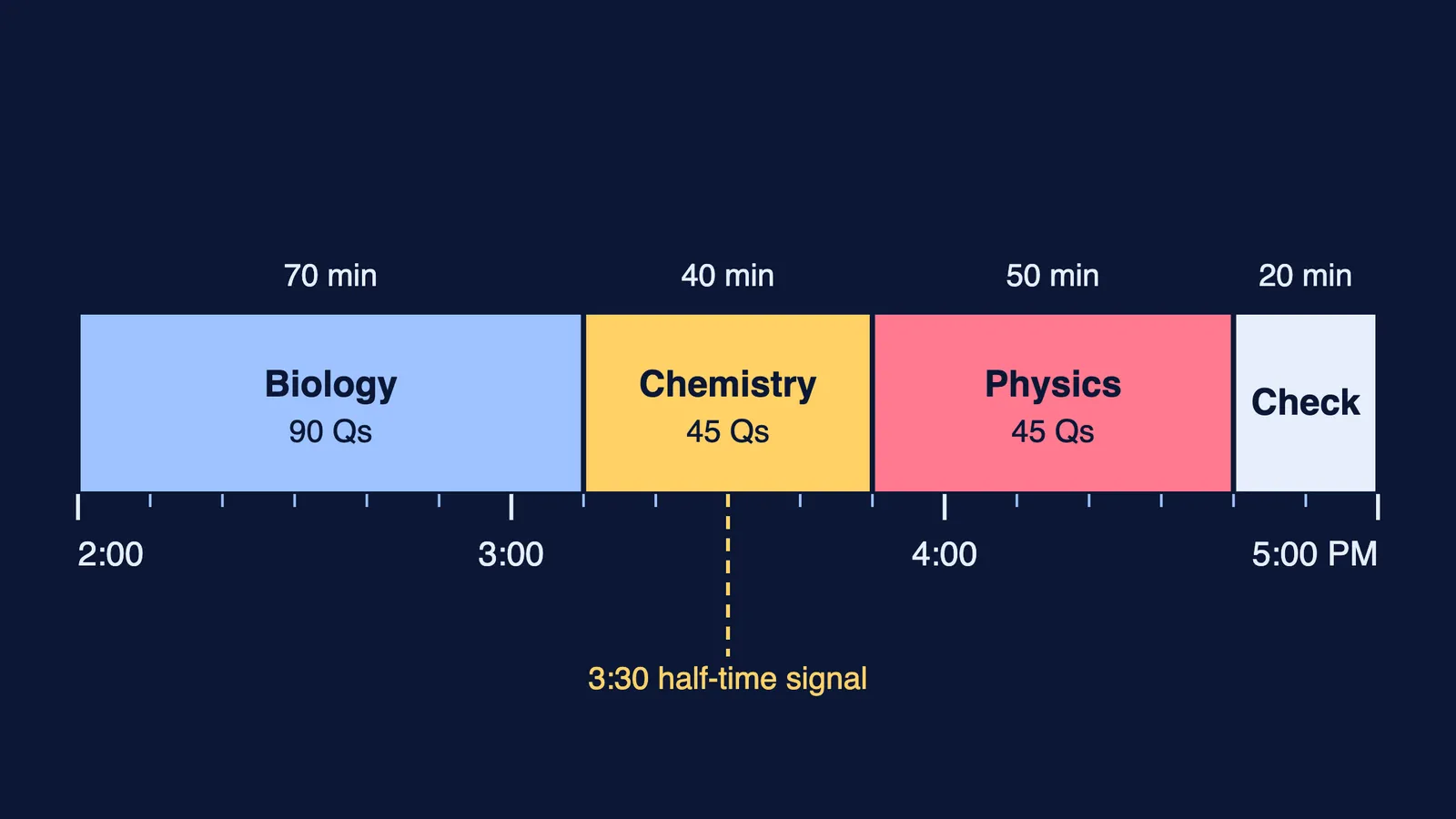
2:00 to 3:10 PM: Biology, 90 questions in 70 minutes (about 47 seconds each).
3:10 to 3:50 PM: Chemistry, 45 questions in 40 minutes.
3:50 to 4:40 PM: Physics, 45 questions in 50 minutes.
4:40 to 5:00 PM: second pass on marked questions and a final OMR check.
The bulletin says a signal is given at the start, at half-time and before the close. At the 3:30 PM half-time signal, Biology should be done and Chemistry half done. If you are more than ten minutes behind, skip faster for the rest of the paper.
When should you skip a question in NEET?
Work in two passes. First, answer what you can; if a question is still open after about 90 seconds, mark it in the booklet and move on. Then return only to the marked ones.
The marking in the 2026 bulletin is +4 for a correct answer, -1 for an incorrect one and 0 for a question left unanswered. So if you are right with probability p, the average value of answering is 4p - (1 - p), which is 5p - 1 marks. That is zero at p = 0.2: answering pays on average whenever you are more than 20% likely to be right. Worked out:
No option ruled out, a pure guess among four (25%): +0.25 marks on average.
One option ruled out (1 in 3, about 33%): +0.67 marks.
Two options ruled out (50%): +1.5 marks.
Confident but wrong, because a distractor caught you: -1, a five-mark swing from the right answer.
These are averages; any single answer is +4 or -1. Wrong answers matter at ties too: the bulletin's tie-break rules look at Biology, Chemistry and Physics marks first, then favour the candidate with fewer incorrect answers relative to correct ones. Our post on the 20% rule for guessing with negative marking has a mock drill to test your guessing.
When should you fill the OMR sheet?
The bulletin says NEET answer sheets are machine-gradable and there is no re-checking or re-evaluation. A bubble in the wrong row is marked as the answer to a different question, so make bubbling a routine:
Bubble after every page or every ten questions, not all at the end.
At each section change, check that the question number in the booklet matches the row on the sheet.
Keep the last 20 minutes for checking and marked questions, not for first-time bubbling.
More in whether to fill OMR bubbles as you go or at the end.
How do you practise this before NEET?
Take at least three full mocks at 2:00 PM on paper with an OMR sheet, using the plan above. Log minutes, marks and guesses right for each section, and shift ten minutes between sections if the numbers say so.
If Physics eats your time because you start numericals with the wrong method, practise them in the Fermi Problem Library, where a step-by-step solver explains the reasoning rather than printing an answer. If the problem is a concept you never quite understood, the Fermi Concept Library has a lesson for every concept in physics, chemistry and biology. If your real score ever falls below your mocks, try these five checks for an exam score lower than your mocks.
Next step: open your last full mock tonight and work out your marks per minute for each section.