On this page
Some study days feel great and some feel like wading through mud, even with the same hours. Research on how people feel at the end of a working day suggests one reason: whether you can see that you moved forward. Here is that idea, the progress principle, turned into a five-minute daily habit.
What is the progress principle?
Harvard Business School professor Teresa Amabile and psychologist Steven Kramer asked 238 people on 26 project teams in seven companies to fill in a short survey at the end of every workday, which gave them nearly 12,000 diary entries (Amabile and Kramer, Harvard Business Review, 2011). They compared each person's best and worst days.
The progress principle is their name for the finding: of all the things that can boost emotions, motivation and perceptions during a workday, the single most important is making progress in meaningful work (HBR).
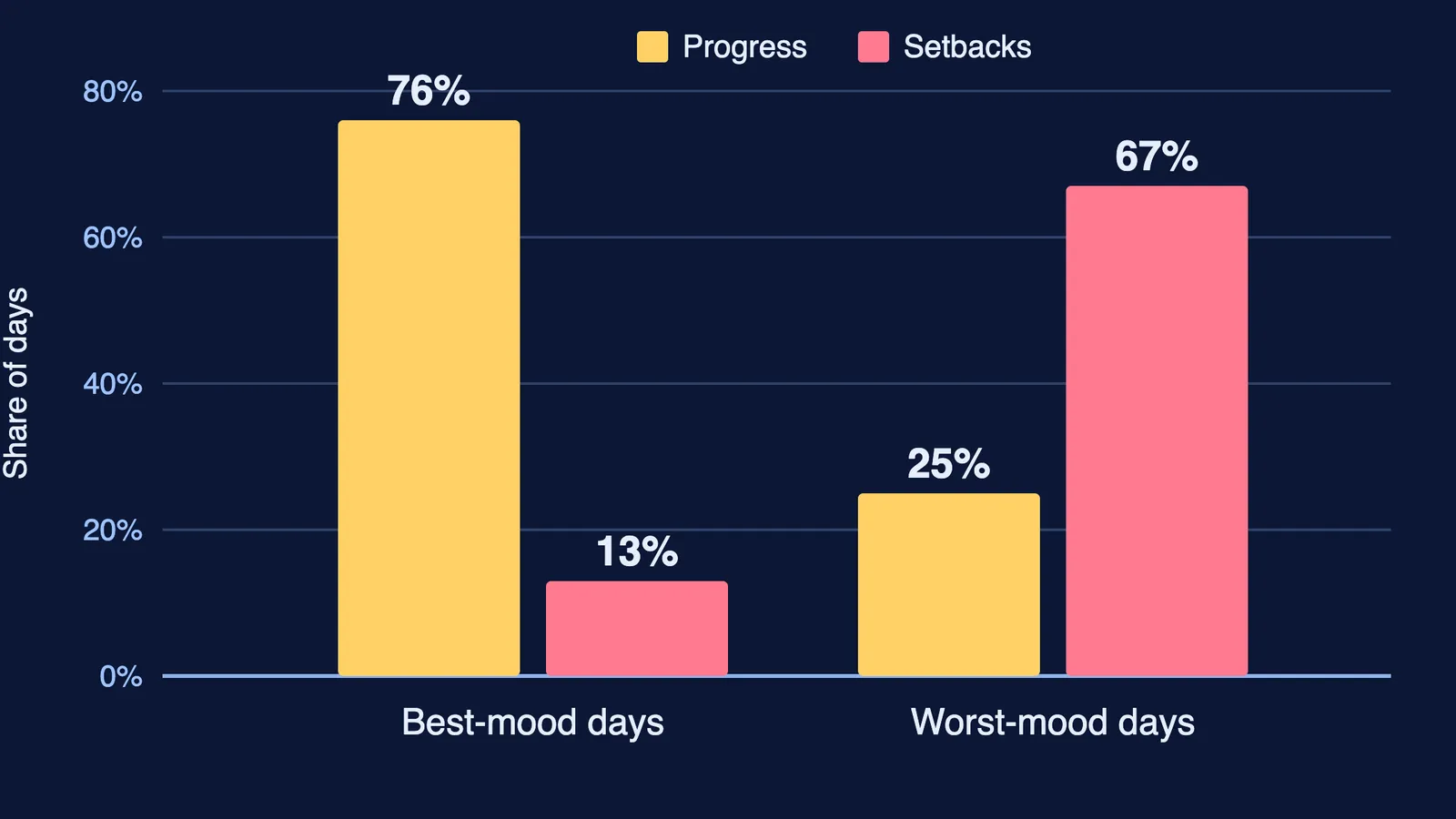
Progress happened on 76% of people's best-mood days, and setbacks on only 13% of them.
On worst-mood days the picture flipped: setbacks on 67%, progress on 25%.
Many of those progress events were only minor steps forward. Across all the events people reported, 28% of those that had only a minor impact on a project had a major impact on how people felt about it.
There is a catch the researchers were honest about. Setbacks hit harder than wins: as HBS Working Knowledge reported, the researchers found the effect of setbacks was two to three times stronger than the effect of progress.
Does this work for students too?
The limits first. The diary study followed adults doing creative work in companies, not students, and it shows progress and good days go together; it does not prove that writing down wins raises your score.
A separate line of research tested the habit directly. A meta-analysis of 138 experiments with 19,951 participants found that being prompted to monitor progress towards a goal helped people reach it, with a small-to-moderate average effect (Harkin and colleagues, Psychological Bulletin, 2016). The effect was larger when progress was physically recorded and when it was reported to others or made public. So write your wins on paper, not just in your head.
How do you keep a daily done-list?
A to-do list shows what is left; a done-list shows what you moved. End every study day with the second.
Shrink the unit. "Finish Rotational Motion" is not a win you can see in a day. "Solve 12 torque problems" is.
At the end of the day, write three lines. What I finished. What I understood that I did not understand yesterday. What I fixed (a wrong answer, a confused concept, a formula you kept mixing up).
Count understanding, not only hours. "Finally saw why the pseudo force points opposite to the frame's acceleration" is a real win.
Name one setback in one line, then one next step for tomorrow. This keeps setbacks from swallowing the whole day.
Show it to someone once a week, a parent, a friend in your batch or a teacher.
What does a done-list look like for a JEE or NEET student?
A worked example: a Tuesday for a Class 12 student preparing for JEE Main, after school and coaching.
Done: 15 questions from the electrostatics DPP, 11 correct.
Understood: why the field inside a conductor is zero, after redrawing the charge diagram twice.
Fixed: re-solved the two Gauss's law questions I got wrong in last week's test.
Setback: mole concept revision did not happen. Next step: 20 minutes on it first thing tomorrow.
A NEET version: 40 Human Physiology MCQs, the nephron drawn from memory, three chemistry errors corrected. None is dramatic. Stacked over a week, they are evidence you are moving, which a bad mock score makes you forget.
To judge when a chapter is truly finished, use this four-part checklist for when a chapter is done. For the "fixed" line, the Fermi Problem Library has worked problems with a step-by-step solver that explains the reasoning, so you can see where your method went wrong rather than only the right answer.
What if a day has no wins at all?
Some days will be blank. Because setbacks weigh more than wins, one bad day can feel like proof that nothing is working. Write it down anyway, then pick the smallest next step: one solved question. Our guide to the two-minute start rule helps on days when starting is the hard part, and this next-day recovery plan helps after a lost day.
Tele MANAS is an initiative of the Ministry of Health and Family Welfare. Tonight, write three lines about what you moved today. That is the whole method.