On this page
Fear of failure rarely looks like fear. It looks like tidying your desk for the third time, making a fresh set of notes on a chapter you already know, or saying "I'll take the mock next week, once the syllabus is done." If that sounds like you, you are not lazy and you are not alone.
What is fear of failure in students?
In achievement-motivation research, fear of failure is the drive to avoid the shame of doing badly, as opposed to the drive to do well. In a 1997 college classroom study, Andrew Elliot and Marcy Church found that students high in fear of failure tended to adopt performance-avoidance goals, where the main aim is not to look worse than others (Elliot and Church, 1997). Those avoidance goals went with lower intrinsic motivation and lower graded performance, while mastery goals (aiming to understand the material) went with higher intrinsic motivation.
Elliot and Holly McGregor later split goals into four kinds: mastering the material, avoiding misunderstanding it, outperforming others, and avoiding doing worse than others (Elliot and McGregor, 2001). Across three studies, the pattern for performance-avoidance goals was more negative than for either kind of mastery goal.
One honest caveat: a review of 243 studies with 91,087 participants found that researchers measure these goals with different questionnaires, and the results shift depending on which one is used (Hulleman and colleagues, 2010). Treat the four-goal picture as a useful map, not an exact law.
How does fear of failure show up when you study?
Three common patterns:
Not starting. If you never really try, a bad mark says nothing about your ability.
Over-preparing. Rewriting notes and re-reading theory feel safe because nobody grades them, so you never reach the questions that could go wrong.
Skipping or abandoning mocks. A test you did not take cannot hurt, so you postpone it or quit halfway when it starts going badly.
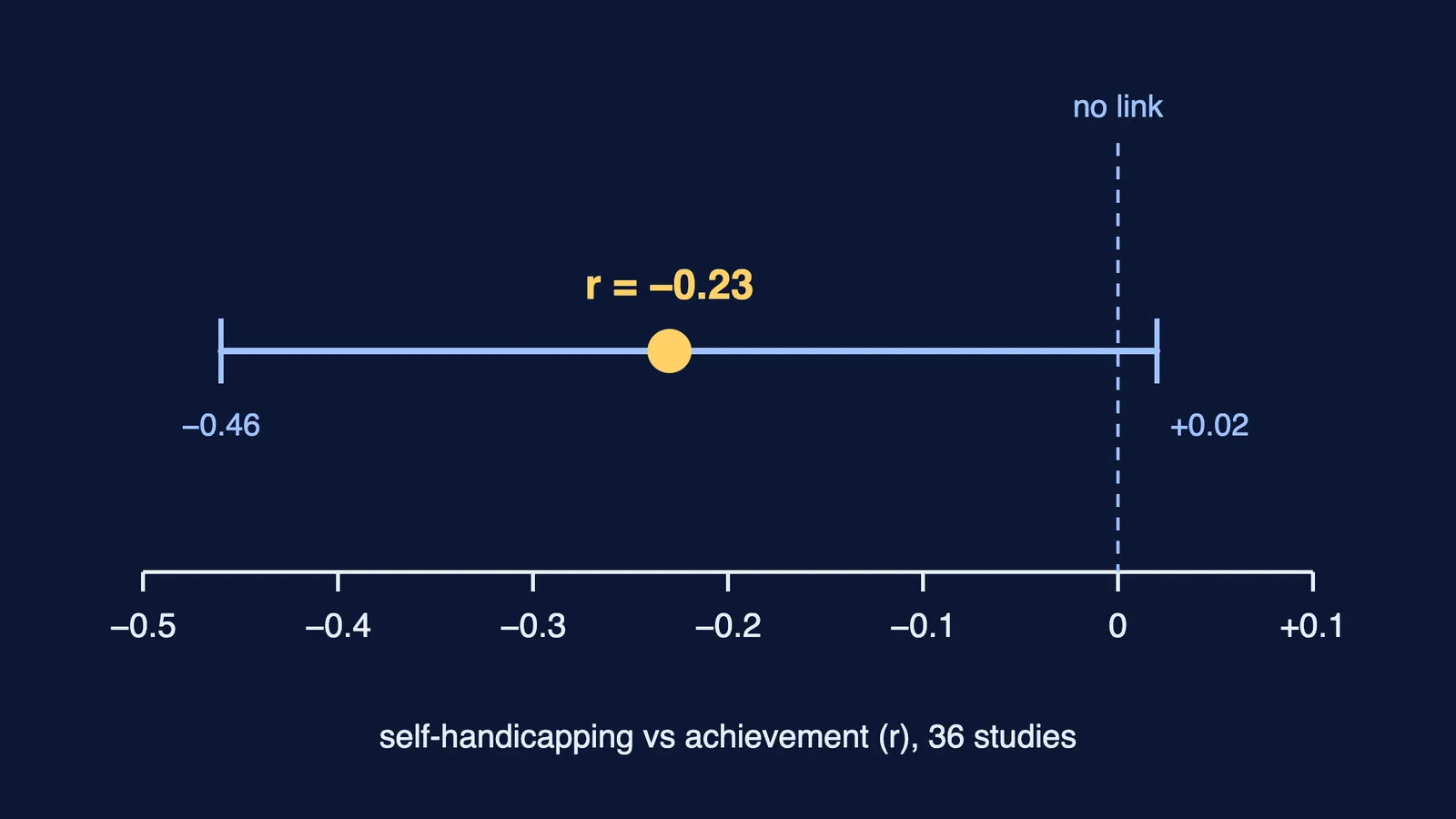
Researchers call the first and third patterns self-handicapping: creating an obstacle so that failure has an excuse. A meta-analysis of 36 field studies with 25,550 students found an average correlation of r = -0.23 between self-handicapping and academic achievement, with the 49 individual effect sizes ranging from -0.46 to 0.02 (Schwinger and colleagues, 2014). The authors describe self-handicapping as a way of protecting self-esteem from the fear of failing. It is a correlation, so it does not prove that self-handicapping causes lower marks, and the size varied with school level and the questionnaire used. But the direction is consistent: the protection usually costs marks.
If delay is your version, read why procrastination is about feelings, not laziness. If endless polishing is your version, read how to keep high standards without getting stuck.
How can you study anyway when you are scared of failing?
The research points in one direction: move your goal from "don't look bad" to "get better at this", and make each attempt small enough that a bad result costs little.
Rewrite the goal. Change "I must not fail this mock" to "I want to find the three topics losing me the most marks."
Shrink the stakes. Ten questions from one chapter, not a full paper.
Score for information. After each set, mark every question Sure, Unsure or Guess, and note why each wrong answer went wrong.
Decide the start in advance. "At 6 pm, at my desk, physics set 1." A fixed start leaves less room for the fear to negotiate.
Keep a mistake log. One line per error.
A 7-day plan to get back into practice
Day 1: Pick one chapter you have been avoiding. Study one worked example for 25 minutes, then close the book and redo it.
Day 2: Ten questions from that chapter, untimed. Mark each Sure, Unsure or Guess.
Day 3: Review only the wrong and Unsure ones. Write one line on each.
Day 4: Ten new questions from the same chapter, loosely timed.
Day 5: A mixed set of fifteen questions from two chapters.
Day 6: One timed section of a mock. Before you begin, write "This is to find gaps."
Day 7: Compare Day 2 with Day 6, pick next week's chapter.
If you get stuck on a question during the week, the Fermi Problem Library has a step-by-step solver that explains the reasoning, so a wrong answer becomes a method you can reuse.
When is fear of failure more than ordinary nerves?
Some nerves before a test are normal, and there is evidence on treating exam nerves as energy. But if fear stops you studying for weeks, disturbs your sleep or appetite, or leaves you feeling hopeless, talk to a parent, teacher or school counsellor. You can also call Tele MANAS, the Ministry of Health and Family Welfare's free, 24x7 mental-health helpline, on 14416 or 1800-891-4416, in around 20 languages (IIT Kanpur counselling service).
Start with ten questions today. A small attempt you finish beats a perfect plan you never begin.