On this page
You probably have a topper, a YouTuber or a famous scientist in mind when someone says "role model". Sometimes that person fires you up for a week. Sometimes their story leaves you feeling smaller. Research explains why both happen, and how to pick a role model who actually helps you study.
When does a role model inspire you, and when does it discourage you?
Psychologists Penelope Lockwood and Ziva Kunda tested this in a 1997 paper, Superstars and me, in the Journal of Personality and Social Psychology. They found two conditions.
First, the star has to be relevant: someone succeeding in the area you care about. In Lockwood's own summary of the work, future teachers were inspired by a highly successful teacher but were unaffected by a successful accountant.
Second, the success has to feel attainable. A relevant star lifted people's view of themselves when they felt they still had time to reach similar success, or believed their abilities could improve. The same star tended to deflate them when they felt the chance had passed, or saw their abilities as fixed.
So an All India Rank 1 story can push two students in opposite directions. If you are in Class 11 and believe you can still get better, it can inspire you. If you are three weeks from the exam and feel stuck, it may just make you feel behind. Believing ability can grow is part of this, and our piece on what the big growth mindset studies found explains how strong that evidence is.
Why do struggle stories work better than success stories?
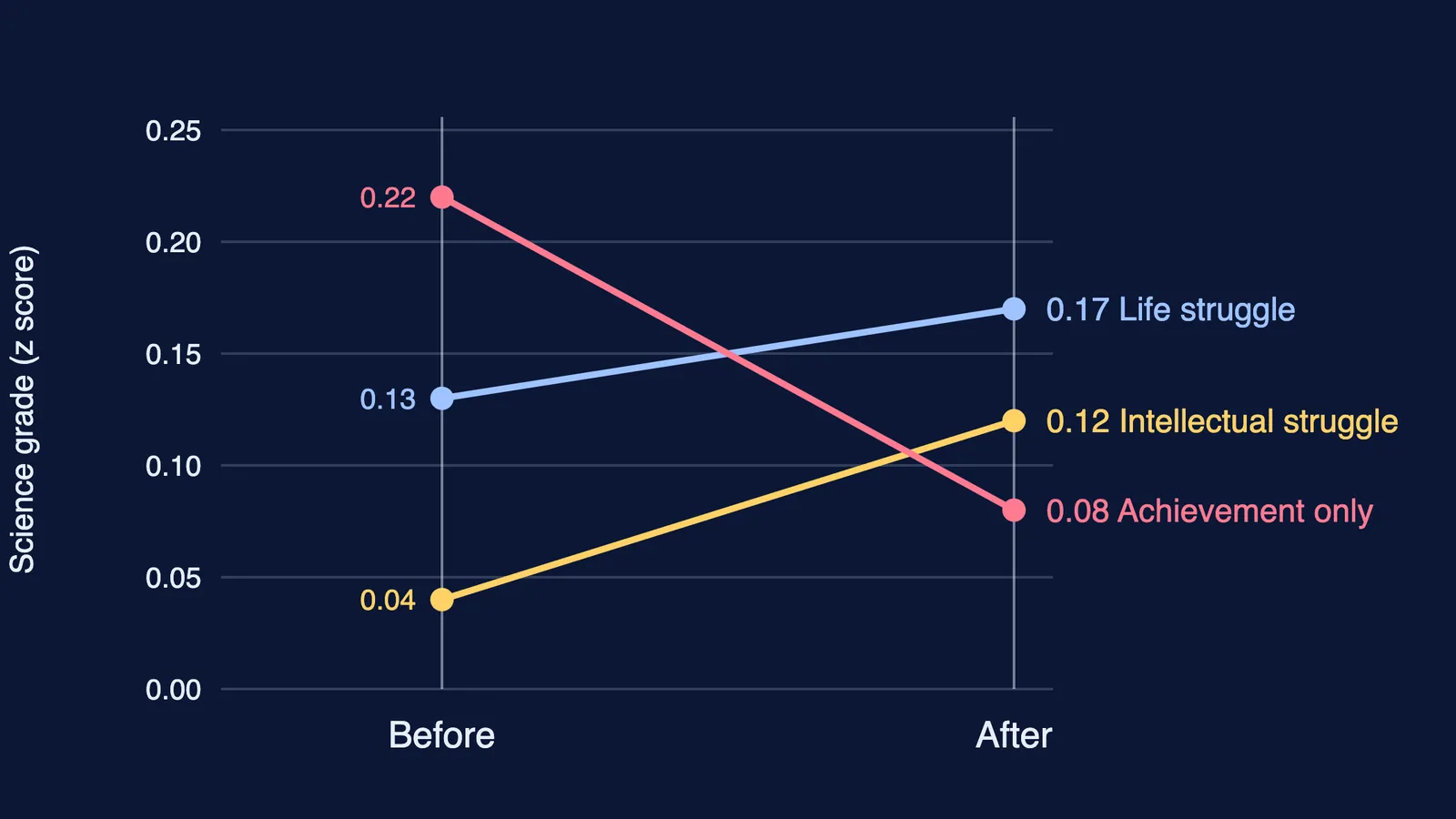
In a study published in 2016, Xiaodong Lin-Siegler and colleagues at Teachers College, Columbia University gave 402 9th and 10th graders in New York short stories about Albert Einstein, Marie Curie and Michael Faraday (Journal of Educational Psychology, 2016). One group read about the scientists' intellectual struggles, such as experiments that failed. One read about struggles in their personal lives. A control group read only about their achievements, like a textbook box.
In the six-week grading period after the stories, students who read either kind of struggle story had slightly higher science grades than the achievement group, whose grades dropped. The benefit showed up for students who had been doing poorly before, not for those already doing well. In interviews, students in the struggle groups felt connected to more of the scientists.
What did Ramanujan's setbacks actually look like?
Srinivasa Ramanujan is often told as a story of pure genius. The St Andrews MacTutor biography gives a fuller picture. He won a scholarship to the Government College in Kumbakonam in 1904, but it was not renewed the next year because he spent more and more time on mathematics. In Madras he passed mathematics in the First Arts exam but failed his other subjects, so he could not enter the University of Madras. In 1912 he took a job as a clerk at the Madras Port Trust while he kept working on mathematics.
The honest lesson is not "fail and you will become Ramanujan". It is that even he lost a scholarship, failed an exam and needed a day job. Setbacks in a record do not decide where a life ends up.
How do you choose a role model who actually helps?
Use this three-question check before you follow anyone's story:
Same field? Pick someone who succeeded at roughly what you are attempting: the same exam, subject or kind of work.
A step ahead, not a mile ahead? A senior who moved from 60 to 120 in JEE Main mocks is often more useful than the topper. Their next step is one you can take.
Do you know their struggles? If you only know the result, find out what went wrong on the way and what they changed.
Then turn the story into a plan. Write down one habit the person used, such as reviewing every wrong answer, and try it for seven days. When you copy a method, work through the steps yourself; the Fermi Problem Library has worked problems with a step-by-step solver that explains the reasoning rather than printing an answer. Our guide to borrowing from a topper's timetable shows how to adapt someone else's routine to your day.
What if comparing yourself makes you feel worse?
If a story leaves you deflated, tell yourself: "They had more time or a different start. What is one thing they did that I can try this week?" That turns the comparison back into something attainable.
If the feeling that everyone else deserves their place more than you keeps coming back, read our piece on imposter syndrome in toppers and droppers.
If low mood lasts for weeks, talk to a parent, teacher or school counsellor. Tele MANAS, the Health Ministry's free 24x7 mental health helpline, is on 14416.