

On this page
Every exam season, toppers' timetables go round WhatsApp groups and YouTube: up at 5, three hours of study before coaching, another five or six after. If you have tried copying one, you probably know how it goes: a strong first few days, one missed morning, and then the whole plan feels broken.
That is rarely laziness. The timetable was never built for your day.
Why do copied timetables usually fail?
A timetable fits one person's day. Three parts of that fit rarely transfer.
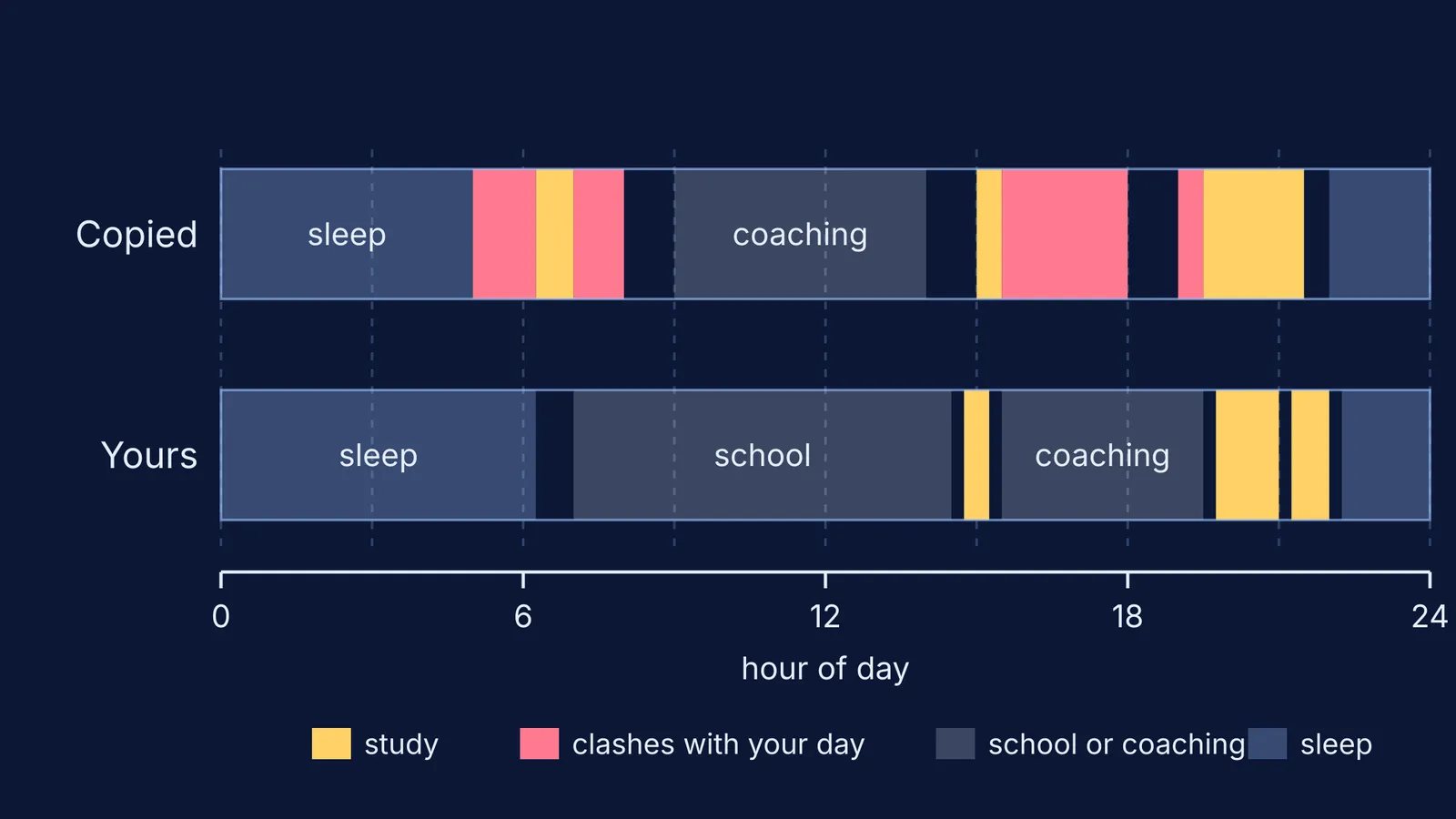
The free hours belong to someone else. A student in full-time coaching from 9 to 2 has open mornings and evenings. A Class 12 student in school until 2:30 and coaching until 7:30 does not. In the worked example below, only 3¼ of a copied plan's 8½ study hours land in time the student actually has.
Body clocks differ, and they shift during the teenage years. In a survey of about 25,000 people, Till Roenneberg's team found that people sleep later and later through adolescence, reaching their latest timing at about 19.5 years for women and 20.9 for men (Nature's report on the 2004 Current Biology study). A 5 am start that suits one 17-year-old can mean an hour of half-asleep reading for another. More in our post on morning or night study and chronotypes.
Plans are optimistic even before you copy them. In a 1994 study, psychology students predicted they would finish their honours theses in 33.9 days on average, but took 55.5 days (Buehler, Griffin and Ross, Journal of Personality and Social Psychology). Only about 30% finished by the date they had predicted. A copied timetable stacks that optimism on top of someone else's schedule.
There is also a selection problem: you see the timetables of people who did well, not of the many who followed similar plans and did not. A shared timetable is not proof of what caused the result.
Which parts of a topper's routine are worth borrowing?
Read a topper's timetable for its principles, not its clock times. These usually travel well:
Fixed start times for study blocks, so you are not deciding afresh every day.
Hard problem-solving placed in the hours you feel sharpest.
Regular self-testing and mock-test analysis, not just rereading notes.
A weekly slot to review the plan and change it.
Protected sleep. The American Academy of Sleep Medicine recommends 8 to 10 hours per 24 hours for teenagers aged 13 to 18 (Paruthi et al., Journal of Clinical Sleep Medicine, 2016). If a timetable you admire gives you less, borrow everything except that.
How do you build your own timetable around your day?
Here is a worked example for a Class 12 student we will call Riya, who has school and coaching on weekdays.
Block the fixed hours first. Sleep 10:15 pm to 6:15 am (8 hours). School with commute 7:00 am to 2:30 pm. Coaching with commute 3:30 to 7:30 pm.
List the real gaps that are left: 2:30 to 3:30 pm and 7:30 to 10:15 pm.
Put the hardest work in the longest gap: problem practice from 7:45 to 9:00 pm.
Give short gaps short tasks: 2:45 to 3:15 pm for recalling that day's school topics from memory, and 9:15 to 10:00 pm for revision and formula cards.
Leave one weekday evening unplanned as a catch-up slot, because some tasks will run long.
Run it for one week, then spend 15 minutes on Sunday moving blocks that did not work.
That comes to 2½ focused hours on a school day. It looks smaller than the copied plan's 8½ hours, but every minute of it falls in time Riya really has. For laying out the whole week, see time blocking for students juggling school and coaching.
If you sit down in a gap and don't know where to start, Fermi's AI tutor can work out what you already know and build a plan for the session, so a 75-minute block starts with a clear next step.
What if you miss a day?
Keep going from the next block. Research on people forming new daily habits found that automaticity took about 66 days on average to level off, with wide variation, and missing the occasional day did not seriously set the process back (Gardner, Lally and Wardle's review, British Journal of General Practice, 2012). If you miss the same block again and again, the plan is too big for your day: shrink it rather than scrap it. More in our guide to building a study routine that lasts.
If keeping up starts to feel overwhelming, talk to someone you trust. The free, 24x7 Tele MANAS helpline, run under the Ministry of Health and Family Welfare, is on 14416.
Start tonight: write down your fixed hours, find your two real gaps, and put one task in each.


