On this page
You have probably said it yourself: "I'll start properly from Monday." It sounds like an excuse, but researchers have found a real pattern behind it. You can use it on purpose if you also plan for what comes after day one.
What is the fresh start effect?
The fresh start effect is the tendency to take up goals right after a "temporal landmark", a date that feels like the start of a new period, such as a new week, month, year, semester or a birthday. The name comes from a 2014 paper in Management Science by Hengchen Dai, Katherine Milkman and Jason Riis (Dai, Milkman and Riis, 2014).
They looked at three sets of real-world records: Google searches for "diet", daily gym visits at a US university, and goals people signed up for on the commitment website stickK. All three went up after landmarks.
Their explanation is like turning to a clean notebook page: a new period makes last month's missed targets feel like they belong to an older version of you, and it nudges you to think about the bigger picture of what you want.
How big is the fresh start effect for students?
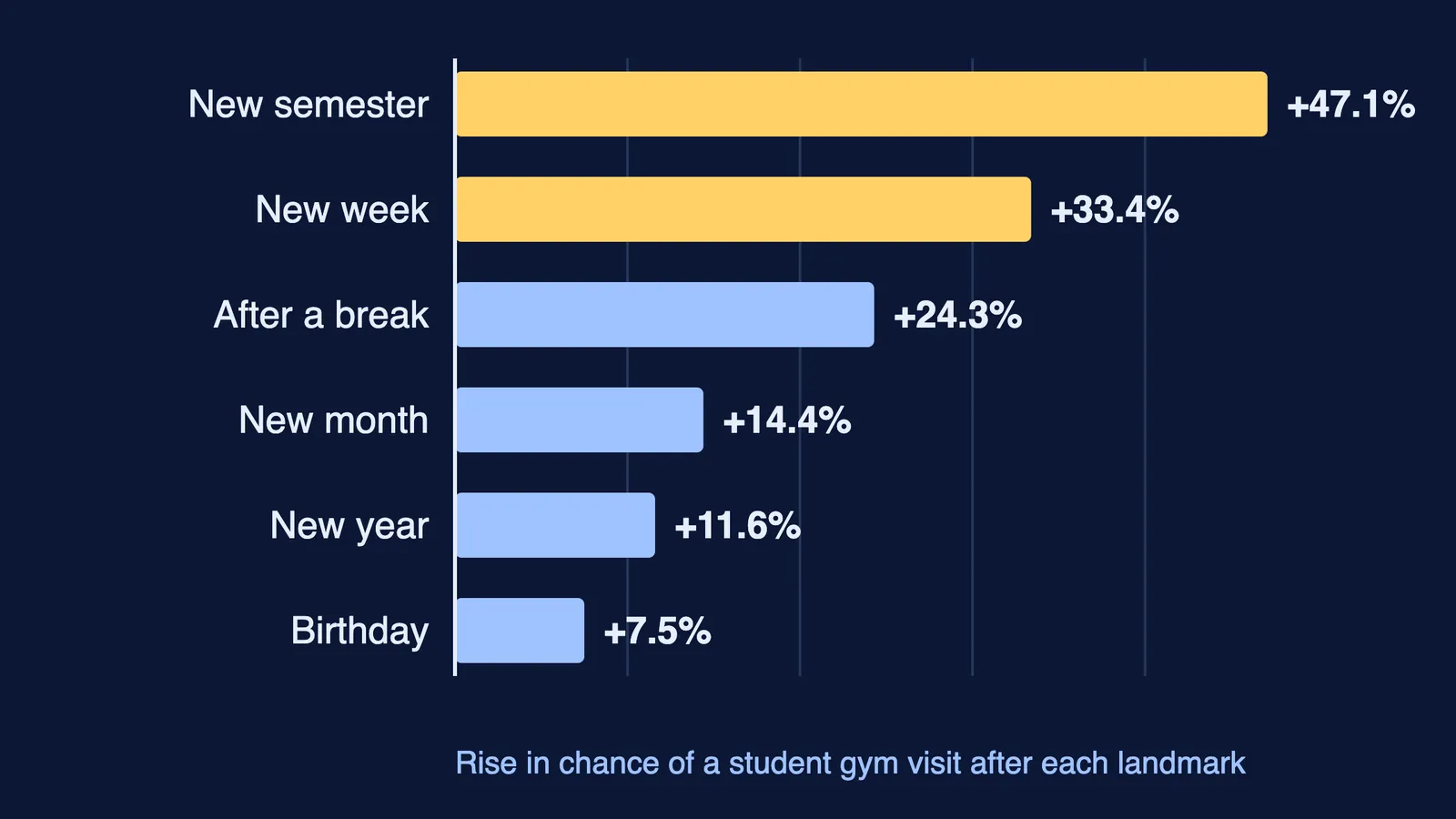
The gym study is the closest to student life. The researchers had daily attendance records for 11,912 undergraduate gym members at a university in the north-eastern United States (full paper, Wharton). Comparing the start of each period with its end, and the first day back from a break with an ordinary day, the researchers estimated that a student's chance of going to the gym was:
47.1% higher in the first month of a semester
33.4% higher at the start of a week
24.3% higher on the first day after a school break
14.4% higher at the start of a month
11.6% higher in the first month of a year
7.5% higher after a birthday, in a subset of 2,076 students with birthday data (the 21st birthday was the exception: visits fell)
Two honest limits. First, these are patterns in gym records from one US university, not a trial on studying; nobody measured study hours. Second, landmarks help you begin, not keep going. In later lab experiments the same team showed that pointing out a "new beginning" date raised people's intentions to start a goal (Dai, Milkman and Riis, 2015, Psychological Science). Intentions, not results.
Why does "I'll start on Monday" sometimes backfire?
Across an archival study and four experiments, Minjung Koo, Hengchen Dai and colleagues found that people put in less effort on an ongoing goal when a new beginning was approaching, expecting their future self to make up for it (Koo, Dai, Mai and Song, 2020). People who eased off may not work harder afterwards to make up the lost progress. The dip was smaller when people were reminded of the everyday things they already did for their goal.
That is the Thursday trap: the week feels spoiled, so you write it off and wait for Monday.
How do you plan a study reset that lasts?
Use the landmark to start, and plan for the dip a few days later. Here is a seven-day reset you can begin on any Monday, the 1st of a month, the day after a unit test, or the first day back after Diwali or summer holidays.
The evening before: write one line on what last week taught you. Pick one subject and one countable target, such as "30 kinematics questions" instead of "finish physics".
Day 1: start at a fixed time and place. Do 40 minutes on that target before anything else.
Day 2: same time, same place. Tick a box on paper when done.
Day 3: add a second subject only if days 1 and 2 happened.
Day 4: expect a slump. Halve the target rather than skipping it.
Day 5: go back over the questions you got wrong this week and redo two of them.
Days 6 and 7: one lighter revision session, then write next week's single target.
If you miss a day, restart the next morning with the halved target. Do not wait for the 1st. If you are not sure which chapter to start with, Fermi's AI tutor can work out what you already know and build a plan for the session, so day 1 begins with a clear next step.
For a heavier pile of pending chapters, this triage plan for a JEE or NEET backlog helps you choose what to drop. If you keep delaying the first step, read why procrastination is about feelings, not laziness. Droppers can pair this with the three-part reset for a mid-year slump.
When is a fresh start not enough?
A new week can lift ordinary low motivation. It is not a fix for feeling low, anxious or unable to cope for weeks at a time. If that sounds like you, talk to a parent, a teacher you trust or your school counsellor. You can also call Tele MANAS on 14416, the government's free, round-the-clock mental health helpline (PIB).
Pick your next landmark, write one target, and start with 15 minutes today.