On this page
You probably picture yourself at an IIT, in a medical college, or in a job you are proud of. Yet that picture often does nothing on a Tuesday evening when a chapter feels hard and your phone is right there. Psychologist Daphna Oyserman studies why that gap exists and what closes it.
What is identity-based motivation?
Identity-based motivation is the idea that you act in ways that fit who you think you are, but only when that identity feels relevant to the choice in front of you right now. In two studies with mostly low-income middle school students, Mesmin Destin and Oyserman found that a "college-bound" future self guides schoolwork only when it is salient and feels connected to today's choices (Destin and Oyserman, 2010).
Oyserman's later work adds a second piece: how you read difficulty. When work feels hard, you can take it as a sign that it is impossible for "someone like me", or as a sign that it matters. Oyserman's team describes classroom activities that help students see school as the path to their adult identity and their difficulties as signals that schoolwork is important (Horowitz, Sorensen, Yoder and Oyserman, 2018).
What did the school studies find?
The best-known test is the School-to-Jobs programme for low-income 8th graders: 141 students in the programme and 123 in a control group (Oyserman, Bybee and Terry, 2006). The sessions linked future selves to concrete strategies and reframed difficulty. Students in the programme improved in test scores, grades and academic initiative, while absences and in-school misbehaviour fell, and the effects held over a two-year follow-up (Oyserman, Bybee and Terry, 2006).
A smaller experiment shows how much it matters whether the future feels tied to school. Seventh graders who were led to picture adult futures that depend on education were eight times more likely to complete a take-home extra-credit assignment than those led to picture futures that do not (Destin and Oyserman, 2010).
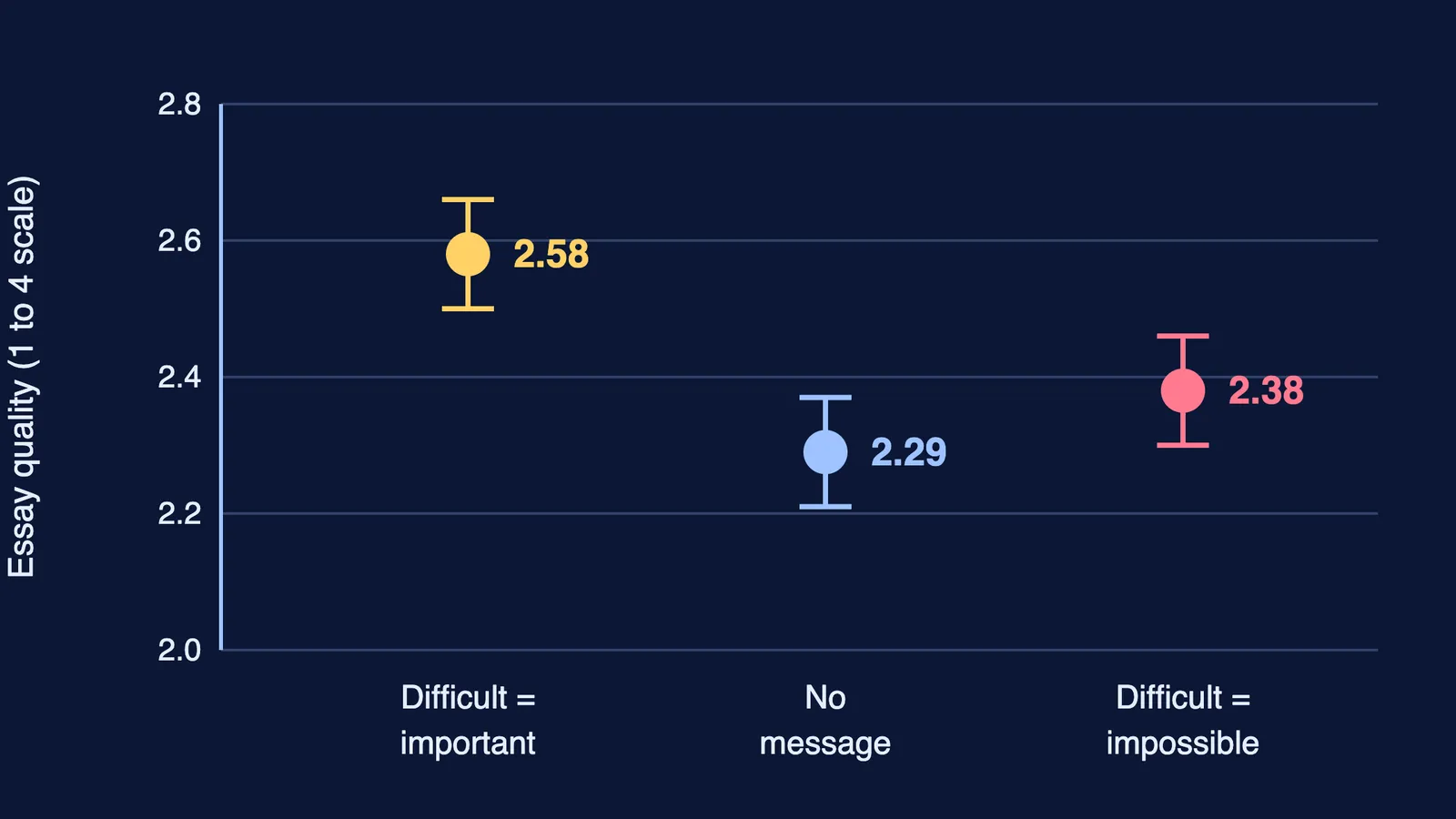
In one of four studies in a 2018 paper, 175 sixth graders at a Detroit-area school got a booklet before a practice state writing test. Those whose booklet said "difficult means important" wrote better essays (adjusted average 2.58 on a 1 to 4 scale) than the other two groups combined; the "difficult means impossible" group (2.38) and the no-message group (2.29) did not differ (Oyserman and colleagues, 2018).
That teacher study, with 211 students, is still useful: after two days of training, 88% of classrooms received the programme at or above the standard for faithful delivery, and better delivery went with higher core grades and lower risk of failing a course (Horowitz and colleagues, 2018).
How can you use identity-based motivation for studying?
A 7-day plan using the three ingredients from the studies: a specific future self, a strategy for today, and a new reading of difficulty.
Day 1: Write one sentence about the adult you want to be in five years, tied to something that needs study (for example, "a doctor who explains things clearly to patients").
Day 2: List three things that person would have done by the end of this school year, about effort rather than marks.
Day 3: Turn one of them into a strategy for today, such as "20 minutes of organic chemistry reactions after dinner".
Day 4: Write down one likely obstacle and what you will do when it shows up. See our guide to study goals with WOOP and if-then plans.
Day 5: Pick a problem that feels hard. Before starting, say to yourself: "This feels difficult, so it is important for me."
Day 6: Ask whether today's study connects to your Day 1 sentence. If not, change tomorrow's task, not the goal.
Day 7: Keep the future self and the strategy that worked; drop the one that did not.
Day 5 needs hard problems you can actually get through. The Fermi Problem Library has worked problems with a step-by-step solver that explains the reasoning rather than printing an answer, so a difficult problem can stay difficult without becoming a dead end.
What should you say to yourself when a topic feels too hard?
Notice which of these two voices you use.
Impossible voice: "I'm stuck again. People like me just aren't good at rotational motion."
Important voice: "I'm stuck, which tells me this chapter matters for where I'm going. What is one small step I can take?"
If the hard feeling is really about dread or avoidance rather than the content, read why procrastination is about feelings, not laziness. Identity-based motivation also sits close to mindset research covered in our look at what the big growth mindset studies found.
You can also call Tele MANAS, the Government of India's mental health helpline, on 14416.
Pick your Day 1 sentence tonight, and keep it where you study.