On this page
By the fourth month of a drop year, the routine that felt fresh in June can feel like the same day on repeat: same chapters, same tests, same desk, and the exam still far off. Nothing has gone wrong with you. Researchers have described a similar mid-point dip in other long stretches of effort, and small changes can help.
Why does a drop year feel boring by month four?
Researchers who study crews wintering in Antarctica have a name for the mid-stretch dip: the “third-quarter phenomenon”, a term usually credited to Bechtel and Berning in 1991 (Crossref record). A 2018 paper in Frontiers in Psychology describes it as low motivation, low mood and tension between crew members around the third quarter of a stay, as people realise the mission is only half complete, and notes that empirical support “remains equivocal” (Sandal, van de Vijver and Smith, 2018). A drop year is not an Antarctic winter, but the shape is familiar: the restart has lost its novelty and the finish line is not yet in view.
The flatness is worth taking seriously because boredom is tied to how well you study. Across five studies of university students, Reinhard Pekrun and colleagues found boredom was linked to more attention problems and to lower motivation, effort, self-regulation and later academic performance (Pekrun et al., 2010). Students who felt more in control and saw more value in the work were less bored, so the reset targets both.
How do you keep going when every day looks the same?
You need the same syllabus in a new shape, targets you can hit, and a guaranteed break.
Step 1: change the format of the work. Rereading notes feels safe and dull; testing yourself feels harder and works better. In a classic experiment, students who took recall tests on a passage remembered more a week later than students who reread it, even though rereading made them more confident (Roediger and Karpicke, 2006).
Rotate formats so no two blocks in a day feel alike:
Timed problem sets against a strict clock
Closed-book recall: write everything you know about a chapter on a blank page, then check
Teach-back: explain one derivation aloud as if to a younger cousin
One full mock a week, followed by a slow analysis of every mistake
If your mock analysis keeps showing the same wrong method, the Fermi Problem Library has worked problems with a step-by-step solver that explains the reasoning rather than printing an answer.
Step 2: swap the far goal for small near ones. “Get a good rank” cannot tell you what to do on a Tuesday. In a 1981 experiment with children who struggled with and disliked arithmetic, those working towards near-term subgoals progressed rapidly and grew interested in the work, while distant goals had no demonstrable effect (Bandura and Schunk, 1981).
Set two or three weekly targets you control, such as “finish 40 mixed questions on rotational motion” or “cut my organic error log to one page”. Small wins show you are still moving.
Step 3: plan one fixed rest block each week. A 2022 meta-analysis of 22 study samples found that micro-breaks of up to about 10 minutes gave small boosts to energy and small reductions in fatigue; their overall effect on performance was not significant, though longer breaks were linked to bigger performance gains (Albulescu et al., 2022). It did not study weekly rest, but it suggests rest is worth planning. We suggest one half-day a week, at the same time every week, with no books and no guilt. Here is more on whether a weekly half day off is worth it.
What does a reset week look like?
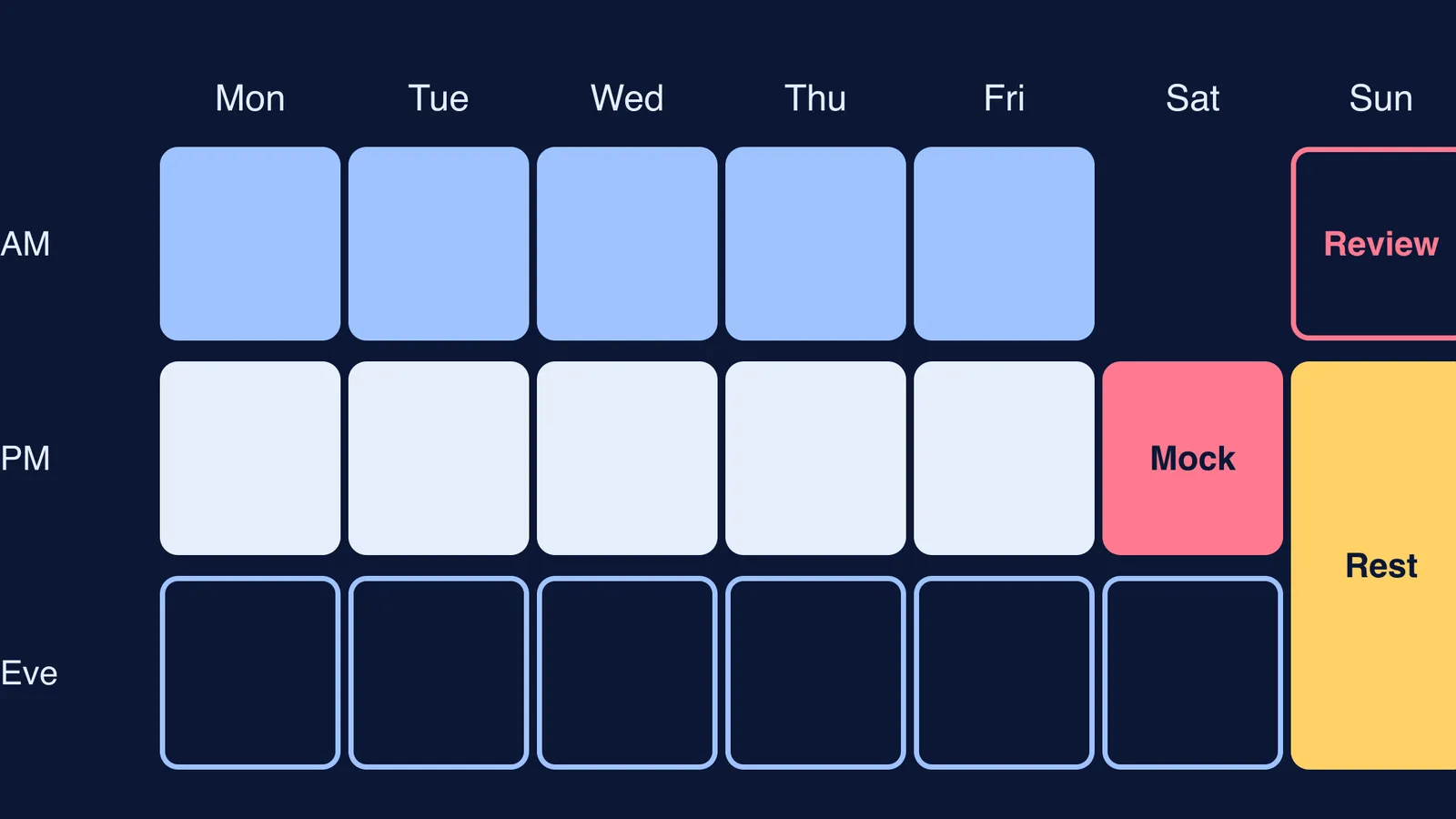
One example for a JEE Main, JEE Advanced or NEET-UG dropper; adjust the hours to your coaching schedule.
Monday to Friday mornings: timed problem sets on the week's main chapter.
Monday to Friday afternoons: closed-book recall or teach-back on older chapters.
Every evening, Monday to Saturday: 45 minutes on the error log, then stop.
Saturday afternoon: one full mock under exam conditions.
Sunday morning: mock analysis and next week's two or three targets.
Sunday afternoon and evening: the fixed rest block.
For the hour-by-hour version, see our daily timetable for drop year students. If you cannot decide where to begin, Fermi's AI tutor can work out what you already know and build a plan for the session, so you start with a clear next step.
When is it more than a slump?
If you feel low most days for weeks, stop enjoying things you used to like, cannot sleep, or feel hopeless, talk to someone you trust and to a professional. Tele MANAS, the government's toll-free mental health helpline, is on 14416 or 1-800-891-4416 in 20 languages. If the hardest part is feeling cut off from friends who moved on to college, read our guide to staying connected during a drop year.