

On this page
When taking a drop year for competitive entrance exams like JEE or NEET, common advice urges an extreme routine often called monk mode. Students are told to deactivate social media, decline invitations, avoid friends, and study alone for long hours every day.
At first, total isolation feels like dedication. Within weeks, however, constant silence brings disorientation. Without the daily structure of school, your social circle vanishes, and every mock score feels like a verdict on your worth. Staying connected with family and trusted peers is not a distraction—it is a cognitive necessity.
Why does a drop year feel so isolating?
The transition into a drop year removes the daily rhythms that anchored you in school. In a classroom, you had hallway conversations, shared lunches, and sports periods. During a drop year, your days are defined by solitary revision.
This isolation often triggers psychological withdrawal:
The peer comparison trap: Seeing classmates post updates from college hostels creates a sensation of falling behind.
The fear of questions: Avoiding calls often stems from dreading questions about your drop year.
The zero-sum guilt: Droppers often worry that time spent with family is time stolen from problem sets.
Total disconnection starves your brain of emotional safety.
How does social isolation affect your exam prep?
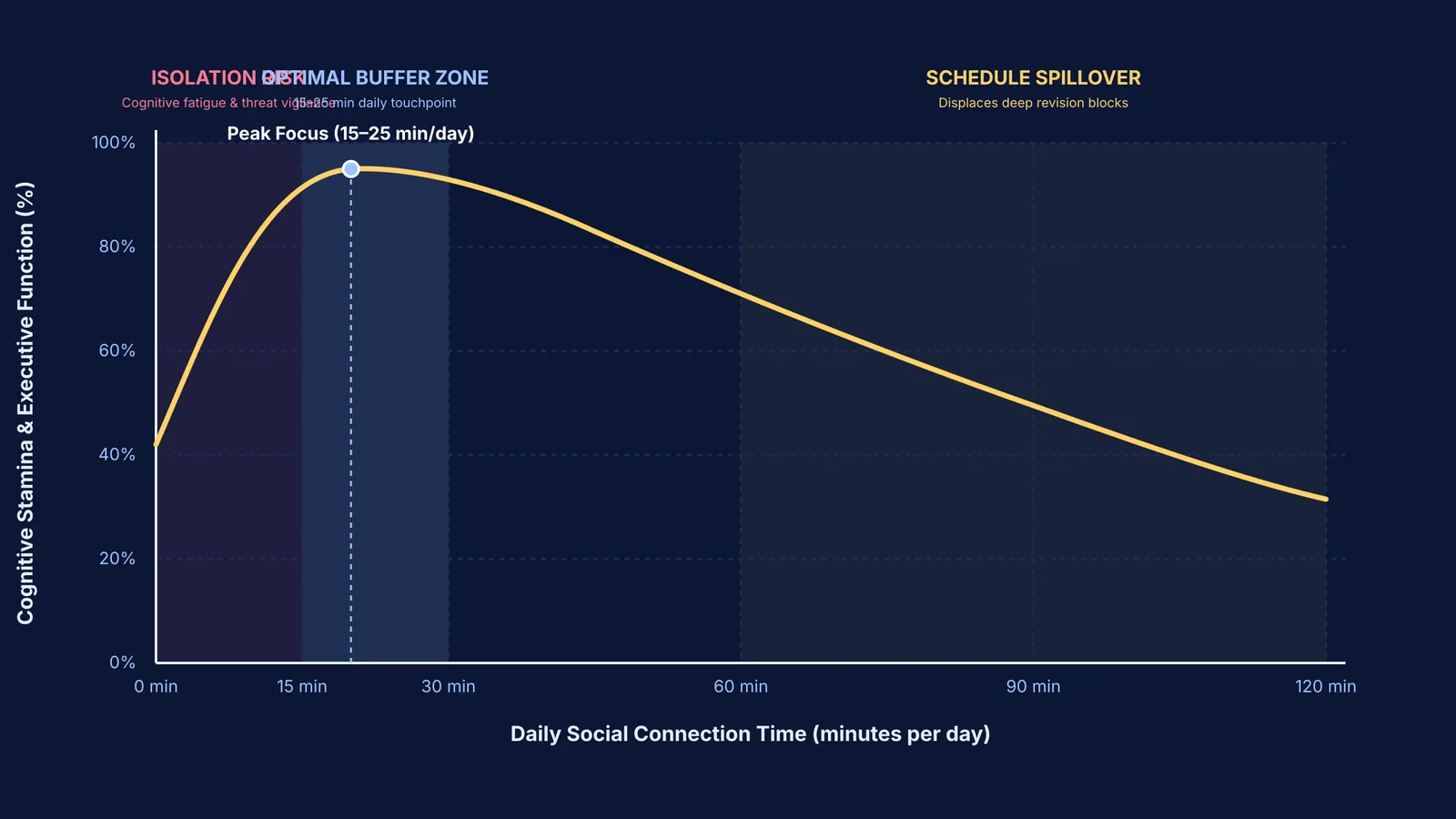
Cutting off human contact does not sharpen focus; it creates mental exhaustion. Research in cognitive psychology explains why complete solitude during high-stakes preparation backfires.
In *Trends in Cognitive Sciences*, researchers John T. Cacioppo and Louise C. Hawkley synthesized evidence showing that perceived social isolation increases chronic stress and impairs executive control. Executive control is the cognitive faculty needed to sustain attention during long study blocks, resist digital distractions, and solve multi-step problems in physics and mathematics. Chronic isolation triggers defensive vigilance, leaving fewer mental resources for deep learning.
Furthermore, social connection acts as an emotional buffer. In *Psychological Bulletin*, Sheldon Cohen and Thomas A. Wills showed that perceived social support protects individuals from the psychological strain of acute stress. Having a trusted person to speak with allows you to view a low mock score as diagnostic feedback rather than a personal failure.
How can you stay connected without losing study hours?
The goal during a drop year is not to maintain an active social calendar, but to establish protected, predictable micro-connections. You can manage your relationships using a simple three-tier filter:
The Daily Anchor (one or two people): Choose a parent, sibling, or close friend who does not judge your progress. Spend fifteen minutes talking with them daily during dinner or an evening walk. Focus on non-exam topics like family news or sports. To see how brief pauses reset focus, read our guide on what to do in a study break.
The Academic Ally (one serious co-aspirant): Connect with a peer once a week for twenty minutes strictly to compare study milestones or discuss tricky concepts. If you need a sustainable timetable, see how to build a study routine that lasts.
Dormant Acquaintances: Mute feeds that trigger comparison. Send a brief note explaining that you are offline for the year, and postpone social outings until after your exams.
When academic doubts arise, open-ended group chats often degenerate into casual banter and panic. For targeted self-study, the Fermi Problem Library provides worked problems with a step-by-step solver that explains the reasoning rather than printing an answer. If you need to rebuild fundamental understanding, the Fermi Concept Library offers lessons on every concept in physics, chemistry, biology, mathematics and computing. And when you sit down in the morning unsure where to begin, Fermi's AI tutor can work out what you already know and build a plan for the session.
What should you say when relatives ask about your drop year?
Uncomfortable questions from extended family often lead students to withdraw further. You can prevent awkward exchanges by setting a calm, scripted boundary:
Thank you for asking. I am taking a dedicated preparation year for my entrance exams. My schedule is demanding, so I keep my phone aside during the day, but I look forward to catching up once exams are over.
Delivering this script sets clear expectations and shuts down unwanted advice. Families also shape a student's daily resilience; parents can read our guide on supporting your child through a drop year to learn how to encourage consistent effort without pressure.
When should you seek professional mental health support?
Dropper stress often causes temporary fatigue. However, prolonged isolation can lead to persistent distress, disrupted sleep, or severe feelings of hopelessness. Exam preparation should never compromise your well-being.
In India, the Ministry of Health and Family Welfare operates Tele MANAS, a toll-free 24/7 mental health helpline coordinated centrally by NIMHANS. Students can call 14416 or 1800-891-4416 from any phone for immediate, confidential psychological first aid and counselling in multiple regional languages. Reaching out for support is a practical step to protect your well-being and academic journey.


