

On this page
A drop year has no school bell, so your timetable has to tell you when to start, stop and rest. Below is a full day you can copy, how test days and the rest half-day change it, and tweaks for coaching or self-study. Parents can read our guide to supporting your child through a JEE drop year.
What does a full drop year day look like?
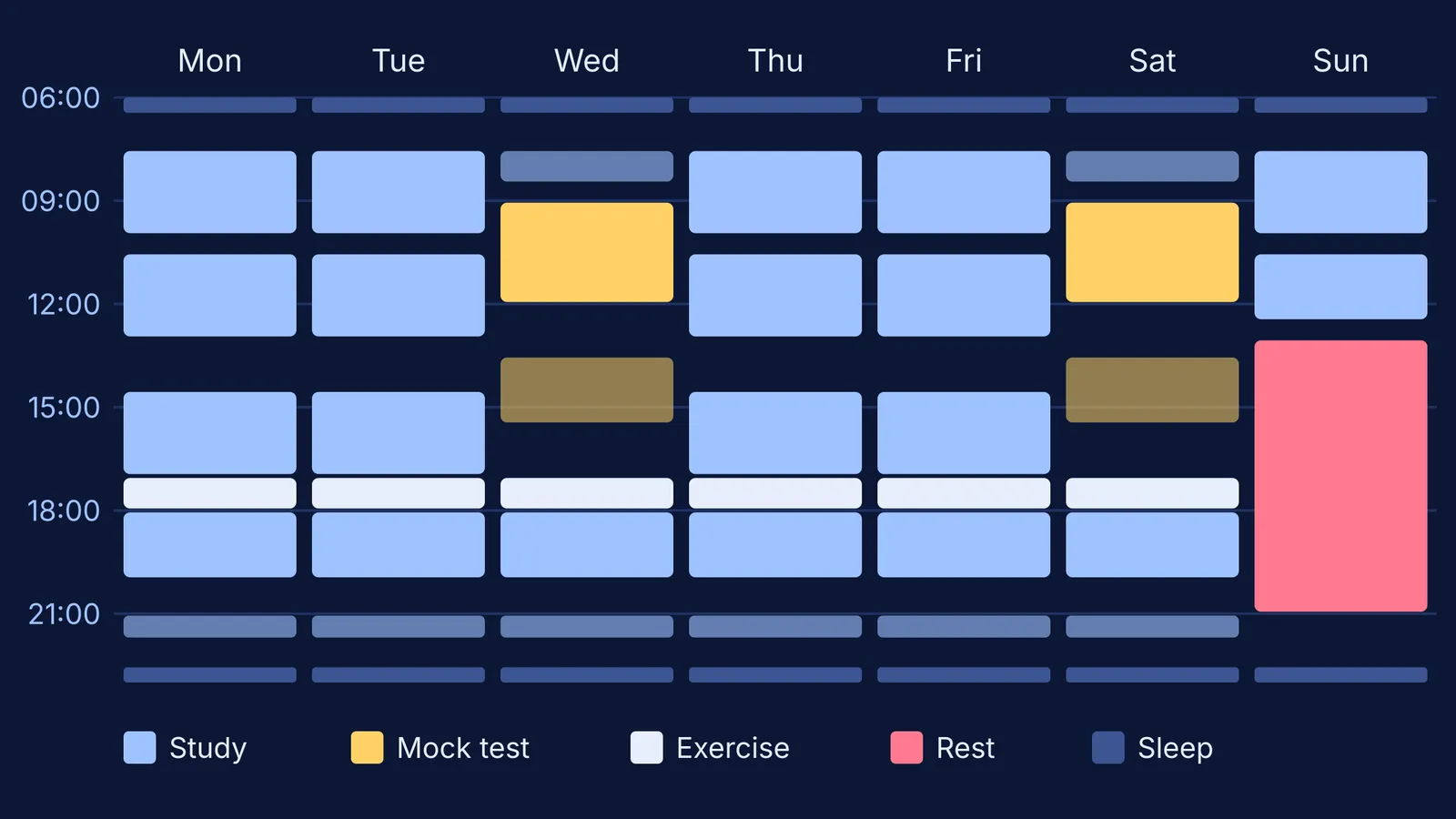
This is the self-study version; shift it an hour either way if you like.
06:30: wake, water, a short walk, breakfast.
07:30 to 10:00, Block 1: your hardest subject and new material, while you are fresh.
10:00 to 10:30: a proper break, away from the desk.
10:30 to 13:00, Block 2: problems in a second subject.
13:00 to 14:30: lunch and rest.
14:30 to 17:00, Block 3: the third subject.
17:00 to 18:00: exercise or outdoor play.
18:00 to 20:00, Block 4: a timed, mixed problem set from all subjects, book closed.
20:00 to 21:00: dinner with family, phone in another room.
21:00 to 21:45: review. Update your error log, quiz yourself on the day's formulae, write tomorrow's first task.
21:45 to 22:30: wind down; lights out at 22:30.
Inside each long block, stand up for five to ten minutes about once an hour. A 2022 meta-analysis of 22 study samples found that breaks of up to 10 minutes gave small gains in vigour and small drops in fatigue. Breaks did not clearly lift performance, and the authors suggest highly draining tasks may need breaks longer than 10 minutes, hence the 30-minute break and long lunch. Here is what to do in a study break.
The 22:30 to 06:30 window gives you eight hours in bed. The American Academy of Sleep Medicine recommends 8 to 10 hours per 24 hours for teenagers aged 13 to 18. A joint statement with the Sleep Research Society recommends 7 or more hours a night for adults. Keep the wake time the same on all seven days.
The World Health Organization recommends that adolescents average at least 60 minutes a day of moderate-to-vigorous activity, and that adults do at least 150 to 300 minutes of moderate activity a week.
Why does the day end with a closed-book quiz?
Because recalling is itself practice. In a 2006 study by Henry Roediger and Jeffrey Karpicke, students who took recall tests remembered more a week later than students who reread, though rereading looked better after five minutes. A 2013 review led by John Dunlosky rated practice testing and distributed practice as high-utility techniques. So Block 4 and the self-quiz are learning, not just checking.
How should test days and the rest half-day work?
Plan two full mocks a week, say Wednesday and Saturday:
07:30 to 08:30: warm-up from your formula sheet, nothing new.
09:00 to 12:00: the mock, matching your real paper's length and time of day (check the current official bulletin).
13:30 to 15:30: analysis. Sort every lost mark into concept gap, wrong method, slip or time.
18:00 to 20:00: fix the three biggest errors.
This 60-minute mock test review routine gives the fuller method. For wrong-method errors, the Fermi Problem Library has a step-by-step solver that explains the reasoning rather than printing an answer, so you can see where your method went off.
The rest half-day is Sunday from 13:00. In the morning, review the week: mock scores, repeating errors, next week's chapters. Then stop: family, friends, sport or a film, not "light revision". If your coaching tests on Sunday, move the half-day to Monday afternoon.
How do you change the timetable for coaching or self-study?
With coaching, classes replace the blocks they overlap:
Before leaving, spend 20 minutes recalling yesterday's class from memory.
At home, eat and rest before sitting down again.
Do that day's homework in the next block, the same day.
Keep Block 4 as mixed, timed problems.
Do not add a fifth block to catch up; travel time counts.
Studying alone, the risk is drift. Write the week's chapter list on Sunday, start every block with a named task ("Rotational motion, exercise 2, questions 1 to 15"), and agree a weekly check-in with a parent or friend. When you do not know where to start a chapter, Fermi's AI tutor can work out what you already know and build a plan for the session, so you sit down to a clear next step.
What if the timetable stops working?
You will miss blocks. Do not make one up late at night; drop it and carry on. If a whole week slips, cut a block rather than abandon the plan.
If low mood, poor sleep or dread lasts more than a couple of weeks, tell a parent and talk to a doctor or counsellor, or call Tele MANAS on 14416, a free, 24x7 national mental-health helpline from the Ministry of Health and Family Welfare.
Copy the day into your notebook tonight, and set tomorrow's 07:30 task before you sleep.


