On this page
Work, Energy and Power is where NEET physics swaps force-by-force bookkeeping for energy accounting. Below: the official topic list, the NCERT map, three worked examples and a one-week plan.
What does the NEET syllabus include in Work, Energy and Power?
The NMC's updated syllabus for NEET (UG)-2026, dated 22 December 2025, lists Unit 4: Work, Energy, and Power as: work done by a constant force and a variable force; kinetic and potential energies, the work-energy theorem, power; the potential energy of a spring, conservation of mechanical energy, conservative and non-conservative forces; motion in a vertical circle; and elastic and inelastic collisions in one and two dimensions.
The textbook is NCERT Class 11 Physics Part I, Chapter 5, Reprint 2026-27. Work and the work-energy theorem sit in 5.2 to 5.6, potential energy and its conservation in 5.7 and 5.8, the spring in 5.9, power in 5.10 and collisions in 5.11. One flag: the vertical circle has no section of its own. NCERT covers it only through a solved example (a bob on a string) inside 5.8. For school exams, see our Work, Energy and Power Class 11 notes.
How is the NEET physics paper set?
In NEET-UG 2026, Physics had 45 of the 180 compulsory questions in a 180-minute paper, according to the NTA Information Bulletin for NEET (UG)-2026. Each was an MCQ with four options and a single correct or best answer: +4 if right, -1 if wrong, 0 if blank. NEET 2027 has not been notified yet, so treat this as the 2026 pattern.
That is about a minute per question with no numerical-value section, unlike our Work, Energy and Power guide for JEE Main. Build fast formula recall, a units check, and the habit of striking out options that break conservation laws.
Three worked examples in NEET style
All use g = 10 m/s². The numbers are ours.
Example 1, a variable force. A 0.5 kg body at rest at x = 0 is pushed by F = (2 + 6x) N to x = 2 m. Find its speed.
Work is the area under the F-x graph: W = ∫(2 + 6x) dx from 0 to 2 = 4 + 12 = 16 J.
Work-energy theorem: ½ × 0.5 × v² = 16, so v = 8 m/s.
Trap: 14 N × 2 m = 28 J. A changing force needs the area.
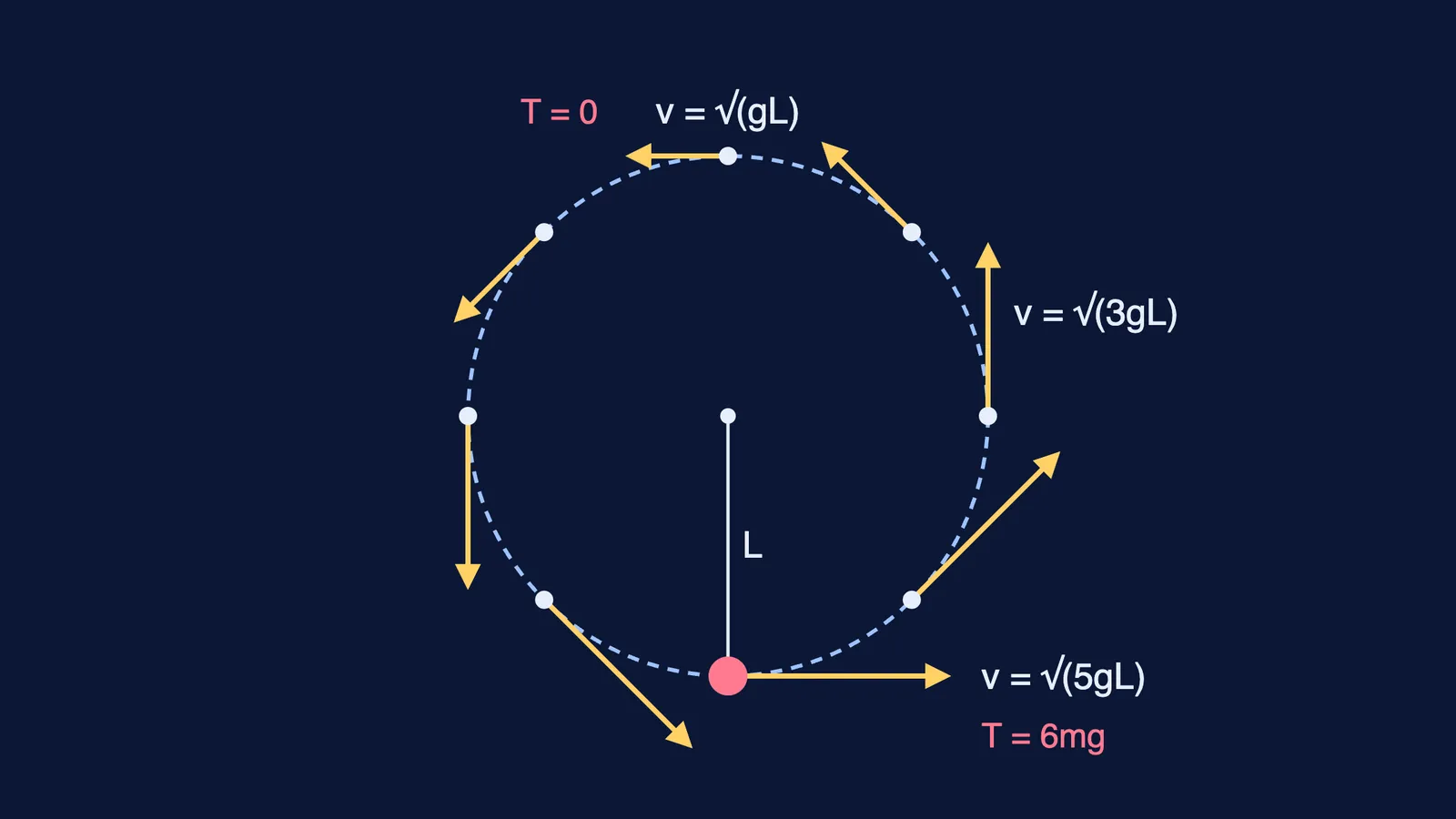
Example 2, a stone in a vertical circle. A 0.2 kg stone on a light 0.5 m string moves at 6 m/s at the lowest point. Does it loop the loop, and what is the string tension at the top and bottom?
To complete the circle it needs at least √(5gL) = 5 m/s at the bottom, so 6 m/s is enough.
Energy over a rise of 2L: v top² = 36 - 4 × 10 × 0.5 = 16, so v top = 4 m/s.
Top: T + mg = mv²/L, so T = 0.2 × 16/0.5 - 2 = 4.4 N. Bottom: T - mg = mv²/L, so T = 2 + 0.2 × 36/0.5 = 16.4 N. The 12 N gap is 6mg.
Example 3, one collision, two endings. A 3 kg ball at 4 m/s hits a 1 kg ball at rest, head-on.
If they stick: v = 12/4 = 3 m/s. Kinetic energy falls from 24 J to 18 J, a loss of one quarter, matching m2/(m1 + m2).
If elastic: v1 = (3 - 1) × 4/4 = 2 m/s and v2 = 2 × 3 × 4/4 = 6 m/s. Momentum (12 kg m/s) and kinetic energy (24 J) are unchanged.
Which traps cost marks in Work, Energy and Power?
Forgetting that friction, and gravity on a rising body, do negative work.
Using mgh for a spring instead of ½kx².
Assuming a string stays tight at the top at any speed; it needs at least √(gL).
Conserving kinetic energy in a collision not stated to be elastic.
Confusing work with power: P = W/t, or Fv for a steady force.
Stuck on a step? The Fermi Problem Library has worked problems with a step-by-step solver that explains the reasoning rather than printing an answer.
How should you practise Work, Energy and Power for NEET?
Days 1-2: read Chapter 5 and mark statements that could become options; see how to study NCERT for NEET.
Days 3-4: redo the solved NCERT examples unaided, including the bob in 5.8.
Days 5-6: timed sets of 15 MCQs in 15 minutes; log each error as concept, sign or arithmetic.
Day 7: redo logged errors, then try these.
Practice questions:
A pump lifts 300 kg of water through 12 m in one minute. Find its power output.
A force F = (5î - 2ĵ + k̂) N moves a body through d = (2î + 3ĵ + 4k̂) m. How much work does it do?
A spring with k = 250 N/m is compressed by 4 cm and released against a 0.1 kg block on a smooth floor. How fast does the block leave?
Answers: 1. 600 W. 2. 8 J. 3. 2 m/s.