On this page
This school-exam guide follows the current NCERT chapter and the CBSE 2026-27 curriculum, with our own solved numericals and practice questions. For entrance tests, see our separate guide to Work, Energy and Power for JEE Main.
What does the CBSE 2026-27 syllabus include in this chapter?
The CBSE Physics curriculum for 2026-27 lists for Unit IV: work by constant and variable forces, kinetic energy, the work-energy theorem, power, potential energy, spring potential energy, conservative and non-conservative forces, vertical-circle motion, and both elastic and inelastic collisions (1D and 2D).
In its Class 11 marks table, Units IV, V and VI share one cell of 17 marks out of 70. There is no separate figure for Chapter 5.
The current NCERT chapter (Reprint 2026-27) runs from 5.1 (including the scalar product) to 5.11 (collisions, including two dimensions). Motion in a vertical circle appears as a solved example under conservation of mechanical energy. The curriculum's question design gives about 38% of theory marks to remembering and understanding, 32% to applying and 30% to analysing, evaluating and creating.
What is the work-energy theorem?
Work done by a constant force is W = F·d = Fd cos θ, where θ is the angle between force and displacement. Work is a scalar in joules and can be negative. Kinetic energy is K = ½mv². The work-energy theorem says that the net force's work on a particle equals the change in its kinetic energy: Kf − Ki = W. For a variable force, work is the area under the F-x graph.
Solved example: a 4.0 kg block starts from rest. You push it with 20 N for 5.0 m against 10 N of friction. Net work = (20 − 10) × 5.0 = 50 J, so ½ × 4.0 × v² = 50 and v = 5.0 m/s.
Power is the rate of doing work, P = dW/dt = F·v, in watts; NCERT notes that 1 hp = 746 W (NCERT chapter).
What makes a force conservative?
NCERT gives three definitions: the force can be written as F(x) = −dV/dx; its work depends only on the end points; its work around a closed path is zero. Friction fails all three. When only conservative forces do work, K + V stays constant.
For an ideal spring, Fs = −kx (Hooke's law) and V(x) = ½kx², zero at equilibrium.
Solved example: a 0.50 kg block on a smooth floor, attached to a spring with k = 200 N/m, is pulled out 0.10 m and released. V = ½ × 200 × (0.10)² = 1.0 J. At x = 0 it is all kinetic: ½ × 0.50 × vm² = 1.0, so vm = 2.0 m/s.
How do you solve an elastic collision in one dimension?
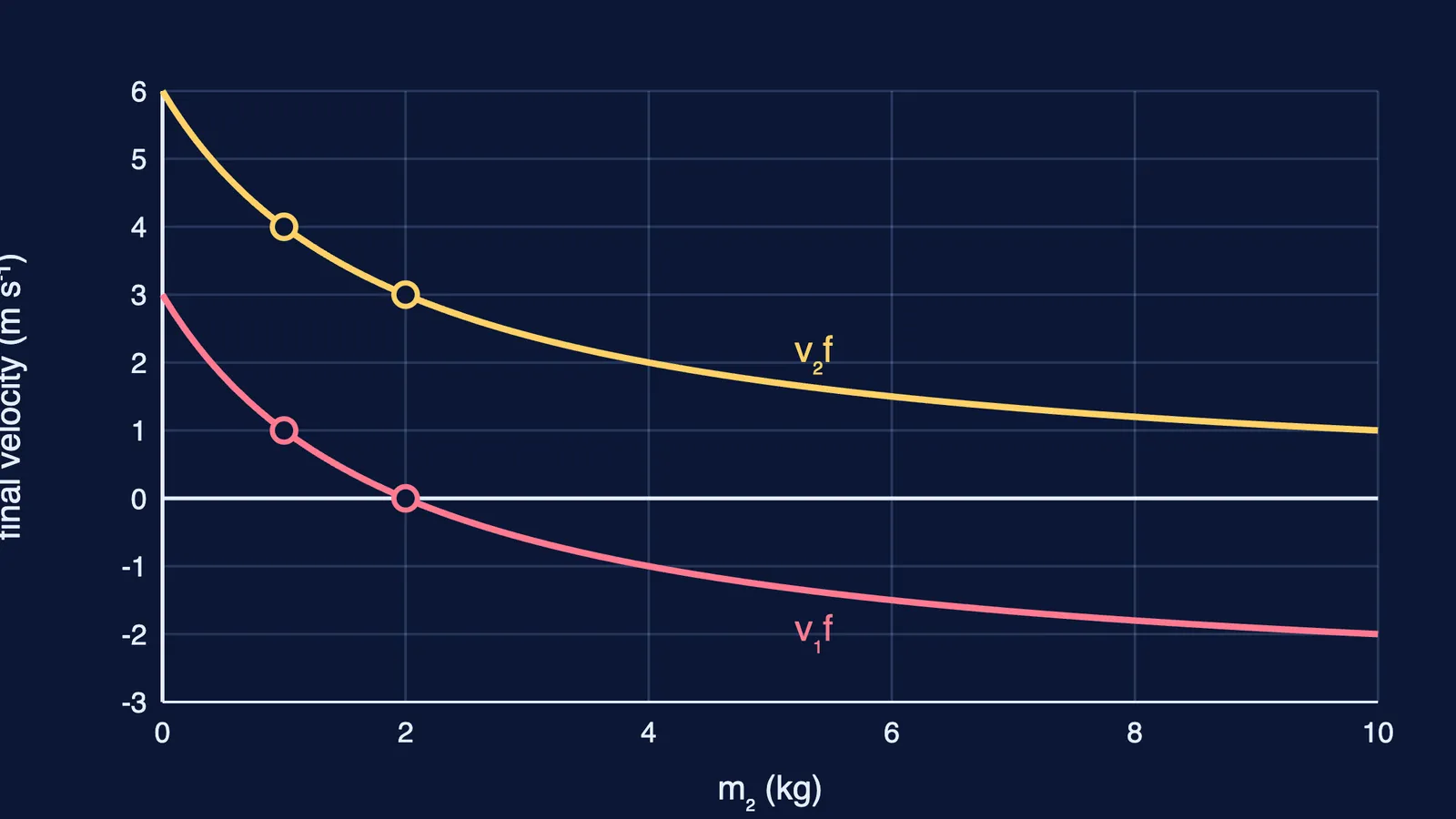
Momentum is conserved in every collision; in an elastic collision kinetic energy is conserved too. With m2 at rest, v1f = (m1 − m2)v1i/(m1 + m2) and v2f = 2m1v1i/(m1 + m2).
Solved example: a 2.0 kg trolley at 3.0 m/s hits a 1.0 kg trolley at rest, head-on and elastically.
v1f = (2.0 − 1.0) × 3.0 / 3.0 = 1.0 m/s, still forward.
v2f = 2 × 2.0 × 3.0 / 3.0 = 4.0 m/s.
Momentum: 6.0 kg m/s before; 2.0 + 4.0 = 6.0 kg m/s after.
Kinetic energy: 9.0 J before; 1.0 + 8.0 = 9.0 J after.
If the trolleys stick together instead, vf = m1v1i/(m1 + m2) = 2.0 m/s, kinetic energy falls to 6.0 J and 3.0 J is lost. The graph at the top shows how equal masses swap velocities and a heavier target sends the first body back.
Practice questions for school exams
We wrote these in board style; the suggested marks are ours.
(2 marks) State the work-energy theorem and derive it from v² − u² = 2as.
(3 marks) Give three definitions of a conservative force and show why friction fails them.
(3 marks) A 1.5 kg ball at 4.0 m/s hits a 0.5 kg ball at rest, head-on and elastically. Find both final velocities and check kinetic energy.
(5 marks) Derive V(x) = ½kx² for a spring, sketch V and K against x, and find the maximum speed of a 0.20 kg block on a spring with k = 80 N/m released from x = 0.05 m.
How should you revise this chapter?
Write the three conservative-force definitions from memory and apply them to gravity, a spring and friction.
Rework NCERT's solved examples unseen, especially the vertical circle and the two-dimensional collision.
End every collision numerical with a momentum check and, if elastic, an energy check.
No regular teacher? Try our weekly self-study plan for Class 11 physics. When a derivation step will not come, Fermi's AI tutor works through problems alongside you, checking understanding as it goes.