On this page
This unit is a few relations used with care. Here are the syllabus, three solved problems, the traps and a plan.
What does the NEET syllabus include in EMI and AC?
The NMC's updated syllabus for NEET (UG)-2026 lists Unit 14 as: Faraday's law; induced emf and current; Lenz's law; eddy currents; self and mutual inductance; peak and RMS values; reactance and impedance; the LCR series circuit and resonance; power in AC circuits and wattless current; the AC generator and transformer.
In the 2026-27 reprint this spans NCERT Class 12 Physics Chapter 6, Electromagnetic Induction, and Chapter 7, Alternating Current. One gap: eddy currents have no section in the current Chapter 6, though NMC still lists them. Learn the idea anyway: changing flux drives circulating currents in solid conductors, which is why transformer cores are laminated.
How is EMI and AC asked in NEET?
In NEET-UG 2026, physics had 45 of 180 questions, answered in 180 minutes, with +4 for a correct answer and −1 for a wrong one, according to the NTA information bulletin. Each was a multiple-choice question with four options and a single correct answer, so you have about a minute per question. More in the NEET-UG paper pattern.
Three habits help:
Recall in seconds: ε = −N dΦ/dt, U = ½LI², V_rms = V₀/√2, X_L = ωL, X_C = 1/(ωC), Z = √(R² + (X_L − X_C)²), P = V_rms I_rms cos φ.
Unit checks: inductance in henry, reactance and impedance in ohm, flux in weber.
Limits: at resonance Z = R and cos φ = 1; a pure inductor or capacitor takes no average power.
Worked examples: three NEET-style problems
1. A shrinking field. A 200-turn coil of area 50 cm², plane perpendicular to the field, sees B fall steadily from 0.6 T to 0.1 T in 0.25 s. Its resistance is 8 Ω.
ε = NAΔB/Δt = 200 × 0.005 × 0.5/0.25 = 2.0 V, so I = 0.25 A. The charge that flows, Q = NAΔB/R = 0.0625 C, does not depend on how fast B falls. If B points into the page, the induced current is clockwise as you look, propping up the dying flux.
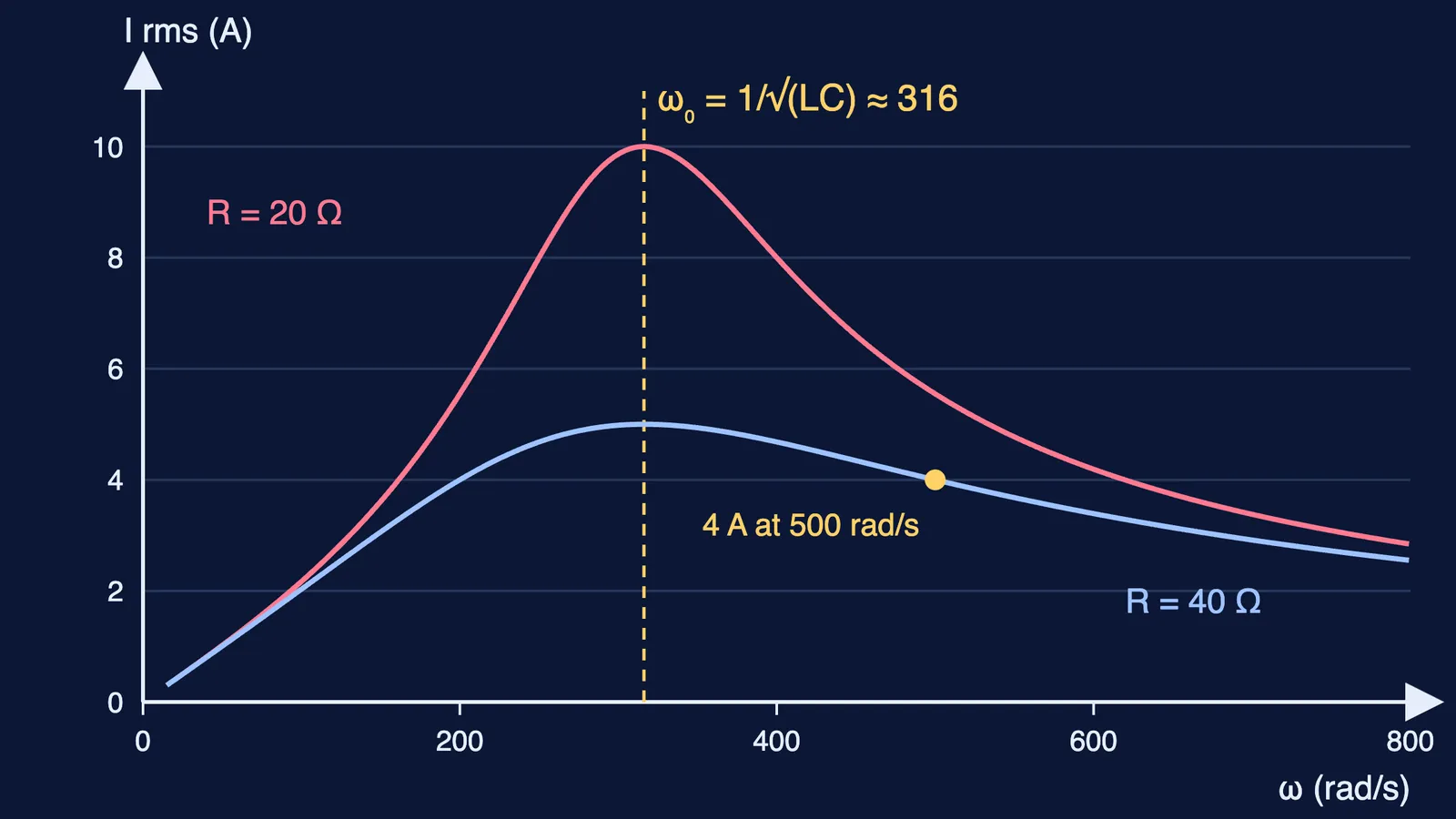
2. LCR off resonance. R = 40 Ω, L = 0.1 H and C = 100 µF in series across 200 V (rms) at 500 rad/s.
X_L = 50 Ω and X_C = 20 Ω, so Z = √(40² + 30²) = 50 Ω and I_rms = 4 A. Power factor R/Z = 0.8, so P = 200 × 4 × 0.8 = 640 W. X_L > X_C, so current lags. At ω₀ = 1/√(LC) ≈ 316 rad/s, Z = 40 Ω, the current is 5 A and P = 1000 W.
3. A step-down transformer. An ideal transformer takes 240 V down to 12 V with 1600 primary turns and feeds a 60 W lamp.
N_s = 1600 × 12/240 = 80 turns. Secondary current is 60/12 = 5 A; primary current is 60/240 = 0.25 A.
Stuck on a step? The Fermi Problem Library has worked problems with a step-by-step solver that explains the reasoning rather than printing an answer.
Which mistakes cost marks in EMI and AC?
Mixing peak and rms: mains 220 V is rms; its peak is about 311 V.
Forgetting N, or leaving area in cm².
Reversing the phase: in a pure inductor current lags voltage by 90°; in a pure capacitor it leads.
Adding V_R, V_L and V_C as plain numbers; as phasors, V² = V_R² + (V_L − V_C)².
Expecting a transformer to raise power or work on steady DC.
Hard to picture phasors? The Fermi Simulation Lab has interactive simulations for the ideas that are easier to see than to read.
How should you practise EMI and AC for NEET?
Two weeks, an hour a day:
Days 1-3: sections 6.2 to 6.6; every flux and emf relation on one card.
Days 4-5: inductance and the AC generator, plus eddy currents.
Days 6-8: sections 7.2 to 7.6; draw each phasor diagram from memory.
Days 9-10: power factor, wattless current and transformers.
Days 11-12: 20 mixed single-correct questions a day, a minute each; label each miss.
Days 13-14: a timed 15-question set; redo misses a day later.
Try these:
A 0.5 m rod moves at 4 m/s at right angles to a 0.3 T field. Find the emf.
A coil's current drops from 5 A to 2 A in 0.1 s, inducing 9 V. Find L and the energy stored at 5 A.
An rms current of 2 A flows through 30 Ω. Find the peak current and average power.
A series circuit has R = 60 Ω and Z = 100 Ω. Find the power factor.
Answers: 0.6 V; 0.3 H and 3.75 J; about 2.83 A and 120 W; 0.6.
Next, see Electromagnetic Induction and AC for JEE Main for longer numericals, or how to answer electromagnetic induction questions in the Class 12 board exam.