On this page
This guide is for the CBSE board paper: which derivations to write, how to lay out answers by marks, where Lenz's law catches people, and a week of revision. Preparing for JEE Main too? Our Electromagnetic Induction and AC guide for JEE Main covers that separately.
What is in the 2026-27 syllabus for this chapter?
In the CBSE Class XII Physics curriculum for 2026-27, Unit III (Magnetic Effects of Current and Magnetism) and Unit IV (Electromagnetic Induction and Alternating Currents) share one 17-mark cell out of 70 theory marks. Chapter 6 lists Faraday's laws, induced emf and current, Lenz's law, and self and mutual induction; CBSE lists the AC generator under Chapter 7, though NCERT derives it in Chapter 6.
The NCERT Class 12 Physics Chapter 6, 2026-27 reprint has five derivations to practise until you can write them cold:
Motional emf of a rod on rails, ε = Blv, from Φ = Blx
Self-inductance of a long solenoid, L = μ0n²Al
Mutual inductance of long coaxial solenoids, M = μ0n1n2πr1²l, with M12 = M21
Energy stored in an inductor, W = ½LI²
AC generator emf, ε = NBAω sin ωt
Eddy currents do not appear in this reprint, so skip them.
How should you set out 2-, 3- and 5-mark answers?
2 marks: the law in one sentence, then the formula with symbols named. For Lenz's law, add that it follows from conservation of energy.
3 marks: labelled diagram, starting expression, key step, boxed result. Motional emf: draw the rod, write Φ = Blx, differentiate, get Blv.
5 marks: diagram, principle, derivation, result and one physical remark. AC generator: coil, field, slip rings and brushes; Φ = BA cos ωt; differentiate; ε0 = NBAω; note the emf peaks when the flux through the coil is zero.
Write your assumptions ("neglecting edge effects"), as NCERT does.
A board numerical, solved two ways
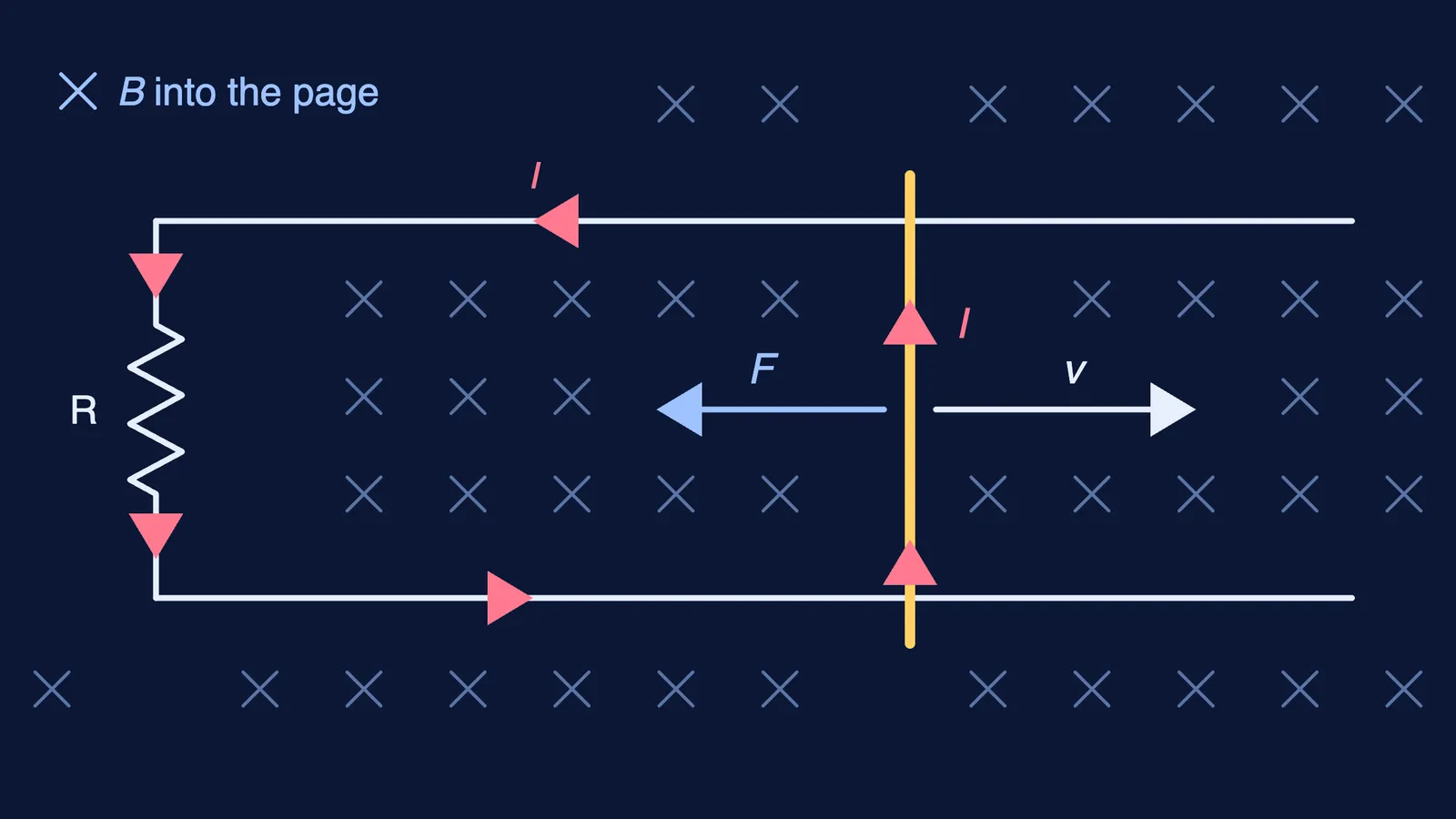
A 20 cm rod slides at a steady 4 m/s on smooth rails in a uniform 0.5 T field into the page. The rails are joined by a 2 Ω resistor; ignore other resistance. Find the emf, current, its direction, and the power needed to keep the rod moving.
Method 1, flux. Φ = Blx, so ε = Bl(dx/dt) = Blv = 0.5 × 0.2 × 4 = 0.4 V, and I = 0.4/2 = 0.2 A. The area grows, so flux into the page grows; the induced current must make a field out of the page inside the loop, so it runs anticlockwise as you look at the page, up the rod in our diagram.
Method 2, energy. The current feels a force F = BIl = 0.5 × 0.2 × 0.2 = 0.02 N against the motion. Pushing with 0.02 N at 4 m/s delivers 0.08 W. The resistor dissipates I²R = 0.2² × 2 = 0.08 W. They match, which checks the current and the direction: a force helping the motion would create energy from nothing.
If the methods disagree, check for unconverted centimetres. The Fermi Problem Library has worked problems with a step-by-step solver that explains the reasoning, so you see which step slipped.
Where do students lose marks on Lenz's law?
All five come from NCERT Chapter 6:
A north pole pushed towards a coil induces an anticlockwise current seen from the magnet's side; pulling it away gives clockwise. Say where you look from.
A loop wholly inside a uniform field has no induced current. Only entering or leaving changes the flux.
A still loop between strong, fixed magnets has no induced current.
An open circuit still has an induced emf, just no current.
Self-induced emf opposes any change in current, increase or decrease, not the current itself.
If directions are hard to picture, the Fermi Simulation Lab has interactive simulations for the ideas that are easier to see than to read.
How do assertion-reason and case-study questions trap you?
Assertion-reason items often pair two true statements where the reason does not explain the assertion, so test the link. "The emf is constant while a rectangular loop leaves a field at steady speed" is true, and "the rate of change of area is constant" explains it. Make it a circular loop and the assertion fails, as NCERT notes, because the area leaving per second keeps changing.
AC generator case studies check that peak emf comes when the coil's plane is parallel to the field: zero flux, changing fastest. NCERT's Example 6.10, the bicycle (100 turns, 0.10 m², 0.01 T, half a revolution per second) gives a peak of 0.314 V.
A one-week revision plan
Day 1: Faraday and Lenz; redo NCERT Example 6.4 and Exercise 6.1.
Day 2: motional emf, plus the rotating rod (Examples 6.6, 6.7).
Day 3: self- and mutual inductance derivations from memory.
Day 4: ½LI² and energy density B²/2μ0 (Example 6.9).
Day 5: AC generator; then begin Chapter 7 with our Alternating Current guide, written for JEE Main.
Day 6: Exercises 6.3 to 6.8, timed.
Day 7: a mixed timed set; if you overrun, use this 20-minute triage plan for a board paper.