On this page
Solutions is a numbers chapter built on few ideas: count particles, apply Raoult's law, correct for dissociation. Fix the formulas, then train for speed.
What does the NEET-UG syllabus include in Solutions?
In the NMC "NEET (UG)-2026" syllabus (notice dated 22 December 2025), Solutions is Unit 5 under Physical Chemistry. It lists:
Ways to express concentration: molality, molarity, mole fraction, and percentage by mass and by volume.
Vapour pressure of solutions and Raoult's law; ideal and non-ideal solutions; vapour pressure-composition plots.
Colligative properties of dilute solutions: relative lowering of vapour pressure, boiling point elevation, freezing point depression and osmotic pressure.
Molar mass from colligative properties, abnormal molar mass, and the van't Hoff factor.
All of it is in NCERT Class 12 Chemistry Part I, Unit 1 Solutions (Reprint 2026-27). We found nothing listed that the chapter has dropped. NCERT also teaches Henry's law here; the NMC syllabus lists it under Unit 6, Equilibrium.
How should you prepare Solutions for NEET?
As in NEET-UG 2026, the NTA information bulletin sets 180 compulsory questions in 180 minutes, 45 of them in Chemistry. Each is a multiple-choice question with four options and one correct or best answer, marked +4 for correct, −1 for wrong and 0 if left blank. That is about a minute each, so:
Keep six relations ready: p = x p° for each volatile component, (p° − p)/p° = x₂, ΔTb = iKbm, ΔTf = iKfm, π = iCRT, and M₂ = Kf w₂ × 1000/(w₁ ΔTf).
To compare colligative properties, compare i × concentration; no constants are needed.
Check units: molality uses kilograms of solvent, molarity uses litres of solution.
Also writing JEE Main? Our Solutions guide for JEE Main covers longer problems.
Three worked examples, solved quickly
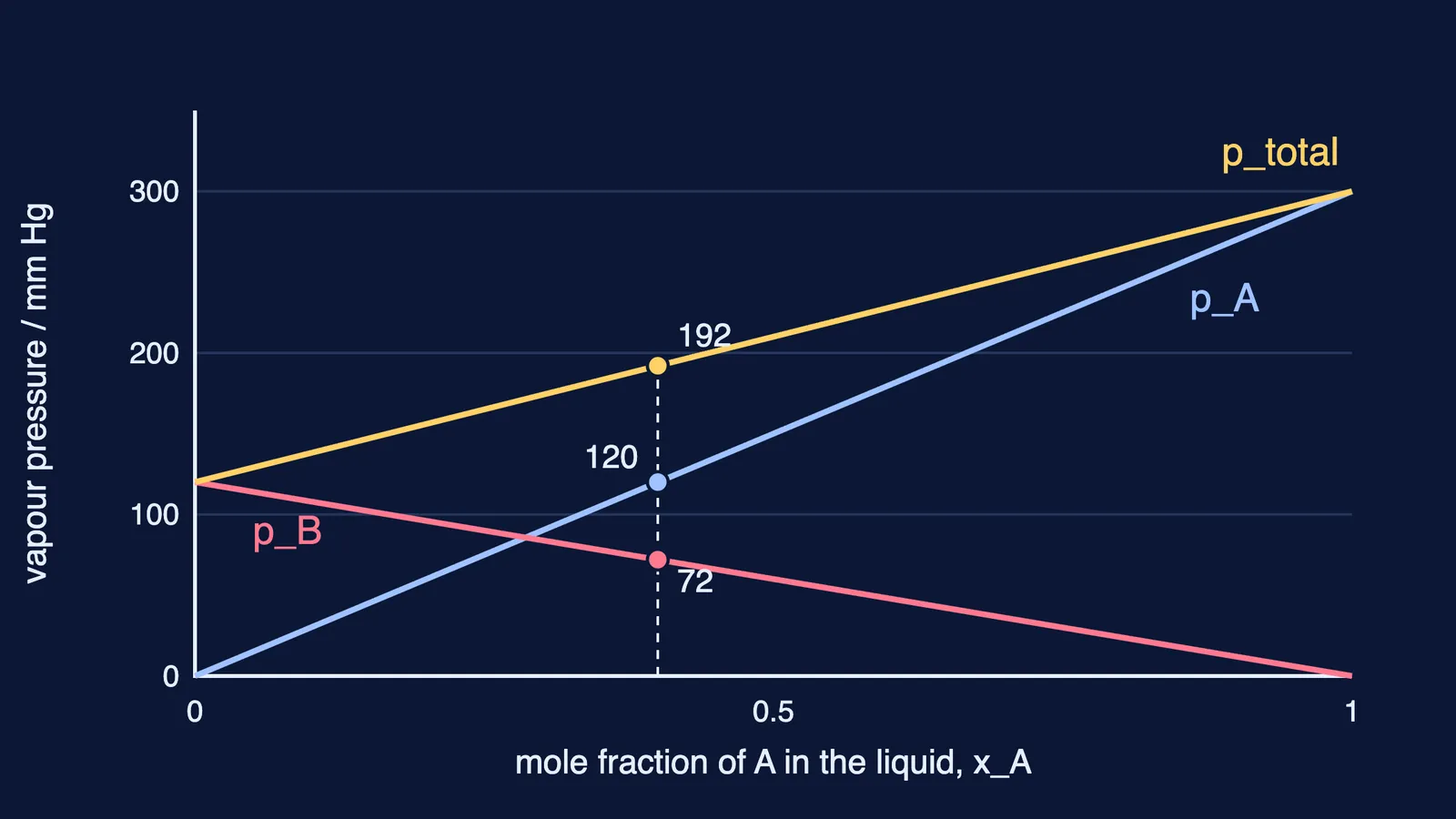
Example 1 (Raoult's law, two volatile liquids). Liquids A and B form an ideal solution. Pure A has a vapour pressure of 300 mm Hg and pure B 120 mm Hg. Find the total vapour pressure at x_A = 0.40, and the mole fraction of A in the vapour.
p_A = 0.40 × 300 = 120 mm Hg; p_B = 0.60 × 120 = 72 mm Hg; total = 192 mm Hg. In the vapour, y_A = 120/192 = 0.625. The vapour is richer in the more volatile liquid.
Example 2 (molar mass from freezing point). 2.50 g of a non-electrolyte in 100 g of water lowers the freezing point by 0.310 K. With Kf = 1.86 K kg mol⁻¹, find the molar mass.
M = (1.86 × 2.50 × 1000)/(100 × 0.310) = 150 g mol⁻¹.
Example 3 (van't Hoff factor). A 0.10 mol kg⁻¹ aqueous solution of a salt AB₂ freezes at −0.484 °C. Find i and the degree of dissociation.
Without dissociation, ΔTf would be 1.86 × 0.10 = 0.186 K, so i = 0.484/0.186 ≈ 2.6. AB₂ gives three ions, so i = 1 + 2α and α ≈ 0.80.
What are the common traps in Solutions?
Each follows from NCERT Unit 1:
Molality vs molarity. Molality is per kilogram of solvent and does not change with temperature; molarity is per litre of solution and does.
Forgetting i. NaCl, K₂SO₄ and glucose at the same molality give different effects.
Deviation direction. Positive deviation means weaker A-B attraction and higher vapour pressure, as in ethanol and acetone; negative deviation, as in chloroform and acetone, means the reverse.
Azeotropes. Large positive deviation gives a minimum boiling azeotrope (ethanol-water, about 95% ethanol by volume); large negative deviation gives a maximum boiling one.
Kelvin and Celsius. A change of 1 K equals a change of 1 °C, but π = iCRT needs absolute temperature.
Stuck on a step? The Fermi Problem Library has worked problems with a step-by-step solver that explains the reasoning rather than printing an answer.
A seven-day practice plan
Day 1: concentration terms and conversions.
Day 2: Raoult's law, ideal solutions, vapour composition.
Day 3: deviations, mixing enthalpy and volume, azeotropes.
Day 4: lowering of vapour pressure, boiling and freezing point.
Day 5: osmotic pressure and molar mass.
Day 6: van't Hoff factor; 20 mixed questions, a minute each.
Day 7: redo every wrong answer and name its trap.
Try these original questions in four minutes:
Assuming full dissociation, which freezes lowest: 0.10 m glucose, 0.06 m NaCl or 0.05 m K₂SO₄?
Ideal liquids X (400 mm Hg) and Y (100 mm Hg) are mixed in equal moles. Find the total vapour pressure and y_X.
At 300 K, 0.25 g of a protein in 50 mL of solution gives π = 0.0083 bar. With R = 0.083 L bar mol⁻¹ K⁻¹, find its molar mass.
True or false: an acid that dimerises in benzene has i greater than 1.
Answers: 1. K₂SO₄. 2. 250 mm Hg; 0.8. 3. 15,000 g mol⁻¹. 4. False.
For the board-exam angle, see Solutions Class 12: board answers and a plan, and for more number work, read our physical chemistry numericals plan for NEET.