On this page
This NEET unit spans three NCERT chapters. Here are the syllabus, four solved problems, the traps and a plan.
What does the NEET syllabus include in Properties of Solids and Liquids?
The NMC's updated syllabus for NEET (UG)-2026 lists Unit 7, Properties of Solids and Liquids, as: elastic behaviour; stress-strain relationship; Hooke's law; Young's modulus, bulk modulus and modulus of rigidity; pressure due to a fluid column; Pascal's law and its applications; effect of gravity on fluid pressure; viscosity; Stokes' law; terminal velocity; streamline and turbulent flow; critical velocity; Bernoulli's principle and its applications; surface energy and surface tension; angle of contact; excess of pressure across a curved surface; drops, bubbles and capillary rise; heat, temperature and thermal expansion; specific heat capacity and calorimetry; change of state and latent heat; and heat transfer by conduction, convection and radiation.
In NCERT Class 11 Physics Part II (2026-27 reprint), this is Chapter 8, Mechanical Properties of Solids, Chapter 9, Mechanical Properties of Fluids and Chapter 10, Thermal Properties of Matter. NCERT names critical speed in one sentence, so learn just the idea: above it, streamline flow turns turbulent. NCERT also covers Poisson's ratio, elastic potential energy and Newton's law of cooling, which Unit 7 does not name; read them once.
How is this unit asked in NEET?
As in NEET-UG 2026, the NTA information bulletin set physics at 45 of 180 questions, answered in 180 minutes, with +4 for a correct answer and −1 for a wrong one. Each question had four options and one correct answer: about a minute each. More in the NEET-UG paper pattern.
Build three habits: formula recall in seconds, scaling (what quadruples when one quantity doubles), and unit checks to strike out options.
Worked examples: four NEET-style problems
1. Stretching a wire. A wire 1.5 m long with cross-section 1.0 mm² (Young's modulus 1.2 × 10¹¹ Pa) carries a 60 N load. ΔL = FL/(AY) = (60 × 1.5)/(1.0 × 10⁻⁶ × 1.2 × 10¹¹) = 7.5 × 10⁻⁴ m, or 0.75 mm. Double the length and the diameter: area goes up four times, so ΔL is 0.375 mm.
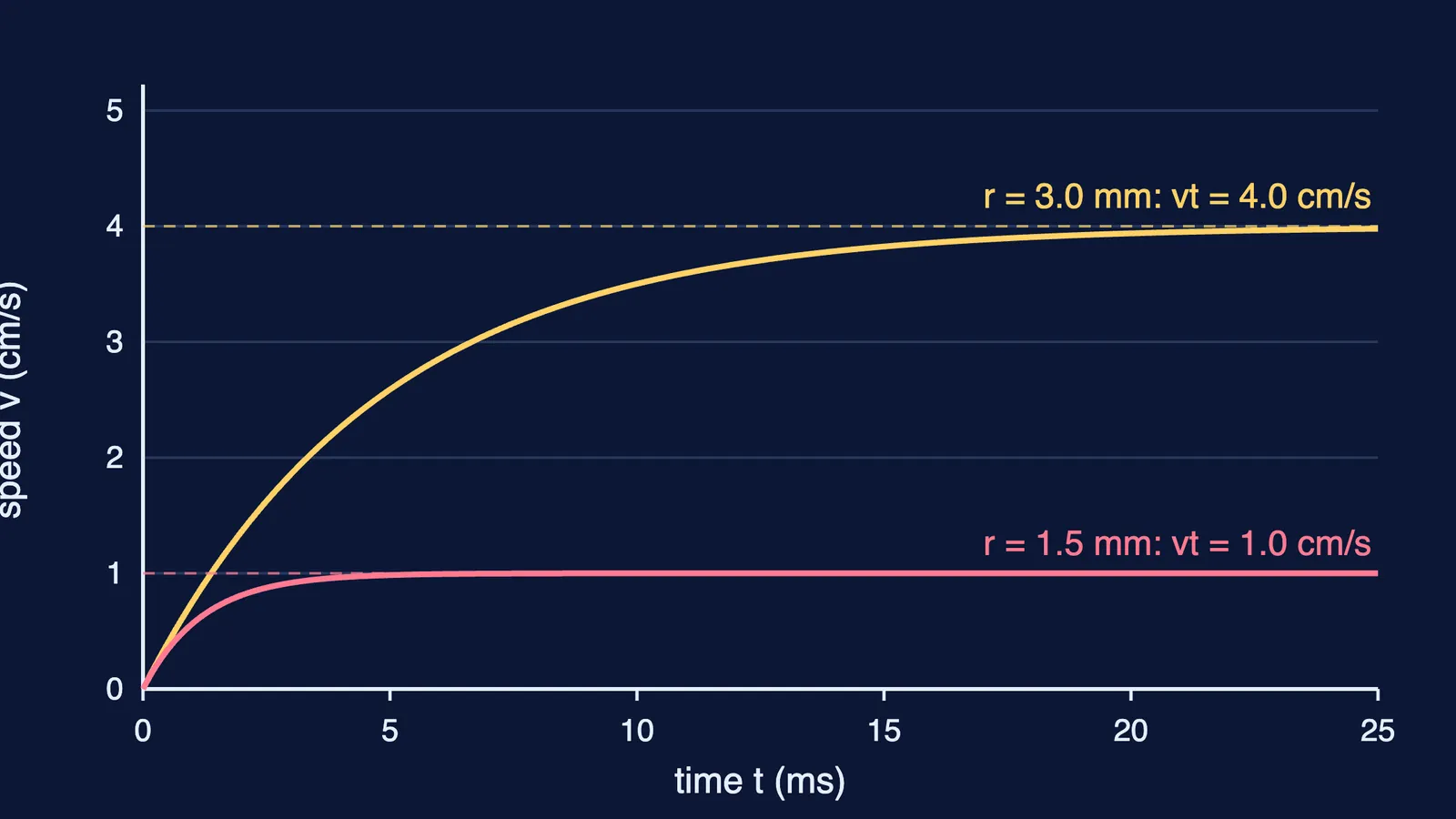
2. Terminal velocity. A ball (radius 3.0 mm, density 7200 kg/m³) falls through oil (density 1200 kg/m³, viscosity 3.0 Pa s); take g = 10 m/s². v_t = 2r²(ρ − σ)g/(9η) = 2 × (3.0 × 10⁻³)² × 6000 × 10/(9 × 3.0) = 0.040 m/s, or 4.0 cm/s. Halve the radius and v_t falls to a quarter: 1.0 cm/s.
3. Bernoulli in a pipe. Water at 1.0 m/s flows through a horizontal pipe that narrows from 6 cm² to 2 cm². Continuity gives 3.0 m/s in the narrow part. The pressure drop is ½ρ(v₂² − v₁²) = ½ × 1000 × (9 − 1) = 4000 Pa.
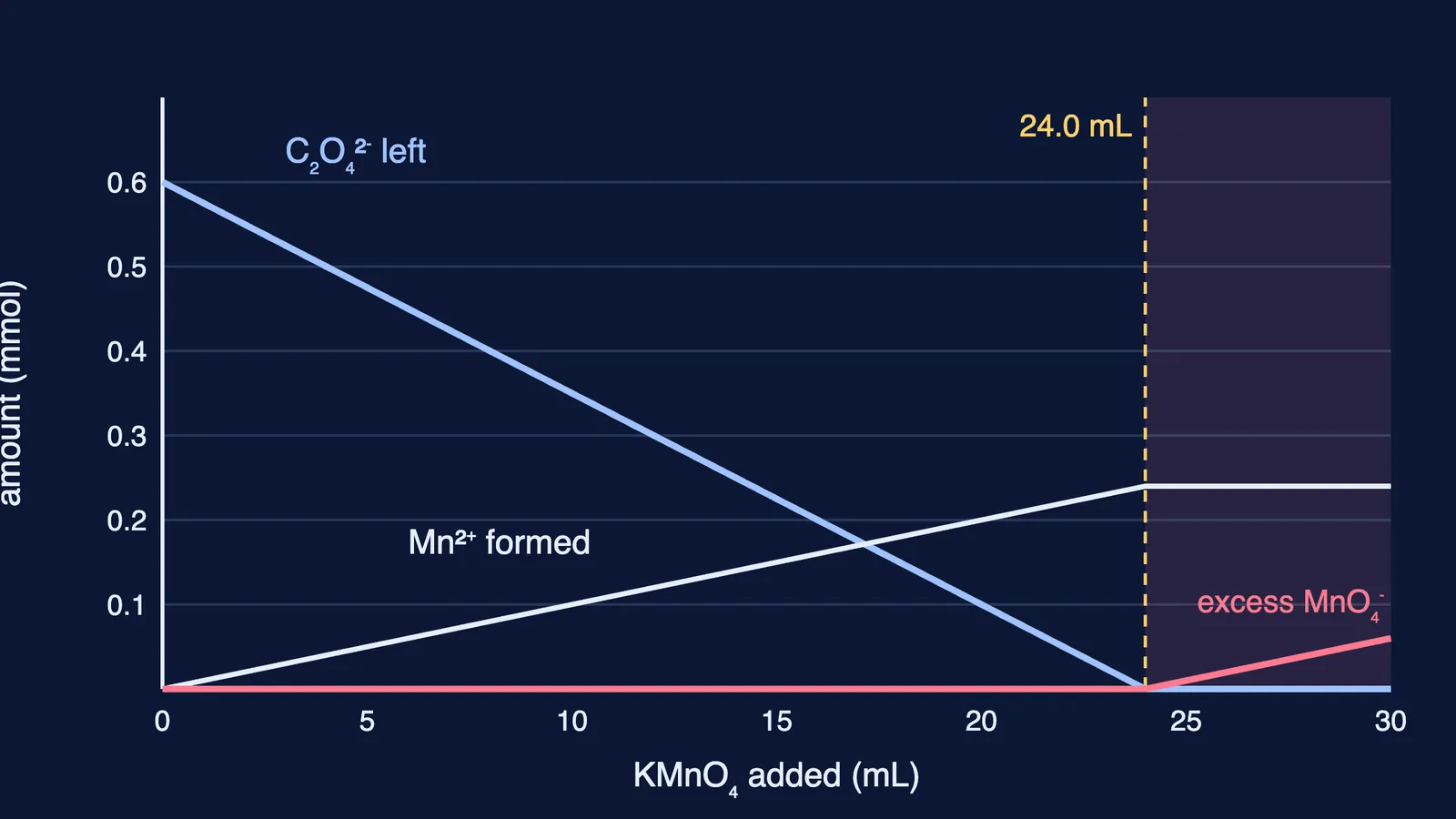
4. Ice in warm water. 50 g of ice at 0 °C goes into 200 g of water at 40 °C (c = 4.2 J/g °C, L = 336 J/g). Cooling the water to 0 °C releases up to 33,600 J; melting needs 16,800 J, so all the ice melts. The remaining 16,800 J warms 250 g: ΔT = 16,800/(250 × 4.2) = 16 °C. Final temperature: 16 °C.
Stuck on a step? The Fermi Problem Library has worked problems with a step-by-step solver that explains the reasoning rather than printing an answer.
Which mistakes cost marks in Properties of Solids and Liquids?
Bubble or drop: a soap bubble has two surfaces, so its excess pressure is 4T/r; a drop has one, so 2T/r.
Young's modulus depends on the material, not on the wire's length or area.
Forgetting buoyancy in Stokes' law: use ρ − σ.
Mixing gauge and absolute pressure: P = Pₐ + ρgh is absolute; ρgh alone is gauge.
Can't picture it? The Fermi Simulation Lab has interactive simulations for the ideas that are easier to see than to read.
How should you practise this unit for NEET?
A two-week plan, an hour a day:
Days 1-3: Chapter 8; every modulus, formula and unit on one card.
Days 4-7: Chapter 9, pressure first, then viscosity, Bernoulli and surface tension.
Days 8-10: Chapter 10; solve its examples without looking.
Days 11-12: 20 mixed questions a day, a minute each, timed.
Days 13-14: a timed 15-question set; label each miss as recall, units, scaling or reading.
Try these (take g = 10 m/s²):
A liquid has bulk modulus 2.0 × 10⁹ Pa. By what percentage does its volume fall when the pressure rises by 1.0 × 10⁷ Pa?
Water (T = 0.070 N/m, contact angle 0°) rises in a capillary of radius 0.20 mm. Find the height.
A 2.0 m rod with α = 1.5 × 10⁻⁵ per °C is heated by 50 °C. Find the increase in length.
Answers: 0.5%; 7.0 cm; 1.5 mm.
For the board-exam side, see Mechanical Properties of Fluids for Class 11 and Thermal Properties of Matter for Class 11.